Section 01 · Definition
What human in the loop for AI agents actually means
The phrase gets used loosely. A clean definition has three parts and ends most of the confusion before it starts.
Quick answer
What is human in the loop for AI agents? Human in the loop for AI agents is the set of architectural patterns that places a person in the agent decision path so that the agent can be reviewed, corrected, or stopped before, during, or after consequential actions, with the placement chosen by the action reversibility and stakes rather than by a blanket policy.
The phrase is used loosely. Teams say “we have a human in the loop” and mean anything from “we read the logs sometimes” to “every tool call is blocked until an operator clicks approve.” Both are oversight, but they sit at opposite ends of a spectrum, and they apply to completely different risk profiles. Treating them as the same thing is how oversight ends up either theatrical or operationally unworkable.
A clean definition has three parts. First, the human is in the agent decision path, not adjacent to it. Adjacent observation is monitoring, not human in the loop. Second, the human has the authority and the mechanism to intervene. Reading a log without a way to roll the action back is observation, not oversight. Third, the intervention point is chosen by the action risk profile, not by an organisational default. A single risk threshold applied to every action is the most common design mistake in early agent deployments.
The rest of this post is about the patterns that fall out of that definition and how to pick between them.
Section 02 · Taxonomy
HITL vs HOTL vs human in the workflow
Three terms get used almost interchangeably, and the distinctions matter for both design and compliance.
Human in the loop is real time, action by action. The agent proposes, the human approves or modifies, the agent executes. The human is inside the inner loop of the agent decision cycle. Latency is high by definition.
Human on the loop is supervisory. The agent acts on its own and the human watches, with the authority and the mechanism to stop or override. The human is outside the inner loop but watching the loop. Latency is low when nothing is wrong and rises when an intervention is needed.
Human in the workflow is a step in a longer process where some steps are automated and some are human. The agent does its segment, hands off, and the human does theirs. There is no real time supervision and no in loop oversight inside the agent autonomous segment. This is the weakest form and is often misdescribed as human in the loop.
Compliance lens
For high risk actions, the EU AI Act expects HITL or HOTL with real authority to intervene, not just a human downstream in the workflow. For lower risk actions where the cost of friction outweighs the cost of an error, the workflow handoff is appropriate.
Section 03 · Decision Rule
The decision rule: reversibility, stakes, and confidence
Three inputs pick the pattern almost mechanically. The mistake is to make the rule one dimensional.
Reversibility is a property of the action itself. Sending an email is irreversible. Posting to a public channel is irreversible. Issuing a refund above a threshold is irreversible without a counter transaction. Editing a draft, querying a database, or staging a change is reversible. Reversibility is binary in practice, even though edge cases exist.
Stakes is the magnitude of the harm if the action is wrong. A wrong calendar invite is annoying. A wrong wire transfer is a board level incident. A wrong clinical note is a patient safety event. Stakes scales with the population affected, the dollar value at risk, the regulatory exposure, and the reputational blast radius. Teams underestimate stakes by ignoring blast radius beyond the immediate transaction.
Confidence is the model calibrated estimate of being correct for this specific action, not its general accuracy on the task. A model that is ninety percent accurate over a benchmark can be sixty percent confident on a particular borderline case. Calibrated confidence requires evaluation infrastructure that scores predictions on a held out set and a runtime signal that exposes per action confidence. The LLM agent evaluation guide covers how to wire that calibration in.
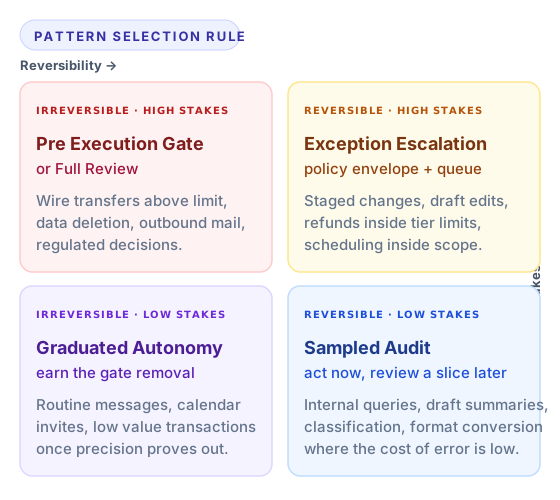
The rule itself: if reversibility is low and stakes are high, require a human in the path regardless of confidence. If reversibility is high or stakes are low, allow the agent to act and audit after. Confidence shifts the threshold up or down within those bands. A calibrated confidence above a high bar can move some medium stakes actions from pre approval to post audit. A confidence below a low bar should bounce even reversible actions to review.
The mistake is to make the rule one dimensional. A confidence only rule lets the agent confidently make an irreversible high stakes mistake. A stakes only rule blocks every reversible action and grinds the system. The product of all three is what works.
Section 04 · The Five Patterns
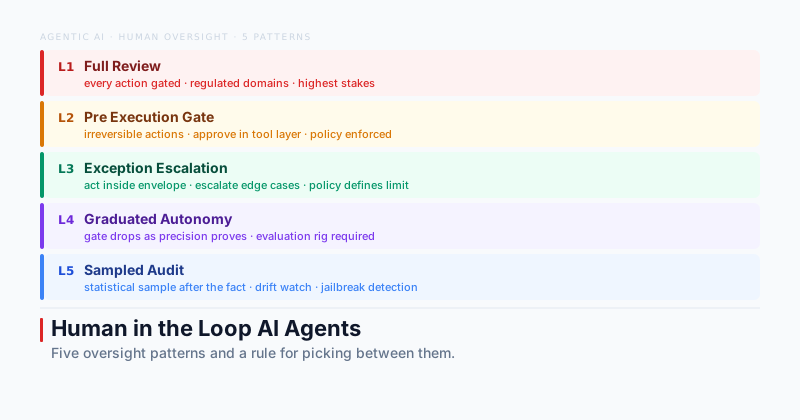
The five HITL patterns
Each pattern maps to a band on the decision rule. Pick by the action profile, not by the team general anxiety level.
Pre execution gate
The agent proposes the action, the system pauses, a person reviews and approves, the action executes. Use this for irreversible high stakes actions: wire transfers above a threshold, public outbound communication, production database mutations, regulated decisions with audit trails. The gate is enforced outside the model. The tool call passes through a policy layer that holds the request, posts an approval card to the operator queue, waits for a decision, then forwards or rejects.
Exception escalation
The agent acts autonomously inside a defined envelope and escalates when the action falls outside. Envelopes are codified as policy: dollar limits, customer tier rules, content category lists, allowed destination domains. Inside the envelope the agent moves at machine speed. Outside it, the request flows to a human queue. Use this for medium stakes actions where most cases are routine and the long tail needs judgement.
Graduated autonomy
The agent earns autonomy as it proves itself. Initially every action is gated. As the measured precision on a class of actions crosses a threshold over a meaningful sample, the gate is removed for that class. New action classes start gated. This is how mature deployments evolve. It requires an evaluation rig that scores agent decisions on a continuous basis and a policy engine that can adjust gates without a code deploy.
Sampled audit
A statistically valid sample of completed actions is reviewed after the fact. Used in combination with one of the patterns above, not as a standalone substitute for oversight on high risk actions. Set the sample rate by the cost of an undetected error and the cost of the review. Use this as the long term watchdog that detects model drift, prompt injection success, and quietly broken tools.
Full review
Every action is reviewed. Use this only for the highest stakes categories, the early days of a new agent, or regulated domains where the audit requirement is one hundred percent coverage. Full review is expensive by design and should never be the default. Most teams that default to it are over indexing on a small set of high risk actions and paying the friction tax on a much larger set of low risk ones.
A useful mental model: think of these as the five rungs on an oversight ladder. Most production agents end up using two or three patterns at once, with each pattern applied to a specific action class. The architecture decision is which rung each class of action sits on.
Section 05 · Enforcement
Architectural enforcement, not prompt enforcement
The single biggest implementation mistake is to encode the oversight rule in the system prompt and call it done.
The prompt is not a control surface. A jailbreak, a prompt injection in retrieved content, or a malformed user input can override a prompt level rule. An attacker who controls the input can sometimes get the agent to bypass its own oversight instructions. A novel input the prompt did not anticipate routes around the rule without anyone noticing.
Enforcement that works is mechanical. The tool layer holds the request and waits for an approval before executing. The policy engine has explicit rules with a deny default. The workflow boundary is the gate, not the model interpretation of the gate.
This implies a few architectural commitments. The agent tool functions cannot be raw API clients. They are wrapped in a policy layer that classifies the request, checks the action class against the active gate set, and either executes, queues for approval, or rejects with a structured error the agent can reason about. The policy engine has its own logs, its own deployment cycle, and its own owner. The agent does not have a back door around the policy layer; if a tool exists, it goes through the policy.
The same logic applies to memory and to retrieval. If retrieved content can change the agent behaviour, then the retrieval source is an attack surface. The AI agent security guide covers the prompt injection patterns to watch for and how to harden the input layer so the oversight rule survives adversarial inputs.
The regulator question
If a regulator audits the system, the question is not what the prompt says. The question is what the code prevents. Designing oversight so the answer is in the code is the difference between a control that works and a control that performs working.
Section 06 · Compliance
EU AI Act Article 14 compliance mapping
The article does not mandate which pattern. It mandates that the oversight be effective.
Article 14 of the EU AI Act requires high risk AI systems to be designed and developed so that they can be effectively overseen by natural persons during the period in which the AI system is in use. The text uses the word “effectively” and lists four properties: the human must be able to understand the system capacities and limitations, monitor its operation, decide not to use its output, and intervene or stop the operation.
The five patterns above map onto those properties as follows. Pre execution gate provides the intervention capability for the highest risk decisions; it satisfies the “decide not to use output” and “stop the operation” requirements directly. Exception escalation and graduated autonomy provide monitored operation with intervention authority for medium risk classes. Sampled audit provides the operational visibility required to understand capacities and limitations over time. Full review covers categories where the regulation requires complete oversight coverage.
The article does not mandate which pattern; it mandates that the oversight be effective. Effective in this context means the operator must have the information, the time, and the authority to actually intervene. A pre execution gate that gives the operator three seconds to read a fifty page contract is not effective. A daily report that arrives a week after the decisions is not effective. The pattern choice and the staffing model have to match the action profile.
For systems falling under Annex III categories, the cost of getting this wrong is a fine up to fifteen million euros or three percent of global revenue. The cost of getting it right is a clean architecture decision and a sustainable operational model. The AI governance checklist covers the broader governance scaffold that Article 14 sits inside.
Section 07 · Practice
What this looks like in practice
The patterns combine. The architecture documents which pattern applies to which action class and the policy engine enforces it.
A mid sized B2B platform deploying a customer support agent might run the patterns in combination. Refunds under one hundred dollars run through exception escalation with a policy engine; the agent acts autonomously inside the envelope and escalates everything outside it. Refunds between one hundred and one thousand dollars run through a pre execution gate with a target response time of two minutes during business hours. Refunds above one thousand dollars or for regulated account types go through full review.
Account closures and data deletion run through a pre execution gate regardless of dollar value because the action is irreversible. Outbound email to the customer goes through graduated autonomy: at deployment every email is gated, and once precision on a class of communication crosses ninety eight percent over a sample of two hundred messages, the gate is dropped for that class. A sampled audit of three percent of all completed actions runs daily, with a small team reviewing for drift, jailbreaks, and policy violations.
The result is that the operator queue is sized to the long tail and the high risk transactions, not the full action volume. The agent moves fast where speed is safe and pauses where pauses are warranted. The architecture documents which pattern applies to which action class and the policy engine enforces it. None of the rules live in the prompt.
If you are sizing this out for a new deployment and the numbers do not work, the right move is not to lower the bar. It is to look at whether the agent action scope is too broad, whether the policy engine can subdivide the envelope further, or whether some action classes belong in a deterministic pipeline rather than an agent at all. The agentic AI consulting engagement is built around exactly this kind of architectural sizing.