Section 01 · Why Now
What changes in August 2026 and why it matters
The EU AI Act has been phasing in since August 2024. August 2026 is when the remaining requirements — including all high-risk AI system obligations — become fully enforceable.
Quick answer
The short answer: August 2026 is the deadline for full EU AI Act compliance. High-risk AI systems face strict documentation, human oversight, and audit requirements. Most enterprise LLMs are limited risk, but any system used in hiring, credit, healthcare, or legal decisions is high risk.
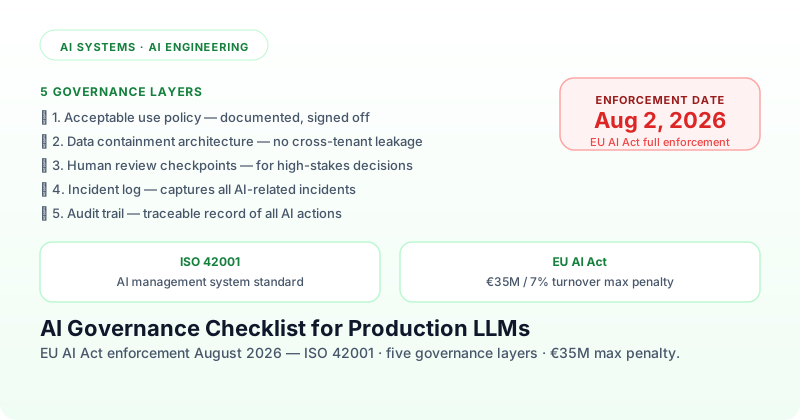
The EU AI Act's phased rollout has given organizations time to prepare, but the August 2026 deadline is real. Enforcement is handled by national market surveillance authorities in EU member states and by the European AI Office for general-purpose AI models. Penalties are substantial: up to €35 million or 7% of global annual turnover for the most serious violations, up to €15 million or 3% for other violations.
The Act also has extraterritorial reach. If your AI system is deployed in the EU — if it affects EU residents, regardless of where your company is based — it falls under the Act. This means AI systems built by companies in Pakistan, the US, or anywhere else that process or affect EU users are subject to compliance.
Section 02 · Risk Classification
What tier does your system fall under?
| Risk tier | Examples | Key obligations |
|---|---|---|
| Unacceptable (prohibited) | Social scoring, real-time biometric surveillance, subliminal manipulation | Banned — cannot deploy in EU |
| High risk | Hiring tools, credit scoring, healthcare diagnosis, educational assessment, law enforcement | Full documentation, human oversight, accuracy requirements, audit trail, conformity assessment |
| Limited risk (GPAI) | General-purpose chatbots, coding assistants, document summarization | Transparency obligations, copyright disclosure, AI-generated content labeling |
| Minimal risk | Spam filters, simple recommendation systems, AI in games | No mandatory requirements |
General-purpose AI models — including GPT-5.4, Claude Sonnet 4.6, and Gemini 2.5 — fall under the GPAI (General Purpose AI) provisions, which require transparency and copyright disclosure but are less burdensome than high-risk requirements. If you build an application on top of a GPAI model and that application is used for a high-risk purpose, the high-risk obligations apply to your application.
Section 03 · The Governance Checklist
Five governance layers every production LLM system needs
Acceptable use policy
A written policy that defines what the AI system is permitted to do, what use cases are prohibited, and what data it is allowed to process. This is the foundation. Without it, you cannot demonstrate to a regulator or auditor that you have thought about the system's risk surface. Document it before August 2026.
Data containment architecture
Production LLM systems should not pass personal data or sensitive information into the model context unless necessary. Implement PII detection before context construction, data residency controls for EU-resident data, and clear documentation of what data the model sees and why. RAG architectures where documents are retrieved selectively are more auditable than systems that pass entire databases.
Human review checkpoints for high-stakes decisions
For any AI-assisted decision that affects a person's life — hiring, credit, healthcare, education — implement a human review step before the decision is executed. The human review does not need to be exhaustive. It needs to be documented, logged, and meaningfully able to override the AI recommendation.
Incident logging
Every incident where the AI system produces an output that is wrong, harmful, or unexpected must be logged with the date, the input, the output, the context, and the resolution. This log is required by ISO 42001 and is the primary evidence base for EU AI Act compliance audits. Start logging now, before August.
Audit trail for AI actions
For agentic systems that take actions — sending messages, updating records, triggering workflows — every action must be logged with the agent's reasoning trace, the tool called, the parameters passed, and the human approvals (if required). This is the control that separates a governable agent from an ungovernable one.
Section 04 · ISO 42001
ISO 42001: the management system that makes governance auditable
ISO 42001, published in late 2023, is the first international standard specifically for AI management systems. It provides a structured framework for how organizations build, deploy, and govern AI systems responsibly. Major auditors — BSI, DNV, TÜV — now certify against it.
The practical relationship between ISO 42001 and the EU AI Act: ISO 42001 gives you the documentation and process framework that the EU AI Act's compliance requirements assume exists. An organization with ISO 42001 certification is well-positioned for EU AI Act audits because the underlying governance infrastructure is already in place.
| EU AI Act obligation | ISO 42001 clause | Priority |
|---|---|---|
| Risk management system | 6.1 — Risk assessment | High |
| Technical documentation | 9.1 — Monitoring, measurement, analysis | High |
| Human oversight mechanism | 8.4 — AI system design controls | High |
| Accuracy and robustness testing | 9.1 — Performance evaluation | Medium |
| Data governance | 8.2 — AI system data management | High |
| Incident logging | 10.1 — Nonconformity and corrective action | High |
Section 05 · AI Contextual Governance Framework
AI contextual governance framework: applying governance to specific deployment contexts
A contextual AI governance framework goes beyond a generic policy document — it maps governance controls to the specific context in which the AI system operates: the user population, the decision domain, the risk profile, and the regulatory environment.
The phrase "ai contextual governance framework" captures a real and important distinction. Generic AI governance frameworks tell you to document your system, log incidents, and have a human oversight mechanism. A contextual governance framework tells you exactly what those controls look like when your system is a clinical decision support tool used by oncologists in Germany, or a credit risk assessment model deployed across 14 EU member states, or an agentic AI sales tool operating in a regulated financial services context.
Context layer 1: user population
Who uses the system and under what authority? A system used by domain experts (lawyers, doctors, engineers) with professional accountability requires different oversight architecture than a system used by consumers. Expert users can catch errors; consumers may not. Contextual governance defines human review checkpoint requirements based on this layer.
Context layer 2: decision domain and consequence
What decisions does the system inform or make, and what happens when it gets one wrong? A system that recommends which document to read next has a low-consequence failure mode. A system that recommends a credit limit, a treatment protocol, or a hiring decision has a high-consequence failure mode. Contextual governance maps consequence severity to required oversight controls — from no human review (low consequence) to mandatory review before action (high consequence).
Context layer 3: regulatory environment
What regulations apply to this deployment? EU AI Act risk tier (limited, high, unacceptable), GDPR data residency requirements, sector-specific rules (HIPAA, MiFID II, FRB guidance for US banking AI, DORA for digital operational resilience). A contextual governance framework explicitly maps each regulation to the technical controls it requires — not as a checkbox but as an engineering specification.
Section 06 · Three Primary Focuses
What are the three primary focuses of AI governance frameworks?
Most AI governance frameworks — whether ISO 42001, NIST AI RMF, or the EU AI Act — organize their requirements around three primary concerns.
Quick answer
The three primary focuses of AI governance frameworks: Risk management (identify and control failure modes), human oversight (ensure humans can review, correct, and override AI decisions), and transparency (document what the system does, what data it uses, and how it was evaluated). Everything else in a governance framework is a specific implementation of one of these three.
Understanding these three focuses helps you prioritize implementation when you have limited time before a compliance deadline. Risk management documentation is typically required first — it is the foundation that the human oversight and transparency controls build on. The ISO 42001 framework organizes all its clauses around these same three priorities, which is why it maps so cleanly to EU AI Act obligations.
Alternative AI governance frameworks: what exists besides ISO 42001
If ISO 42001 is not the right fit for your organization, three frameworks cover similar ground. The NIST AI Risk Management Framework (AI RMF) provides a four-function structure (Govern, Map, Measure, Manage) that is strong for US-based organizations and does not require certification. The EU AI Act Compliance Checklist from the European AI Office is a self-assessment tool specifically for the Act's requirements. The Singapore AI Governance Framework (Model AI Governance Framework 2.0) is strong for Asia-Pacific deployments. ISO 42001 is the only one that produces a certifiable audit trail — the others are frameworks without certification bodies.