Section 01 · Why Patterns Matter
Why choosing the wrong pattern is expensive
A multiagent system built on the wrong pattern does not fail obviously — it ships slowly, runs expensively, and fails intermittently in ways that are hard to reproduce.
Quick answer
The short answer: Multiagent design patterns define how agents communicate, coordinate, and pass state. The pattern you choose determines your system's cost, reliability, and debuggability. Get it wrong and you spend the rest of the project fighting coordination bugs.
In 2026, 57% of enterprises deploy multiagent workflows, but most engineer them ad-hoc — agents calling agents, message queues bolted on, state passed in ways that made sense for the first five calls but break at the sixtieth. The production incidents almost always trace back to a coordination pattern problem, not a model problem.
The good news: there are four patterns that cover the vast majority of production multiagent use cases. Knowing which one fits your problem before you start building saves weeks of architectural rework.
Section 02 · Pattern 1
Sequential: linear pipelines where order matters
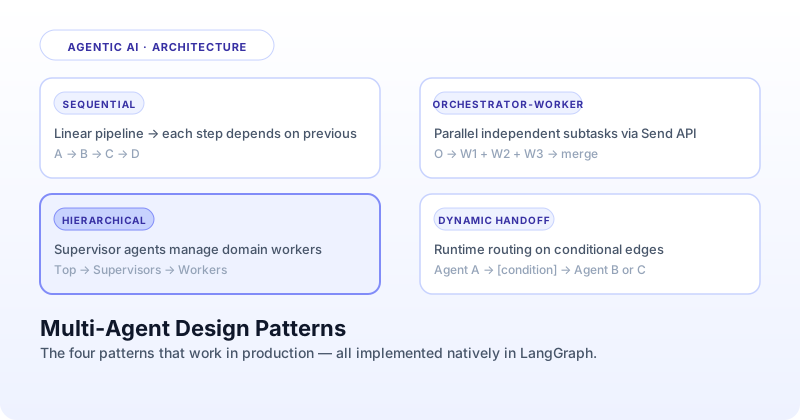
The sequential pattern is a chain: Agent A runs, passes its output to Agent B, which passes its output to Agent C. Each step can access the outputs of all previous steps. No parallelism. No routing decisions. The graph is fixed at design time.
Use when
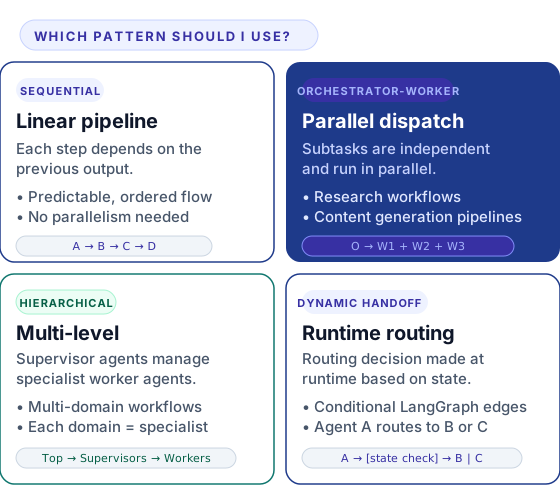
Each step depends on the output of the previous step, the workflow is predictable and does not branch, and simplicity and debuggability outweigh throughput concerns. Document processing pipelines — ingest, extract, classify, summarize, store — are the canonical example.
Avoid when
Steps are independent of each other and could run in parallel. Running independent steps sequentially wastes time and adds latency for no benefit. If steps A, B, and C do not depend on each other, use the orchestrator-worker pattern instead.
Section 03 · Pattern 2
Orchestrator-worker: parallel dispatch for independent subtasks
The orchestrator-worker pattern has a central orchestrator that breaks a goal into independent subtasks, dispatches them to specialized workers in parallel, waits for results, and synthesizes a final output. Wall-clock time is the runtime of the slowest subtask, not the sum of all subtasks.
Use when
The goal can be decomposed into independent subtasks that do not depend on each other's outputs. Research workflows — gather data from 10 sources simultaneously, then synthesize — are the canonical example. The orchestrator dispatches all 10 retrievals in parallel rather than in sequence.
Avoid when
Subtasks are interdependent and must execute in order. The orchestrator-worker pattern adds coordination overhead — the orchestrator must track all worker states, handle partial failures, and manage synthesis. For linear workflows, sequential is simpler and equally fast.
In LangGraph, implement this with the Send API: the orchestrator node fans out to worker nodes by sending them typed messages simultaneously. The graph collects all responses into the shared state before the synthesis node runs. This is now the standard implementation pattern — custom message passing infrastructure is no longer necessary.
Section 04 · Pattern 3
Hierarchical: supervisor agents for complex multi-domain workflows
The hierarchical pattern introduces supervisor agents between the orchestrator and the workers. A top-level orchestrator delegates to domain supervisors. Each supervisor manages the workers in its domain. Results flow back up the hierarchy to the top-level synthesizer.
Use when
The problem spans multiple distinct domains — legal research, financial analysis, and technical evaluation, for example — where each domain has specialized tools and requires domain-specific reasoning. A flat orchestrator-worker structure would need the orchestrator to understand all three domains. A hierarchical structure delegates domain-specific understanding to domain supervisors.
Avoid when
The workflow is single-domain and the added hierarchy creates coordination overhead without adding capability. Hierarchical systems are significantly more complex to debug: a failure in a worker might surface as an ambiguous error at the supervisor level. Introduce hierarchy only when the complexity of the problem justifies it.
Section 05 · Pattern 4
Dynamic handoff: runtime routing based on evolving context
Dynamic handoff allows agents to transfer control to other agents at runtime based on the state of the conversation or task — without a fixed graph. The agent decides at each step who should handle the next step based on the current context.
Use when
The workflow cannot be fully defined at design time because the next step depends on intermediate results. Customer service agents that route to specialized agents based on issue type and severity are the canonical example. The routing logic lives in the model's reasoning, not the graph structure.
Avoid when
The routing logic can be expressed as a fixed graph. Dynamic routing is powerful but creates unpredictability: it is harder to test exhaustively, harder to audit, and harder to debug when the model routes unexpectedly. Prefer fixed patterns when possible and use dynamic handoff only when flexibility is essential.
Section 06 · Implementation
LangGraph: the production default for all four patterns
LangGraph implements all four patterns natively. Sequential chains map directly to linear graph edges. Orchestrator-worker uses the Send API for parallel dispatch. Hierarchical architectures use subgraphs with typed state boundaries between levels. Dynamic handoff uses conditional edges that route based on state values at runtime.
The key properties that make LangGraph the production default: typed state (you cannot accidentally pass malformed data between agents), built-in persistence (agent state survives process restarts), and the checkpoint system (you can inspect, debug, and replay any step of any run). These are the features that matter when something goes wrong at 3am in production.
For how patterns fit into a complete production agentic AI architecture, see my agentic AI consulting service which covers orchestration design as part of full system delivery.