Quick answer
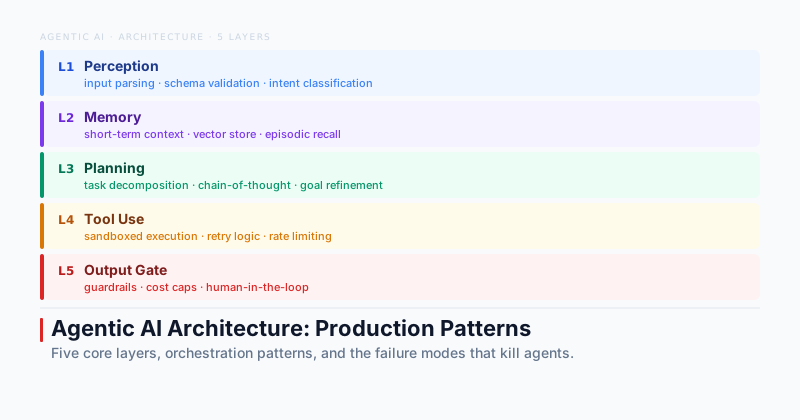
What is agentic AI architecture? Agentic AI architecture is the set of software layers that allow an AI system to plan, act, observe results, and loop across multiple steps autonomously. A production agentic system has at minimum an orchestration layer, a tool layer, a memory layer, an evaluation layer, and a safety layer working together.
Section 01 · Framing
What makes agentic AI architecture different from traditional LLM apps?
A traditional LLM application executes a fixed sequence once per request. An agentic system loops, decides, and acts until it reaches a goal. That runtime autonomy is the structural difference that makes agentic architecture fundamentally more complex.
A traditional LLM application follows a fixed path: receive input, construct a prompt, call the model, return output. The flow is linear, the sequence is known before the request arrives, and the model executes once per request. Building these systems is primarily a prompt engineering and API integration problem.
Agentic AI systems are different in a structural way. An agent observes its environment, selects an action from a set of tools or capabilities, executes that action, observes the result, and decides what to do next based on what it found. That loop repeats until the agent reaches a stopping condition. Nothing about the sequence is fixed in advance.
This difference has concrete architectural consequences. A linear LLM app can be built as a stateless request handler. An agent cannot. An agent needs state that persists across steps within a single run. It needs logic that controls when to continue looping and when to stop. It needs a way to call external tools and handle the results of those calls. It needs guardrails that prevent harmful actions before they execute, not after. And it needs observability that captures not just the final output but every intermediate decision point.
Four properties define an agentic system and distinguish it from a prompt wrapper:
Autonomy
The agent decides what to do next without being told step by step. The developer specifies a goal, not a procedure.
Tool use
The agent can call functions, APIs, databases, browsers, or other agents to gather information or take actions in external systems.
Memory
The agent can access prior context, both within a run (working memory) and across runs (long term memory). Without memory, each step is stateless and the agent cannot build on what it found earlier.
Goal directed iteration
The agent loops until it satisfies a convergence condition, not until it completes a fixed number of steps.
Production systems built on this model require a layered architecture. For teams exploring the broader design patterns that govern how agents coordinate with each other, the multiagent design patterns guide covers the orchestration topologies in depth.
Section 02 · Core architecture
The five layers every production agent system needs
Production agent systems that ship and stay running share a common structural pattern. Teams that build them independently arrive at the same architecture because the problems they are solving are the same.
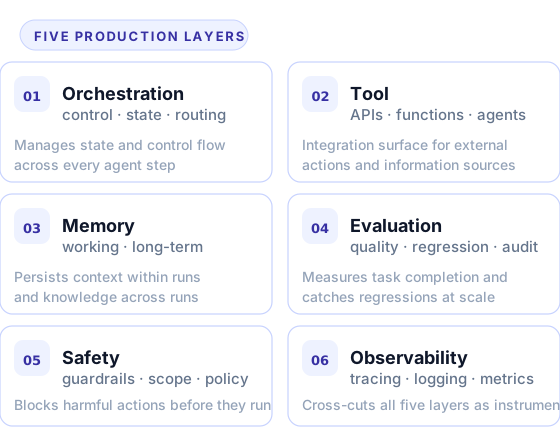
Orchestration
The control plane. It manages agent state, routes decisions, handles retries, and enforces convergence conditions. Every agentic system has an orchestration layer even if the team did not call it that. The question is whether it was designed explicitly or assembled from ad hoc Python logic that nobody can debug at 2am.
Tool
The integration surface. Tools are the functions, APIs, databases, search indices, browsers, code interpreters, and other agents that the orchestration layer can invoke. Tool design has more impact on production reliability than model selection. A poorly designed tool interface causes more hallucinations, retries, and failures than a weaker model with a well designed tool surface.
Memory
State persistence. Production agents need working memory (the context of the current run) and long term memory (facts, preferences, or domain knowledge that persist across runs). Most teams wire the first correctly and skip the second until a customer asks why the agent does not remember anything.
Evaluation
Quality measurement. How does the system know whether the agent completed its task correctly? Evaluation answers this question at scale, across many runs, without a human reviewing every output. It covers correctness metrics, task completion rates, and regression tracking.
Safety
Guardrails and policy enforcement. The safety layer intercepts agent actions before they execute and blocks those that violate defined policies: input filtering, output filtering, tool call rate limiting, scope restriction, and human approval workflows for high stakes actions.
Observability
Not a separate layer so much as an instrumentation obligation on all five. Every state transition, tool call, memory access, evaluation result, and safety intervention should be traced and logged. Teams that skip observability early almost always retrofit it under pressure, after the data that would have established baselines is gone.
Section 03 · Orchestration
Orchestration layer: managing agent state and control flow
The orchestration layer is where most of the architectural decisions that matter live. Getting it right is the difference between an agent that behaves predictably and one that loops forever or silently fails on edge cases.
The orchestration layer has four responsibilities.
State management. The orchestrator holds the agent's working state across the steps of a run. This state includes the original goal, the history of tool calls and their results, intermediate reasoning, accumulated findings, and any flags set by the evaluation or safety layers. State needs to be defined explicitly and persisted to a backend that survives process restarts.
In memory state works for demos. In production, an agent that crashes and loses everything it has done so far is a support ticket waiting to happen. Wire the state to Redis, Postgres, or a purpose built checkpoint store from the beginning.
Control flow and routing. After each step, the orchestrator decides what to do next. Should the agent call another tool? Has it gathered enough information to synthesize a response? Should it escalate to a human? Production routing logic needs explicit convergence conditions: a maximum step count, a confidence threshold, or a quality score from the evaluation layer that the agent must meet before it is allowed to produce a final response.
Retry and error handling. Tools fail. Models hallucinate tool names that do not exist. APIs return rate limit errors. A well designed retry policy includes exponential backoff, a maximum retry count per tool call, and a fallback path when retries are exhausted.
Human in the loop. Some actions are too consequential to execute without human approval. The orchestrator needs a mechanism for pausing execution, surfacing the pending action to a human reviewer, and resuming or canceling based on their decision. This requires careful attention to state serialization so the agent can resume from exactly where it paused.
| Responsibility | Missing it causes |
|---|---|
| State persistence | Agent loses progress on process restart |
| Convergence condition | Infinite loop until API cost limit is hit |
| Retry policy | Single tool failure kills the entire run |
| Human in the loop | High stakes actions execute without review |
| Routing logic | Agent gets stuck or takes wrong branch silently |
Section 04 · Tool and memory
Tool and memory layers: what agents can reach and remember
Tool design is underappreciated. The tool interface design determines how reliably the agent behaves more than almost any other architectural factor.
Every tool an agent can call is a trust boundary. A tool that accepts ambiguous inputs gives the model room to hallucinate arguments. A tool that returns unstructured text forces the model to parse outputs that were not designed for machine consumption. A tool with overly broad permissions allows the agent to take actions outside its intended scope.
One thing per tool
Each tool should do exactly one thing. Tool names and descriptions should be unambiguous at the level of a language model reading them. Input schemas should be strict and validated before execution. Output formats should be structured rather than prose.
Minimum necessary permissions
An agent that needs to read from a database does not need write access. An agent that needs to search the web does not need to execute code. Scope restriction is one of the cheapest safety controls available and one of the most frequently skipped.
Idempotent where possible
Tools should be designed so that retrying a failed tool call does not cause duplicate side effects. This makes retry logic safe and simplifies failure recovery in the orchestration layer.
Memory architecture. Production agents need two kinds of memory. Working memory is the context of the current run. It includes the original goal, the history of steps taken, tool results, and intermediate reasoning. It must be bounded in size because unlimited context accumulation will eventually exceed model context windows and degrade performance. Rolling summarization or selective retention strategies prevent runaway growth.
Long term memory persists across runs. It includes facts the agent has learned, user preferences, domain knowledge indexed for retrieval, and records of past actions. Long term memory is almost always implemented as a vector store or a key value store, accessed via a retrieval step at the start of each run or on demand during a run.
The interaction between working memory and long term memory is an architecture decision that teams often defer until too late. How an agent stores and retrieves information from long term memory is itself a tool call. Precise retrieval schemas, filtered by metadata (source, confidence, topic), produce more reliable agent behavior than broad semantic similarity alone.
For teams building production agent systems and needing help with tool and memory layer architecture, the Agentic AI Consulting service covers this as part of the architecture review engagement.
Section 05 · Evaluation and safety
Evaluation and safety layers: the two you cannot skip in production
Engineering teams under deadline pressure cut scope in a consistent order. Evaluation goes third, safety goes fourth. This is approximately the reverse of the order in which these omissions cause production incidents.
Evaluation layer. Production evaluation for agents operates at three levels.
Task completion rate
Measures whether the agent successfully finished the requested task. Requires a definition of success that is computable without human review of every run. For most agentic tasks, this means specifying explicit success criteria in the task definition and checking whether the final output meets them.
Action audit
Tracks which tools were called, in what order, with what arguments, and what they returned. Action audit data is the raw material for debugging failures and for detecting drift — an agent that silently changes which tool it calls for a certain query type may be degrading without triggering a task completion failure.
Regression testing
Runs a fixed set of representative tasks against a new model version, prompt version, or tool configuration before promoting to production. Without regression testing, model upgrades routinely cause silent regressions that are only discovered when customers complain.
The Echonos AI platform case study shows how staged releases, smoke checks and rollback keep a production AI pipeline safe to change.
Safety layer. Safety in agentic systems operates differently from safety in single call LLM applications because agents have agency. An agent with tool access can browse the web, write to databases, send emails, execute code, and call external APIs. A safety layer that only filters model outputs misses the most dangerous failure modes, which happen during execution.
Input filtering
Prevents adversarial instructions from reaching the orchestration layer. Prompt injection, where a malicious document or tool result attempts to redirect the agent, is a documented attack vector for agents with web browsing or document reading capabilities.
Tool call interception
Reviews agent actions before they execute. Actions with high risk (deleting records, sending external communications, accessing financial systems) should require either elevated permissions or human approval.
Scope enforcement
Ensures the agent cannot escalate its own permissions. An agent that starts with read access to a database should not be able to grant itself write access, even if the model reasons that write access would help accomplish the goal faster.
Section 06 · Failure modes
The three most common architecture failures and how to avoid them
Most agentic AI projects that fail in production do not fail because of model quality. They fail because one of three architectural problems was not solved at design time.
Failure 1: Infinite loops
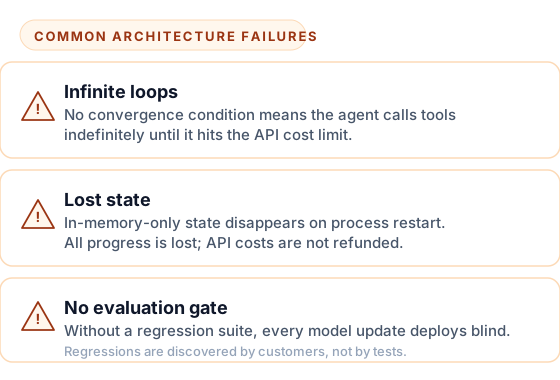
An agent that cannot satisfy its convergence condition will loop indefinitely. Without an explicit maximum step count or a quality threshold the agent must meet before producing a final answer, the loop has no exit condition. The fix requires three controls: a hard step limit, a soft quality threshold from the evaluation layer, and a fallback response behavior when the agent terminates without satisfying the goal.
Failure 2: Lost state
Agents that rely on in memory state lose everything when the process restarts. In production, process restarts happen constantly: deployments, crashes, scaling events, maintenance windows. An agent 12 steps into a 20-step research task that loses its state on restart has produced no deliverable output while consuming 12 steps worth of API costs. Every state transition should be checkpointed to a durable backend before the next step begins.
Failure 3: No evaluation gate
Teams that do not build evaluation infrastructure before shipping have no reliable mechanism for detecting when the agent stops working correctly. Model updates, prompt changes, tool API changes, and data distribution shifts all affect agent behavior. The evaluation gate catches regressions before they reach users. Teams that defer it typically retrofit it after a production incident, at which point the data needed to establish a baseline is gone.
Section 07 · Build vs. buy
When to use a framework vs. build your own orchestration layer
The answer depends on what you are building, how much flexibility you need, and how much complexity you can sustain. Most teams that think they need custom orchestration are actually hitting a configuration problem.
Frameworks like LangGraph, CrewAI, and AutoGen handle the structural plumbing of agent orchestration: state schema definition, graph-based control flow, node execution, conditional routing, and (in LangGraph's case) native interrupt and checkpoint support. Building all of this from scratch takes months. Using a framework gets a working orchestration layer running in days.
Frameworks are the right choice when the orchestration shape your system requires matches one of the patterns the framework was designed for. LangGraph is excellent for single agent loops with conditional branching and persistent state, for human in the loop workflows, and for the coordinator subagent pattern where a router agent delegates to specialist agents.
Custom orchestration is the right choice when the framework's abstractions do not fit. Three common mismatches:
Performance requirements too strict
Framework overhead is typically 5 to 20 milliseconds per orchestration step. For low latency applications where every millisecond matters, the framework abstraction layer may be the bottleneck.
Unusual control flow
Frameworks make common orchestration shapes easy and unusual shapes hard. If your system requires orchestration logic the framework was not designed for, you spend more time fighting its abstractions than you save by using them.
Dependency footprint constraints
Enterprise environments with strict dependency review processes sometimes cannot add large framework dependencies on the schedule a product launch requires. A slim custom orchestration layer with no external dependencies outside the standard library may ship faster in those contexts.
The practical rule: start with a framework. Build on it until you hit a concrete limitation it cannot accommodate. Then evaluate whether the limitation is a fundamental mismatch (warranting a custom replacement) or a configuration problem (solvable within the framework). Most teams that think they need custom orchestration are hitting a configuration problem.
If you reach a genuine fundamental mismatch, extract the specific components you need to own (typically the routing logic and state schema) while keeping the rest of the framework in place. Full replacement of a working orchestration framework is rarely the right move.