
Section 01 · Definition
What AI advisory services actually provide
Advisory is not implementation. Understanding the distinction prevents the most common procurement mistake in early stage AI programs.
Quick answer
What are AI advisory services? AI advisory services give leadership structured guidance on where AI should create value, what the organization is ready to support, and which use cases and vendors deserve investment. Strong advisory produces prioritized decisions, realistic roadmaps, and measurable business cases — not generic AI recommendations.
AI advisory services are structured consulting engagements that assess an organization's readiness for AI, identify high-value use cases, and develop a practical adoption strategy. The work is decision oriented — the deliverables are prioritized choices, validated roadmaps, and business cases, not running software.
Implementation consulting owns engineering outcomes: the code runs, the model is deployed, the integration is live. Advisory consulting owns leadership decisions: which investments to make, what to build versus buy, how to sequence the work, and what governance the organization needs before it can operate AI responsibly at scale. Many firms combine both — but the distinction matters for buyers, because the skills, the accountability model, and the risk profile differ considerably.
Senior level AI advisory typically covers strategy development, vendor review and selection, integration oversight, and AI governance. That breadth reflects the decision landscape leadership actually faces: not just what to build, but who to trust, what to buy, and how to stay in control of the systems being deployed.
Section 02 · Readiness
Assess readiness before recommending investment
The gap between an appealing use case and one the organization can execute often comes down to infrastructure, data, and talent — not the AI capability itself.
A readiness assessment examines the four constraints that determine what an organization can realistically deploy: data quality and availability, existing infrastructure and integration complexity, current team capabilities and hiring capacity, and regulatory or governance requirements. Any proposed use case that runs into a hard constraint in one of these areas needs either a remediation plan or a lower priority score before it belongs on a funded roadmap.
The output is not a scorecard. It is a constraint map. Each constraint gets an estimated remediation cost and timeline. A proposed use case that would require six months of data infrastructure work before any model training can begin looks very different on a constrained roadmap than it does in a slide deck. Advisory work that skips this step tends to produce roadmaps that collapse in the first quarter of execution.
For organizations beginning this process, the AI readiness assessment framework for CTOs and founders covers the dimensions and tooling in detail.
Data, systems, talent, and governance
Data constraints include availability, quality, labeling, and access control. Systems constraints include integration complexity, API availability, and cost to run inference at scale. Talent constraints include ML engineering capacity and the domain expertise required to validate model outputs. Governance constraints include regulatory requirements and organizational risk tolerance for model errors in production.
A constraint aware roadmap shows not just what to build, but what has to be true before each phase can begin. When constraints are visible, scope negotiations become tractable — it is clear which investments enable other investments, and which proposed timelines are not credible without additional headcount or data infrastructure work.
Section 03 · Prioritization
Prioritize use cases and business cases
Organizations entering AI investment typically identify 15 to 30 potential use cases. Three to five of them will deliver the majority of the value. Advisory work is how you find out which ones.
Estimate the business outcome
Tie each estimate to a specific process, a current cost baseline, and a realistic improvement factor. Revenue uplift, cost reduction, or risk mitigation — stated as measurable targets, not directional claims. Generic assertions like improved efficiency are not scoreable and should not appear in a business case.
Assess data availability and integration complexity
Model maturity for this task type, time to first production result, and current data readiness all shape feasibility. High value use cases with low feasibility belong on a longer time horizon, not the top of the funded list. Build versus buy decisions, governance controls, and measurement tied to ROI all belong in this assessment.
Score regulatory exposure and failure modes
Regulatory exposure, model failure modes, reputational risk, and dependency on vendor decisions that have not yet been made. A use case that requires a regulatory approval pathway that has not been scoped carries risk that the prioritization score should reflect — not absorb silently.
Fund the first move, not the roadmap
The objective of use case prioritization is to identify one to three use cases worth funding now, with clear success criteria and a defined timeline for evaluation. A roadmap that funds everything is a wish list. The first funded project sets the template for how the organization evaluates AI investment going forward.
Section 04 · Vendor Evaluation
Vendor, platform, and operating model decisions
Platform choices made at the advisory stage last for years. Getting them wrong is expensive to reverse — and advisors with no vendor relationship are the only ones positioned to evaluate them neutrally.
A vendor neutral evaluation compares platforms on the criteria that matter for the specific use case: capability fit, integration complexity with existing systems, pricing model at scale, lock in depth, and enterprise support quality. Many organizations receive vendor recommendations from implementation partners who have certifications, referral fees, or preferred relationships with specific cloud providers. That is a legitimate business model — but it is not advisory.
Platform selection also determines the operating model. A fully managed vendor solution reduces engineering overhead but limits control over model behavior, data residency, and pricing leverage. A self hosted or fine tuned model requires more internal capability but gives the organization ownership of the architecture. Advisory work surfaces these tradeoffs before the organization is committed to a path.
For the evaluation criteria and due diligence process, the AI vendor due diligence checklist covers each dimension in depth.
Platform decisions carry architecture implications that compound
An organization that chooses a tightly integrated vendor solution for its first use case will find that the same vendor becomes the path of least resistance for every subsequent use case. Advisory work should surface this dependency pattern early, before lock in becomes a structural constraint rather than a deliberate choice.
Vendors should be evaluated on documented criteria before any relationship begins. The evaluation should produce a written recommendation with the criteria, scores, alternatives considered, and the rationale for the decision — so it can be revisited if the vendor's roadmap or pricing changes.
Section 05 · Handoff
Bridge strategy to execution
The advisory to implementation handoff is the most commonly mishandled transition in AI programs. Strategy documents that live only in slide decks do not transfer.
Strong advisory bridges enterprise strategy and execution through concrete artifacts: architecture briefs that describe the intended system design, governance frameworks that define accountability and review cadence, vendor selection rationale documented for audit, and a phased roadmap that engineering can sequence and staff. Effective AI advisory covers responsible AI guidance, production engineering architecture, governance controls, and capability transfer — each of those is a distinct artifact type, not a slide header.
The architecture brief describes what the system should do, the constraints it operates under, the vendor or platform decisions made, and the integration points with existing systems. The governance framework names who is accountable for model outputs, what the review cadence is, and what triggers a human review or override. Both documents should be reviewed and signed off before implementation begins.
Capability transfer means the organization can interpret and evaluate the AI systems it operates after the advisor is gone. That requires training for the teams who will own model oversight, documentation of how model outputs should be interpreted in the context of the business process, and a defined escalation path for model failures or unexpected outputs. An organization that outsources this judgment creates a dependency that persists long after the advisory engagement ends.
Section 06 · Evaluation
How to evaluate an AI advisor
Independence and technical depth are the two qualities that separate advisory that produces decisions from advisory that produces reports.
The first question to ask any AI advisory firm is whether they have preferred vendor relationships, referral agreements, or implementation partnerships that would benefit from a specific platform recommendation. A credible advisor discloses these and explains how they are managed. An advisor who cannot answer this question clearly should not be evaluating your vendor options.
The second question is whether the advisory team can explain the technical constraints that shape the recommendation. Use case prioritization that does not account for data infrastructure gaps, model latency at scale, or integration complexity with existing systems is not prioritization — it is a preference list. The technical depth required to produce a grounded recommendation is adjacent to implementation capability, even if it is not the same thing.
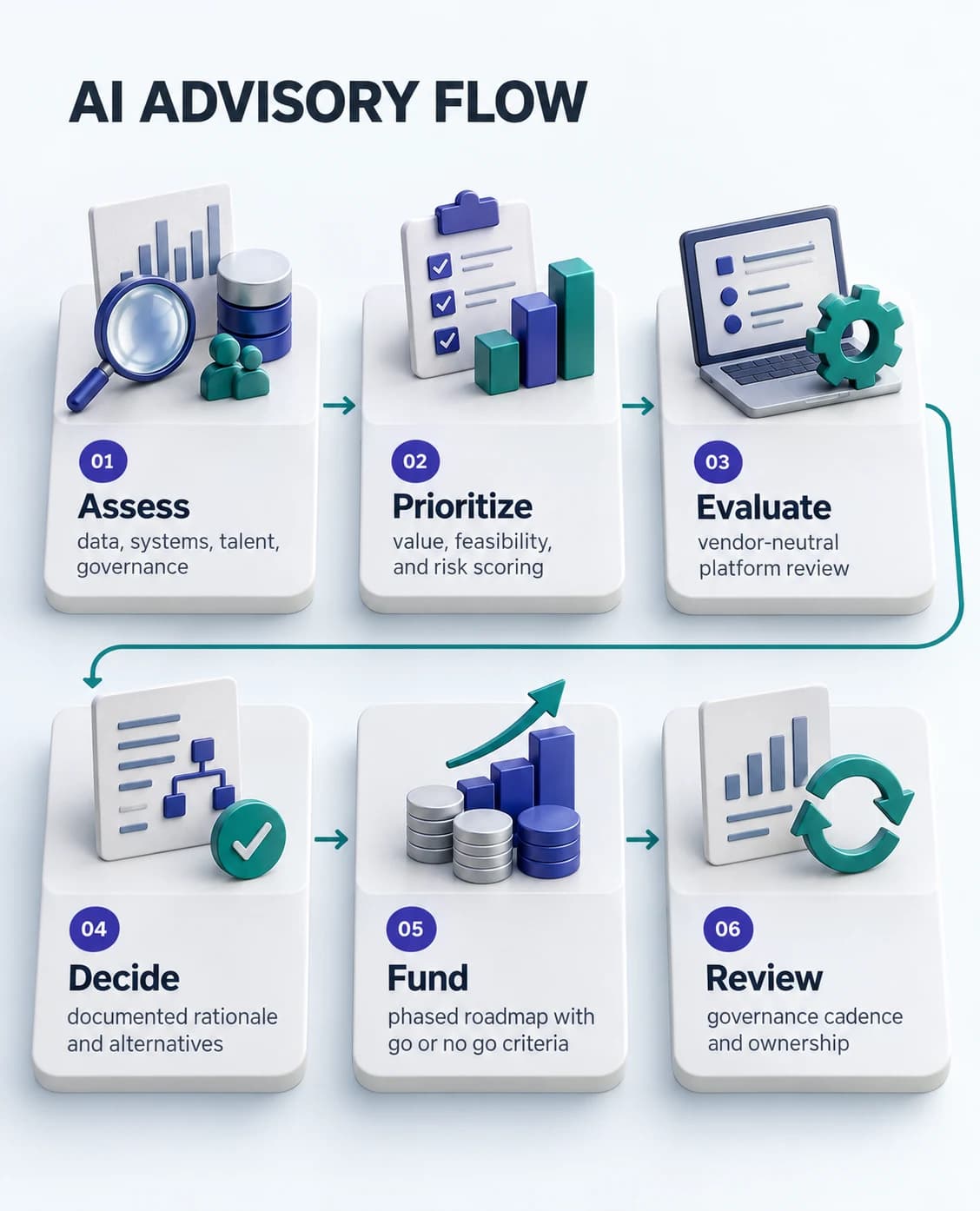
At the end of an advisory engagement, the artifacts you receive should include: a constraint map that names assumptions and gaps, business cases with named dependencies rather than potential ROI alone, vendor recommendations with documented rationale and alternatives considered, a governance framework with named owners rather than principles, and a phased roadmap with clear go or no go criteria at each phase boundary.
Ask for a sample deliverable
The combination of vendor independence and technical depth is rare. Most technically grounded advisory comes from implementation partners who have vendor relationships. Most vendor neutral advisory comes from strategy firms that lack technical depth. The intersection is where the work is most valuable — and the most direct way to assess it is to ask for a sample deliverable from a prior engagement.
If you are evaluating whether structured advisory is the right engagement model for your AI program, the Agentic AI Consulting service includes a strategic scoping pass that produces a readiness view, a prioritized use case shortlist, and an architecture recommendation before implementation begins.