Section 01 · Definition
What AI Governance Consulting Delivers
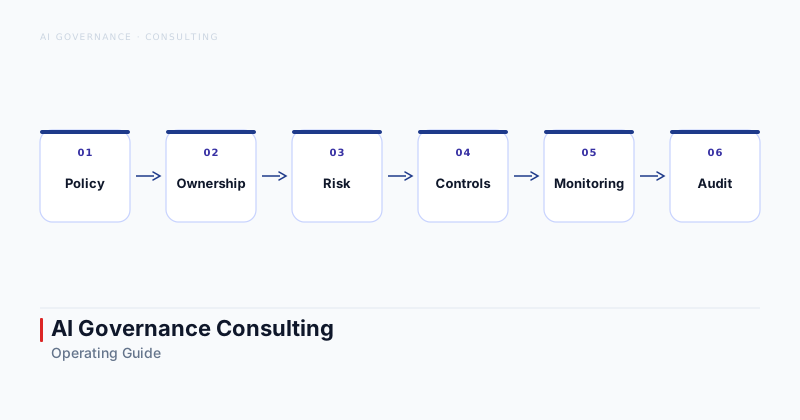
Strong governance consulting produces controls that live inside delivery workflows and assigns owners who appear on real org charts — not theoretical frameworks teams route around.
Quick answer
What is AI governance consulting? AI governance consulting helps organizations define and implement the policies, roles, controls, and monitoring processes needed to use AI responsibly. It typically covers AI inventory, risk classification, accountability, approval workflows, vendor governance, human oversight, documentation, and ongoing monitoring so governance becomes part of normal delivery rather than a separate policy exercise.
Most organizations adopting AI can articulate responsible AI as a goal. Fewer can show the specific controls, decision rights, and monitoring processes that make that goal operational. AI governance consulting bridges that gap by translating principles into procedures that survive contact with real product teams, real engineering pipelines, and real regulatory scrutiny.
Strong AI governance consulting does two things that distinguish it from a policy writing exercise. First, it produces controls that attach to real work — approval gates, documentation requirements, and risk reviews that sit inside sprint planning, procurement, and release workflows. Second, it assigns owners who appear on existing org charts so accountability is durable rather than theoretical.
IBM's governance approach emphasizes a holistic framework integrated with data management infrastructure and automated controls across the model portfolio. That integration is the operative word. A governance program that sits outside your delivery system is one that teams will route around when timelines compress.
The advisory work is distinct from implementation. Governance consultants define what controls are needed, who owns them, and how compliance is measured. They do not build the models or run the engineering. That distinction matters for scoping and for avoiding conflicts of interest when advisors also sell implementation services.
From Principles to Operating Controls
The gap between a responsible AI policy and an executable governance program is specific: policies name values; controls name decisions. A policy can state that high risk AI requires human oversight. A control names who signs the approval, what documentation is required, where that record is stored, and what happens if the step is skipped.
Governance consulting converts policy language into that level of operational specificity. The outputs are process descriptions, decision trees, approval forms, monitoring requirements, and documented ownership — not philosophical commitments.
Why Governance Must Live inside Delivery
A governance framework that requires teams to leave their normal workflow to seek approval will be bypassed. Organizations that successfully govern AI have embedded review points into the tools and processes engineers already use: approval fields in their model registry, governance checklists in their deployment pipeline, incident escalation that connects to their existing on call rotation.
Section 02 · Assessment
Assess Governance Maturity and AI Inventory
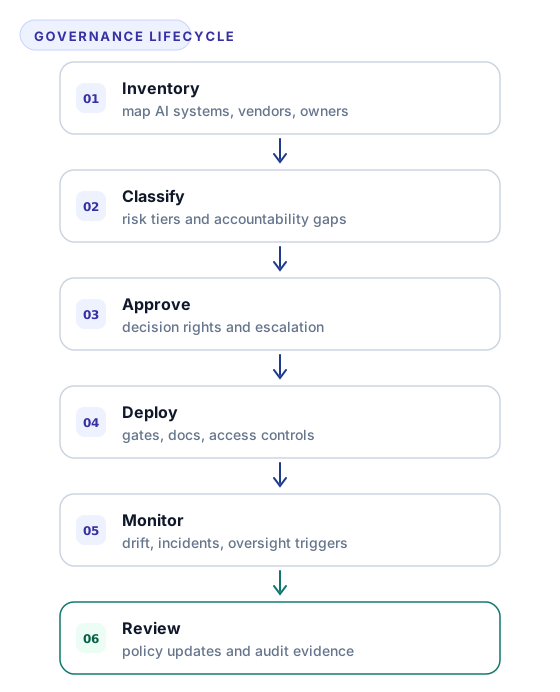
You cannot govern what you have not catalogued. The starting point is an inventory that maps every AI system, vendor model, and ownership gap.
The starting point for any governance program is an inventory of current AI systems: which models are in production, which are in development, which are procured from third parties, and who owns each. HSO describes AI governance consulting as spanning readiness assessment, framework design, data governance, agentic oversight, AI centers of excellence, and responsible AI program delivery. The readiness assessment is usually the first deliverable, because it establishes what exists and what is missing simultaneously.
Current Systems, Vendors, and Ownership
An AI inventory should capture model name and version, use case and business process, data inputs and outputs, risk level, current owner, whether the model is internal or third party, and what monitoring exists. Many organizations discover during this step that they have AI systems no one currently owns, vendor models operating under assumptions no one has validated, and production uses that were never formally approved.
The inventory creates the baseline for everything that follows. Risk classification, policy design, and control selection all depend on knowing what you are actually governing.
Risk Classification and Accountability Gaps
Not all AI systems carry the same risk. A model that classifies internal documents is governed differently from one that makes credit decisions or generates clinical recommendations. Governance consulting should produce a risk classification scheme — typically two to four tiers — with clear criteria, and then apply it to every system in the inventory.
The accountability gaps that surface during this process are often more important than the technical gaps. An AI readiness assessment for CTOs and founders typically surfaces both: where the organization is technically unprepared and where ownership is genuinely unclear.
Section 03 · Framework Design
Design Policies, Roles, and Decision Rights
Decision rights are the mechanical output of governance design — specifying who can decide, who must be consulted, and who must be informed for every class of AI decision.
With an inventory and risk classification in hand, the design phase produces the actual governance framework: policies, decision rights, approval processes, and accountability assignments. Bamboo Data Consulting stresses governance structures that define how AI decisions are made, who owns them, and how risk is managed across the organization. For each class of AI decision — approving a new model for production, changing a model version, expanding a model scope, responding to an incident — the framework should specify who can decide, who must be consulted, and who must be informed.
Approval Paths and Escalation
Approval paths answer a specific question: who signs off before a production deployment, and what do they need to see? For a low risk internal tool the answer might be a team lead with documented test results. For a high risk customer-facing model it might be a cross functional review panel with a completed risk checklist, a bias evaluation, and sign off from legal, compliance, and the responsible engineering lead.
Escalation paths answer what happens when something goes wrong after deployment. Who gets paged for an AI incident? Who decides whether to take a model offline? Who communicates with regulators if required? Governance programs that define approval paths but not escalation paths create accountability for deployment and none for ongoing operation.
Business, Technical, and Risk Ownership
Effective governance separates three ownership types that are often conflated. Business ownership covers which team is accountable for the AI system's outcomes and business decisions. Technical ownership covers which team is accountable for model health, version control, and infrastructure. Risk ownership covers which function — often a central risk, compliance, or AI governance team — is accountable for framework compliance and exception handling.
Combining all three into one role creates governance bottlenecks. Separating them clearly, with documented handoffs, makes the program scalable.
Section 04 · Operationalization
Operationalize Controls across the Lifecycle
Embedding controls into existing delivery workflows is what turns a governance framework into a governance program — one that runs without anyone remembering to invoke it manually.
Policies and decision rights describe what is required. Operationalization embeds those requirements into the workflows where they will actually run. Centric Consulting focuses on embedding AI governance policies into day to day operations to support compliance, transparency, and responsible scaling. That embedding is the difference between a framework and a program. A framework is a document. A program is a set of controls that run whether or not anyone remembers to invoke the framework manually.
Development and Deployment Gates
Development gates are control points that apply before a model reaches production. Examples include a completed model card, a documented data lineage review, a bias evaluation against agreed criteria, a security review for models that handle personal data, and an approval from the risk owner for any model classified above the lowest risk tier.
Deployment gates connect to CI/CD and release workflows. A model that does not have an approved model card in the registry should not be deployable to production. Making that a pipeline gate rather than a team convention means it is enforced consistently rather than selectively.
Monitoring, Documentation, and Evidence
Ongoing monitoring answers the question: how would we know if a deployed model is behaving outside its approved parameters? The monitoring requirements should specify what metrics are tracked — output distribution, error rates, latency, data drift, fairness metrics — at what thresholds alerts are triggered, who reviews alerts, and how reviews are documented.
Documentation and evidence requirements answer what auditors and regulators will ask for. A properly governed model should have an approval record, a model card, a data lineage document, test results, any exception approvals, monitoring logs, and a record of any incidents and their resolution.
Section 05 · Third Party and Agents
Govern Third Party Models and AI Agents
Vendor models and autonomous agents require explicit governance — not assumptions about what the provider handles or what actions an agent can safely take without review.
Third party models introduce governance challenges that in-house models do not. You cannot audit the training data of a vendor model. You cannot control model version updates the vendor ships. You cannot inspect the inference pipeline. What you can control is how you use the model, what data you send it, what outputs you act on, and what contractual commitments the vendor has made. AI vendor due diligence is the starting point: reviewing contracts for data handling, model versioning policies, incident notification obligations, and audit rights before a vendor model goes into production.
Vendor and Model Risk
Vendor risk for AI models has dimensions that traditional software procurement reviews miss: model deprecation timelines, version drift without notice, shared inference infrastructure, training data provenance, and behavioral changes in model updates. A governance program should require vendor models to be inventoried alongside internal models, risk-classified on the same scale, and reviewed under the same approval process.
Human Oversight and Autonomous Actions
AI agents that take actions autonomously — sending communications, modifying records, executing transactions — require explicit governance around what they can do without human review. The governance framework should specify, for each agent, which actions require a human decision step before execution, which require a human review after execution but before the outcome is used, and which are fully autonomous with only logging required.
As agents become more capable, those boundaries will shift. Governance consulting should produce a framework for how those boundaries are reviewed and updated, not just what they are at launch. The AI governance framework for production LLMs covers the technical instrumentation that supports those oversight requirements at the model level.
Section 06 · Evaluation
How to Evaluate an AI Governance Consultant
The distinctions that matter to buyers are not credentials or brand recognition — they are evidence of operational implementation and genuine vendor independence.
The governance consulting market includes global advisory firms, boutique responsible AI specialists, and technology vendors offering governance as an add-on to their implementation services. Ask for examples of governance programs the consultant has designed that are currently in production. Then ask where those programs sit relative to the organization's engineering and product workflows. A governance framework that lives in a document repository and requires manual process adherence is not the same as one where approval gates are enforced by tooling, documentation requirements are checked at deployment, and monitoring is automated with defined escalation paths.
Evidence of Operational Implementation
Specific questions to ask any governance consultant:
- Can you show a model registry or approval workflow you designed that is actively used?
- Where do your governance controls intersect with CI/CD pipelines or deployment tooling?
- How are exceptions handled, and what does the exception approval process look like?
- What evidence retention requirements did you define, and how are they enforced?
Questions about Controls, Auditability, and Ownership
Auditability is the test of a governance program. If a regulator or an internal auditor asked for evidence that a specific model was reviewed, approved, and monitored appropriately, could the organization produce that evidence without a manual document hunt?
A governance consultant who cannot walk you through how audit evidence is captured, stored, and retrieved has designed a policy framework rather than an operating program. The same applies to ownership: if every owner is a committee rather than a named individual, accountability diffuses to the point where no one is responsible for anything.
Governance programs that work assign human owners to every control and every AI system. They produce retrievable evidence for every significant decision. They make compliance part of delivery rather than a parallel obligation that competes with delivery for time.
My governance engagements typically start with the inventory and maturity assessment, then move to framework design aligned with your actual delivery processes. See how I approach agentic AI consulting if that is the kind of advisory work you are scoping.