Section 01 · Definition
What is an AI systems architect?
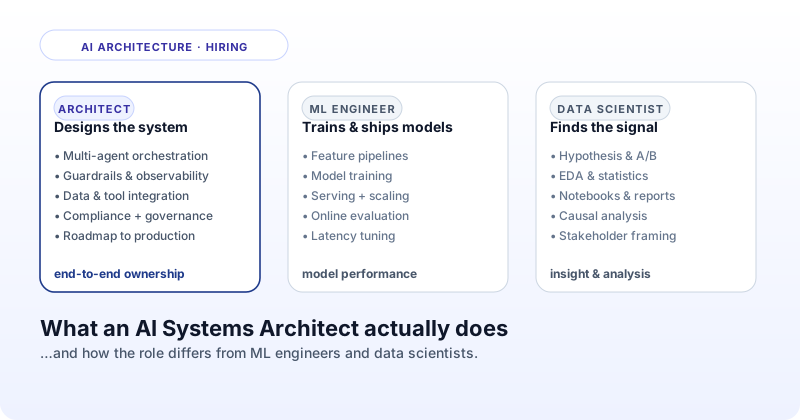
An AI systems architect is a senior technical role responsible for designing the overall structure of AI-powered products — the data pipelines that feed models, the inference infrastructure that serves them, the orchestration layers that coordinate AI components, and the observability systems that keep the whole thing healthy in production.
Quick answer
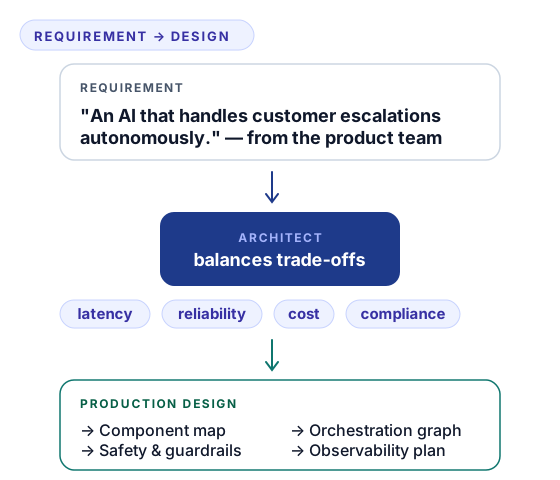
In one sentence: An AI systems architect turns a product requirement into a production-grade technical design that accounts for latency, reliability, cost, compliance, and the failure modes specific to AI systems.
The title is relatively new but the discipline is not: it is software architecture applied to the unique demands of machine learning, large language models, and agentic AI systems. An AI systems architect turns a product requirement (“we want an AI that handles customer escalations autonomously”) into a production-grade technical design.
My own work as an AI systems architect spans LangGraph-based agent orchestration, Temporal workflow infrastructure, Cloudflare edge deployments, and full observability stacks — from initial architecture document to production handoff.
Section 02 · Role comparison
AI systems architect vs. ML engineer vs. data scientist vs. software engineer
These four roles are frequently confused — sometimes deliberately, by people trying to charge architect rates for engineer-level work. Here is a precise breakdown of who does what.
| Role | Primary concern | Core outputs | AI involvement |
|---|---|---|---|
| AI Systems Architect | How AI components connect, scale, and fail | Architecture docs, infra design, orchestration patterns | Designs systems that use AI |
| ML Engineer | Training, evaluating, and serving ML models | Trained models, feature pipelines, model APIs | Builds the AI itself |
| Data Scientist | Extracting insight from data via statistical methods | Analyses, experiments, model prototypes | Explores AI possibilities |
| Software Engineer | Building reliable application code | Backend services, APIs, product features | Integrates AI components |
The key distinction: an ML engineer asks “how do I train a better model?” An AI systems architect asks “how do I build a system that uses this model reliably at scale?” Both questions matter. For most product teams, the systems-architect question is the blocking one — because you can always swap in a better model later, but rearchitecting a production system is expensive.
Section 03 · What they own
The six core responsibilities of an AI systems architect
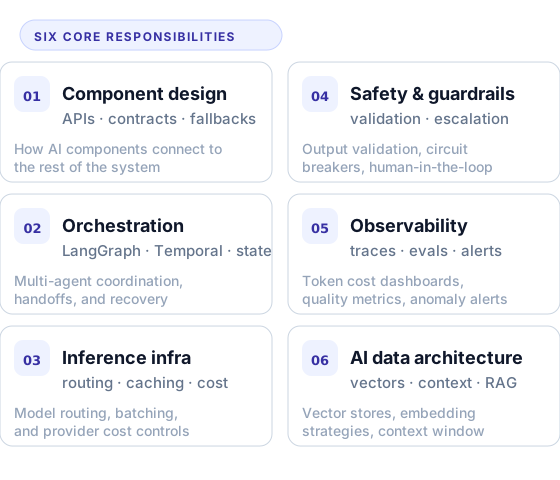
Whether the engagement is full-time, fractional, or a one-off architecture audit, the surface area is the same. These six concerns are the architect's beat.
AI component design and integration
Defining which AI capabilities go into the product and how they connect to the rest of the system — APIs, data contracts, latency budgets, and fallback behaviour when models are unavailable or return low-confidence outputs.
Orchestration and workflow design
Designing the orchestration layer that coordinates multiple AI components — whether that is a LangGraph multi-agent graph, a Temporal durable workflow, or a custom state machine. This layer determines how agents collaborate, hand off tasks, and recover from failures.
Inference infrastructure
Specifying how models are served in production: self-hosted vs. API-based, model routing, caching, batching, and cost management across providers. For latency-sensitive products, the inference architecture is often the difference between a viable product and one that users find too slow.
Safety and guardrails architecture
Designing the safety layer that sits between agent outputs and production consequences — prompt injection defences, output schema validation, content policy enforcement, human-in-the-loop escalation paths, and circuit breakers that halt runaway agent behaviour.
Observability and evaluation
Specifying what gets measured and how: agent trace collection, token cost dashboards, quality metrics (BLEU, ROUGE, human evaluation), and anomaly detection. Without observability, you are flying blind — you will only learn about AI system failures when users report them.
Data architecture for AI
Designing the data pipelines that feed models at inference time: vector databases and embedding strategies for RAG systems, feature stores, context window management, and the retrieval architecture that determines what information an agent has access to when it needs to make a decision.
Section 04 · When to hire
When does your team need an AI systems architect?
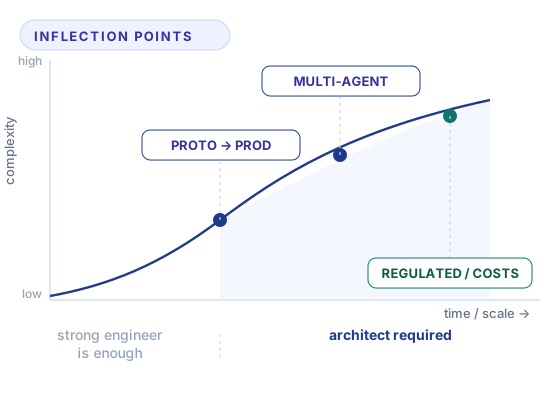
Most early-stage AI products do not need a dedicated AI systems architect — a strong full-stack engineer with LLM experience can get a product to initial production. The role becomes necessary at specific inflection points.
Quick answer
Hire one when: you are moving from prototype to production, adding a second AI model or agent, entering a regulated industry, watching AI costs grow faster than usage, or your team is stalled on architecture decisions.
You are moving from prototype to production
The gap between a working LLM demo and a production-grade system is architectural — caching, fallbacks, observability, cost controls, and load handling. This is when architecture decisions made at demo stage start incurring compounding technical debt.
Your AI product involves multiple models or agents
As soon as you have more than one AI component that needs to coordinate — a reasoning agent, a search agent, a validation agent — you need someone to design the orchestration layer. Multi-agent systems fail in non-obvious ways that a single-model developer will not anticipate.
You are entering a regulated industry
Fintech, healthcare, legal, and government applications require compliance-first architecture. An AI systems architect who has built for regulated domains will design the audit trail, data residency controls, and governance model that your legal and compliance team requires.
Your AI costs are unpredictable or growing faster than usage
Runaway LLM token costs are almost always an architecture problem — missing caches, inefficient context management, or poor model routing. An AI systems architect will identify and fix these structural inefficiencies.
Your team keeps arguing about the right way to build it
Extended technical debates about model choice, orchestration approach, or infra design are often a sign that no one has the specific background to make these calls with confidence. An AI systems architect provides that decision authority.
Section 05 · Deliverables
What an AI systems architect delivers
If you are evaluating candidates or consultants, these are the concrete outputs you should expect. Architects who cannot produce written, reviewable deliverables are engineers, not architects.
| Deliverable | What it contains |
|---|---|
| Architecture document | System diagram, component responsibilities, data flows, API contracts, failure modes |
| Infrastructure specification | Cloud services, deployment model, scaling approach, cost estimates, IaC outline |
| Orchestration design | Agent graph or workflow diagram, state machine definitions, tool registry, retry logic |
| Safety & guardrails spec | Input/output validation rules, escalation triggers, circuit breaker design, compliance controls |
| Observability plan | Metrics list, trace design, dashboard specs, alert thresholds, evaluation methodology |
| Handoff documentation | Runbook, decision log, known failure modes, recommended next iteration |
For a concrete example of what this looks like in practice, see the NebulaDesk case study — an agentic workspace where AI systems architecture cut product spec cycle time by 50%.
Section 06 · How to evaluate
How to evaluate an AI systems architect
Four interview moves that quickly separate a real architect from a senior engineer with the wrong title.
Ask them to describe a production failure they designed for
Good architects think in failure modes from the start. They should be able to describe specific failure scenarios in their previous systems and explain how the architecture handled them — not just that 'we had monitoring'.
Ask how they would approach your specific system
Within 30 minutes of a conversation, a strong AI systems architect should be able to sketch the high-level architecture for your use case — identifying the key components, the main risks, and two or three trade-offs worth discussing. Vague generalities are a warning sign.
Review their architecture documents, not just their code
Architecture quality shows in written design docs, not in code quality alone. Ask to see an architecture document from a previous project — even redacted. If they have not written one, they are an engineer who has been called an architect.
Ask about cost and observability explicitly
Many AI system failures are not functional bugs — they are cost overruns or silent degradations that observability would have caught. An architect who has not designed for these concerns in previous systems is missing the production discipline the role requires.
Section 07 · Engagement model
Fractional AI systems architect vs. full-time hire
Most seed-to-Series-A startups cannot justify a full-time AI systems architect at $200,000–$350,000 total compensation. A fractional engagement gives you the same architectural depth at 20–40% of the cost — for the period when you actually need it most.
| Model | Best for | Typical cost (2026) |
|---|---|---|
| Full-time hire | Post-Series A, multiple concurrent AI initiatives | $200,000–$350,000 TC/year |
| Fractional retainer | Seed–Series A, ongoing architecture oversight | $6,000–$14,000/month |
| Project-based | Specific architecture deliverable or audit | $15,000–$60,000 fixed |
My fractional CTO service combines AI systems architecture with broader technical leadership — useful for founders who need one person to own both the AI architecture and the engineering team direction.