Section 01 · The Core Distinction
What is the actual difference between fine-tuning and RAG?
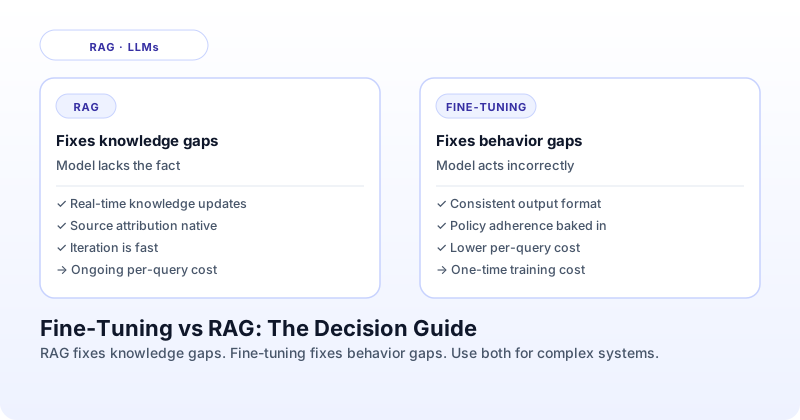
The most useful mental model: RAG changes what the model can see right now. Fine-tuning changes how the model tends to behave every time.
Quick answer
In one sentence: RAG fixes knowledge gaps by injecting relevant context at inference time. Fine-tuning fixes behavior gaps by adjusting model weights during training. Use the right tool for the right failure mode.
When a production LLM system gives a wrong answer, the failure is in one of two places: the model does not have the right information, or the model has the information but does not use it correctly. These are different problems. Treating them as the same problem leads to expensive, poorly targeted solutions.
RAG retrieves relevant documents and includes them in the context window at inference time. It is ideal when knowledge changes frequently, when you need source attribution, or when the domain is large enough that fine-tuning would be prohibitively expensive. The model's weights do not change.
Fine-tuning updates the model's weights on a curated dataset. It is ideal when you need consistent output format, a specific tone or style, strong classification performance, or behavior that must follow a policy even when context does not mention it.
Section 02 · When to Use RAG
Four situations where RAG is the clear choice
Your knowledge changes frequently
Fine-tuning is a snapshot. Every time your data changes, you re-train. RAG reads live documents, so updates are immediate. For any knowledge base with weekly or monthly changes — product docs, internal policy, legal filings — RAG is the only practical option.
You need source attribution
RAG retrieves named documents, so every answer can cite the chunks it drew from. Fine-tuned models encode knowledge in weights with no traceable provenance. For compliance, legal, and medical applications where you must show your sources, RAG is required.
Your failure mode is missing or stale facts
If users are getting wrong answers because the model does not know recent events, proprietary data, or organization-specific context, that is a knowledge gap. RAG closes it directly. Fine-tuning would not help — you cannot fine-tune in real-time, and training on stale data bakes in stale knowledge.
Your knowledge base is large or heterogeneous
Fine-tuning on a dataset with tens of thousands of diverse documents tends to produce a model that is better at many things but not reliably better at the specific thing you need. RAG retrieves the right passage for each query. Coverage is more precise at scale.
Section 03 · When to Use Fine-Tuning
Four situations where fine-tuning is the right call
You need consistent output format
If your application requires structured JSON, specific XML schemas, or a predictable response shape that prompt engineering alone cannot reliably produce, fine-tuning on format examples works. The model learns to output the structure without being told every time.
Your failure mode is behavioral, not factual
If the model knows the right answer but writes it in the wrong tone, at the wrong length, or in the wrong style for your brand, that is a behavior gap. Fine-tuning on examples of the desired behavior closes it. RAG cannot help here — it adds context, not style.
You need strong domain-specific classification
For routing, intent classification, or labeling tasks where accuracy must be very high and latency must be low, a small fine-tuned model regularly beats a prompted general-purpose model. Fine-tuning a 7B model on your classification task often outperforms prompting GPT-5 at a fraction of the cost.
You need policy adherence without relying on prompt injection
If every response must follow a specific policy regardless of what the user says — safety rules, regulatory requirements, brand guidelines — fine-tuning the policy into the model is more robust than relying on system prompt instructions that a clever user might work around.
Section 04 · Decision Framework
One question before you choose
Before committing to either approach, answer this: is my failure mode a knowledge gap or a behavior gap?
| Dimension | RAG | Fine-tuning |
|---|---|---|
| Failure mode it fixes | Missing or stale facts | Wrong behavior or format |
| Knowledge freshness | Real-time | Training snapshot |
| Source attribution | Native | Not available |
| Upfront cost | Low to medium (infra) | Medium to high (training) |
| Per-query cost | Higher (retrieval + generation) | Lower (generation only) |
| Iteration speed | Fast (update docs) | Slow (re-train) |
| Best for | Knowledge-intensive apps | Style, format, classification |
| 2026 default | Yes, for most new builds | Yes, layered on top of RAG |
The decision tree is simple. Start with prompt engineering. If that fails, identify the failure mode. If it is factual, add RAG. If it is behavioral, add fine-tuning. If it is both, run hybrid.
Section 05 · The 2026 Standard
Hybrid RAG plus fine-tuning: what most production systems use
The RAG versus fine-tuning debate is largely resolved in 2026. Most production-grade AI systems use both. RAG handles knowledge retrieval — fresh documents, proprietary data, cited answers. Fine-tuning handles behavior — consistent format, tone, and policy adherence. The two techniques are complementary, not competing.
A typical hybrid stack: a fine-tuned base model for format and policy adherence, with RAG layered on top for domain-specific knowledge retrieval. The fine-tuning run happens once (or quarterly as behavior requirements change). The RAG pipeline updates continuously as documents change.
Try prompt engineering first
Claude Sonnet 4.6, GPT-5.4, and Gemini 2.5 Pro with well-structured prompts handle a wide range of behavior requirements without any fine-tuning. If the model can do what you need with good prompting, the training cost is not worth it.
If your knowledge base fits in context, skip RAG
A knowledge base under roughly 100,000 tokens can be included directly in the context window using full context loading with prompt caching. The setup cost is lower than a RAG pipeline and latency is competitive for many use cases.
Section 06 · Three-Way Comparison
RAG vs fine-tuning vs prompt engineering: the full comparison
Most teams work through the three options in sequence: prompt engineering first, then RAG if knowledge is the gap, then fine-tuning if behavior is the gap. Each has a distinct cost structure, iteration speed, and appropriate failure mode.
Quick answer
When to use each: Prompt engineering: always try first — it is free and fast. RAG: when the model lacks factual knowledge or needs current information. Fine-tuning: when the model has the knowledge but the behavior, format, or style is wrong.
| Dimension | Prompt Engineering | RAG | Fine-tuning |
|---|---|---|---|
| Fixes | Instruction following, format, context framing | Missing or stale knowledge | Behavioral gaps, style, classification |
| Iteration speed | Minutes | Hours to days | Days to weeks |
| Upfront cost | None | Low to medium (infra) | Medium to high (training) |
| Per-query cost | Zero extra | Higher (retrieval + generation) | Lower (generation only) |
| Knowledge freshness | Static (in context) | Real time | Snapshot at training time |
| Source attribution | Only if you craft it | Native from retrieved chunks | Not available |
| When to try | Always first | After prompt engineering fails on knowledge | After RAG fails on behavior |
Prompt engineering has become significantly more powerful in 2026. Claude Sonnet 4.6 and GPT-5.4 with well-structured system prompts, few-shot examples, and chain of thought guidance handle a wide range of use cases that previously required fine-tuning. The threshold for when fine-tuning adds genuine value has shifted upward. Before investing in a fine-tuning run, exhaust what is achievable with structured prompts — the result might surprise you.
Prompt engineering vs RAG: which comes first?
Always prompt engineering. If you can get the model to answer correctly with context you provide directly in the prompt — whether via a system prompt, a few-shot block, or an inline context window — that is cheaper and faster than running a retrieval pipeline. RAG makes sense when the knowledge base is too large to fit in context, changes frequently, or needs source attribution. Prompt engineering with direct context inclusion is often sufficient for knowledge bases under 100,000 tokens.
Prompt engineering vs fine-tuning: where the line is
Prompt engineering controls what the model does with information it already has. Fine-tuning changes how the model is inclined to respond at a weight level. For consistent output format, brand tone, and policy adherence across thousands of calls, fine-tuning is more robust than relying on a system prompt the user could potentially override. For tasks where the model clearly has the capability but needs to be directed, prompt engineering is faster and reversible.