Section 01 · Definition
What is a fractional CTO and why do startups use one?
Quick answer
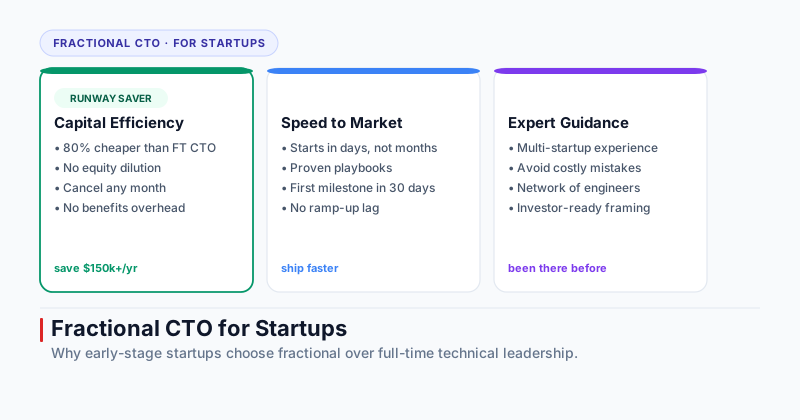
The short answer: A fractional CTO gives early stage startups senior technical leadership, architecture direction, and credibility with investors at a fraction of the cost of a full time hire — typically 20 to 40 percent of an equivalent full time salary.
A fractional CTO is a senior technical executive who works with your company part time — typically one to three days per week — providing the strategic and architectural leadership of a full time CTO without the full time cost or commitment.
The arrangement works because most seed and early Series A startups do not yet need a full time CTO. What they need is someone who can set the technical direction, make the three or four architectural decisions that will matter most over the next 18 months, and credibly represent the technical side to investors and enterprise customers. That is a 10 to 20 hour per week job, not a 50 hour per week job.
Understanding what a fractional CTO actually does at a strategic level is useful context before you decide whether to hire one. This post is about the decision itself and what happens after you make it.
Section 02 · Signals
Five signals your startup needs a fractional CTO now
Most founders who need a fractional CTO already know something is wrong. These are the five patterns that show up most often.
Your engineers have no technical north star
Your team is shipping, but every sprint produces a slightly different set of patterns. The codebase is accumulating decisions that made sense locally but add up to an incoherent architecture. A fractional CTO sets the standard and holds the team to it.
Fundraising is imminent and investors will ask architecture questions
Series A investors will ask about your infrastructure choices, security posture, and data model. A fractional CTO gives you a credible voice in those conversations and helps you prepare the technical due diligence package that serious investors expect.
You are building in a regulated domain
Healthcare, fintech, legaltech, and anything touching children's data or government systems has compliance requirements that most generalist engineers have not navigated before. A fractional CTO who has shipped in your vertical already knows where the traps are.
Tech debt is visibly slowing your release cadence
If you used to ship a feature in a week and it now takes three, and your engineers are spending more time untangling dependencies than writing new logic, you have a structural problem. A fractional CTO can triage what to pay down immediately versus what to schedule over the next two quarters.
You lost your technical cofounder
Departure of a technical cofounder is one of the most disruptive events a startup can face. A fractional CTO can be onboarded in two to three weeks and provides bridge coverage while you decide whether to backfill the role.
Section 03 · The First 90 Days
What a fractional CTO actually delivers in the first 90 days
The first 90 days of a fractional CTO engagement follow a recognizable pattern. What the deliverables look like depends on your stage, but the arc is consistent.
Days 1 to 30: Audit and align
The first month is almost entirely diagnostic. A good fractional CTO will refuse to prescribe solutions before they understand the current state. Expect them to interview every engineer, map the current architecture, identify the three to five decisions that need to be made in the next 90 days, and produce a written architecture brief. The written brief is the key output of month one. If a fractional CTO ends month one with only verbal observations and no document, that is a warning sign.
Days 31 to 60: Establish foundations
Month two is where direction becomes structure. The fractional CTO chooses or ratifies the primary infrastructure patterns, establishes engineering standards, runs hiring or contractor evaluations if needed, and begins meeting with investors or enterprise prospects as technical representative. By the end of day 60, decisions are less ambiguous and the engineering roadmap is tied to the business roadmap.
Days 61 to 90: Delivery momentum
Month three shifts from setup to output. The fractional CTO drives the first major technical initiative from the audit, transfers knowledge so the engineering team can operate more independently, and refines the engagement model. By day 90, the engagement has usually paid for itself in avoided architectural mistakes alone.
Section 04 · Cost
How much does a fractional CTO cost for a startup?
Cost varies by commitment level, the individual's background, and your stage. These are realistic ranges for the US market.
| Commitment | Typical hours per month | Monthly cost | Best for |
|---|---|---|---|
| Advisory (1 day/week) | 30 to 40 hours | $5,000 to $10,000 | Pre seed, primarily investor prep |
| Part time embedded (2 days/week) | 60 to 80 hours | $10,000 to $18,000 | Seed, needs architecture direction |
| Near full time (3 days/week) | 80 to 100 hours | $18,000 to $28,000 | Series A, active team leadership |
For context: a full time CTO at a Series A startup in a major US market commands $220,000 to $320,000 in total compensation. A 3 day per week fractional arrangement at $22,000 per month ($264,000 annualized) costs roughly the same — but without equity dilution at current valuation, without a six month search, and with no severance risk if the fit is wrong.
Most seed stage engagements land in the $10,000 to $15,000 range. If you are getting a quote significantly below $7,000 per month for a genuine 2 day per week commitment, verify that the candidate has actually held CTO-level responsibility before — the pricing often reflects advisory only experience.
Equity is sometimes offered in early engagements. If you go this route, 0.1 to 0.5 percent with a 2-year vest and no cliff is a reasonable range for a 12-month commitment. Do not offer equity in lieu of cash if the engagement is less than six months — it creates misaligned incentives.
For a deeper breakdown of pricing structures and the factors that move the number up or down, the fractional CTO hiring guide covers rate benchmarking in detail.
Section 05 · Comparison
Fractional CTO vs. technical cofounder vs. full time hire
| Factor | Fractional CTO | Technical cofounder | Full time CTO hire |
|---|---|---|---|
| Time to start | 2 to 4 weeks | 3 to 12 months to find | 4 to 9 months to hire |
| Monthly cash cost | $8k to $28k | Near zero (equity only) | $18k to $28k salary alone |
| Equity given | 0 to 0.5% | 10 to 40% | 0.5 to 3% |
| Availability | Part time | Full time | Full time |
| Replaceability | Easy — no equity, contract | Very hard | Moderate — severance risk |
| Best stage | Pre seed through Series A | Pre seed (founding) | Series A onward |
The key insight is that a fractional CTO is not a discounted full time CTO. They are different instruments. A fractional CTO is best when you need technical credibility and direction but not full time day to day management. A full time CTO is best when you have 10 or more engineers and the technical function needs dedicated leadership every working day.
A technical cofounder is in a completely different category: that is a founding stage decision about equity and mission alignment, not a service engagement. If you are already past launch and evaluating between fractional and full time, the cofounder option is probably off the table — and that is fine.
The most common mistake is using a fractional CTO as a substitute for eventually hiring full time when the company grows past the point where part time leadership makes sense. Plan the transition. Around 12 to 18 engineers, most companies need a full time technical executive, and the fractional CTO should be part of that planning.
Section 06 · How to Hire
How to find and evaluate a fractional CTO
The market for fractional CTOs is less structured than the market for full time executives. There is no standard credential and the quality range is wide.
Define the primary job to be done
Before you post or reach out to anyone, write one paragraph describing the single most important thing you need the fractional CTO to accomplish in the first 90 days. Specific job definitions attract specific candidates and filter out generalists recycling a template.
Source from warm referrals and fractional talent networks
The best fractional CTOs are rarely on job boards. Ask your investors, your advisors, and founders who raised their Series A in the last 18 months. Networks like Toptal and CTO craft communities surface credible candidates. Expect to evaluate four to six candidates to find one worth a trial.
Run a paid technical audit as the interview
The most reliable hiring signal is a paid engagement. Offer a two week paid audit at $3,000 to $5,000. The candidate reviews your codebase, interviews your engineers, and produces a written technical brief. If a candidate declines the paid audit and wants to go straight to a retainer contract, that is a risk signal.
Evaluate the written deliverable on five criteria
When you receive the audit brief, look for: specific findings not generic observations; prioritized recommendations with a rationale for the ranking; honest acknowledgment of what they do not know yet; a clear understanding of your business model not just the technology; and language your cofounders without a technical background can read and act on.
If you are ready to move forward with the search, the fractional CTO service outlines the engagement model and what to expect at each stage of the process.