Quick answer
What is the difference between LangGraph, AutoGen, and CrewAI? LangGraph is a stateful graph runtime that models agent logic as nodes and edges with persistent shared state. AutoGen is a conversation actor framework where agents send and receive messages in structured multiturn dialogs. CrewAI is a role based orchestration layer that organizes agents into crews with assigned tasks and goals. They target different system shapes and team experience levels.
Section 01 · Framework selection
Why framework choice matters more than it should
Every software architecture decision carries an abstraction cost. In the current multiagent space, that cost varies dramatically between frameworks, and choosing the wrong one for your system shape means either fighting the framework or carrying complexity the problem never required.
This is not a theoretical concern. Engineers regularly report spending weeks after initial prototyping realizing the framework they chose cannot express the system shape they need without workarounds. A team that picks AutoGen for a system that requires granular state persistence ends up rebuilding state tracking outside the framework. A team that picks LangGraph for a simple crew delegation workflow ends up maintaining a verbose graph definition for something CrewAI would express in twenty lines.
The three frameworks LangGraph, AutoGen, and CrewAI are all capable of building working multiagent systems. The practical question is which one fits the shape of your system with the least friction. Getting that match right at the start is worth the time it takes to understand the architectural model behind each.
For the broader context on how these orchestration shapes connect to production design patterns, the multiagent design patterns guide covers the four coordination topologies that appear most often in production systems.
Section 02 · LangGraph
LangGraph: when the graph model is the right fit
LangGraph is a stateful graph runtime built on top of LangChain. The core model is a directed graph where nodes are computations and edges are transitions. The graph maintains a shared state object that every node can read and update.
The design gives you explicit, inspectable control over every step of agent execution. When you define a LangGraph workflow, you know exactly what runs when, what state is available at each node, and under what conditions each edge fires.
Complex branching workflows
If your agent needs to evaluate intermediate outputs and take meaningfully different code paths based on them — route to a different tool set, invoke a subgraph, or escalate to a human reviewer — LangGraph expresses this cleanly as conditional edges. The graph structure makes the branching visible and testable.
Human in the loop systems
LangGraph's interrupt mechanism lets a graph pause at any node, emit the current state to an external handler, and resume when the handler signals approval. This is the pattern production agentic systems use for regulated workflows where a human must review before a high-stakes action is taken.
Long running tasks with persistent state
LangGraph supports checkpointing to a persistence backend so a graph can survive process restarts. An agent that processes a document overnight and picks up where it left off after a crash requires exactly this capability.
Multiagent systems with explicit handoffs
A coordinator agent that routes to specialized worker agents, with defined state available to all of them, is a natural LangGraph topology. The graph makes the handoff logic explicit rather than implicit inside LLM prompts.
LangGraph requires you to define every node, every edge, and the full state schema before the graph runs. For early-stage prototypes where the agent flow is not yet known, or for delegation workflows where you just want agents with roles to coordinate, the graph definition overhead slows iteration. The LangGraph vs LangChain guide covers the decision between them in detail for teams already in the LangChain ecosystem.
Section 03 · AutoGen
AutoGen: when conversation driven agents work better
AutoGen models multiagent coordination as a conversation. Agents are actors that send and receive messages. A conversation is a structured message-passing loop between two or more agents, governed by a termination condition.
The fundamental unit is not a graph node but a message exchange. An initiating agent sends a message to a responder agent, which replies, and the conversation continues until a termination condition is met — a solution is found, a max-turn limit is hit, or a human approves the outcome.
LLM debate and refinement patterns
Two agents reasoning against each other — a coder and a critic, a planner and a reviewer, a proposer and a verifier — map naturally onto the conversation actor model. The back-and-forth structure is what AutoGen is built for.
Code generation and execution workflows
AutoGen has strong built-in support for an assistant agent that writes code and an executor agent that runs it in a sandbox, evaluates the result, and sends the output back. This generate, execute, evaluate, refine loop is an AutoGen canonical pattern.
Research and exploration agents
An agent that explores a solution space iteratively, proposing steps, receiving critique, and revising, mirrors the conversation model naturally. The lack of a predefined graph is a feature here — the conversation develops dynamically based on what the agents discover.
AutoGen's conversation model makes it harder to enforce precise state schemas across agents, implement deterministic routing logic that must be guaranteed, or add human in the loop checkpoints at specific non-conversation positions in the workflow. For systems that require all three, LangGraph provides cleaner primitives.
Section 04 · CrewAI
CrewAI: when role based abstraction speeds you up
CrewAI organizes agents into crews. A crew has a list of agents defined by role and goal, a list of tasks assigned to specific agents, and a process that determines execution order. The framework handles the orchestration plumbing.
The abstraction sits above both the graph model and the conversation model. CrewAI can use LangGraph as its underlying runtime and can integrate with AutoGen agents in hybrid configurations, but from the developer's perspective, you define roles and tasks, not nodes and edges or conversation turns.
Prototyping and early iteration
When you want a multiagent workflow running in hours rather than days, CrewAI's role task abstraction removes the boilerplate. Define three agents with roles — researcher, analyst, writer — define three tasks, and the crew runs. The feedback loop is fast.
Structured delegation pipelines
Workflows that naturally decompose into specialized roles — research, then analysis, then synthesis, then writing — map directly onto a sequential crew. The crew abstraction makes the delegation structure explicit without requiring graph definition.
Teams new to agentic AI
The role and task vocabulary is intuitive for engineers who have not previously worked with graph runtimes or conversation actor frameworks. The conceptual onramp is shorter, and working agents can be in place before the full architecture is designed.
CrewAI's role based abstraction trades control for speed. When you need granular control over branching logic, custom state schemas, or specific interrupt conditions, you are working against the abstraction rather than with it. For structured framework selection guidance as part of a production system design, the agentic AI consulting service covers this as part of the discovery phase.
Section 05 · Decision
Decision table: match the system shape to the framework
The right framework follows from the system shape, not from popularity or recency. Use this table to match your architectural requirements to the framework that fits with the least friction.
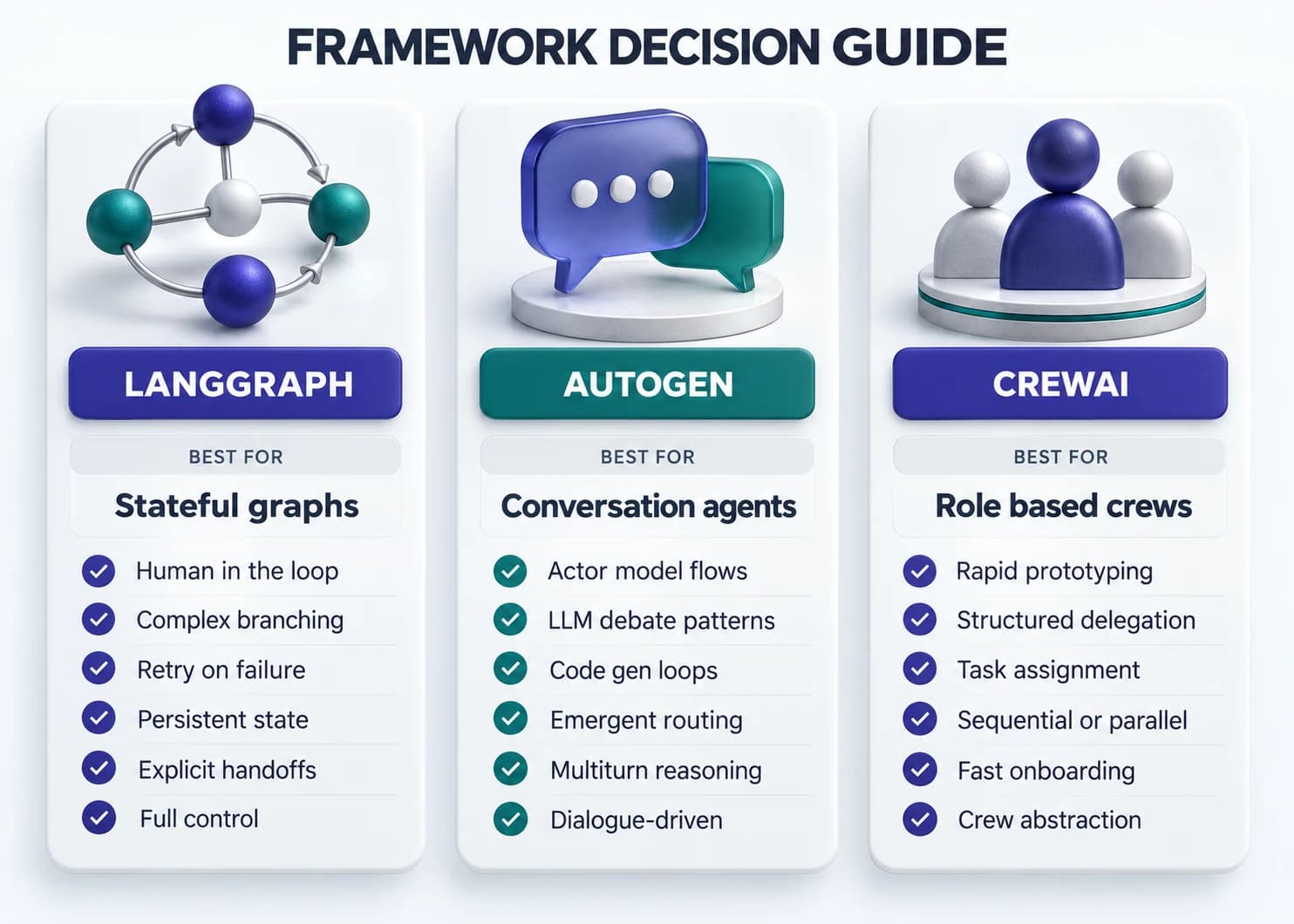
| System shape | Best framework |
|---|---|
| Branching stateful workflow with conditional routing | LangGraph |
| Agent that must loop and retry on failure | LangGraph |
| Human in the loop checkpoints at defined positions | LangGraph |
| Long running task requiring state persistence across restarts | LangGraph |
| LLM debate, critique, or coder and executor pattern | AutoGen |
| Coordination logic that emerges from agent dialogue | AutoGen |
| Code generation with execution and evaluation loop | AutoGen |
| Fast prototype of a delegation crew | CrewAI |
| Structured pipeline with clear role decomposition | CrewAI |
| Teams new to multiagent frameworks | CrewAI |
A key clarifying question: do you know the routing logic in advance? If yes, LangGraph is likely the right model — you define that logic as edges. If the routing emerges from LLM outputs dynamically, AutoGen or CrewAI's higher-level model may serve better. If you are still discovering the right agent decomposition, start with CrewAI and migrate once the shape is clear.
Section 06 · Failure modes
Production failure modes by framework
Each framework has a characteristic failure mode in production. Knowing these in advance prevents the most common class of rewrite.
LangGraph failure modes
Infinite loops without convergence conditions
A LangGraph agent that cannot satisfy its goal will call tools and cycle indefinitely until it hits an API cost limit. Always define a max steps counter or a convergence check on every conditional loop edge before shipping to production.
In-memory state lost on restart
LangGraph's default state is in-process memory. A process restart erases everything. For any agent that runs longer than a single HTTP request lifetime, wire the checkpointer to a Postgres or Redis backend before going to production.
Graph definition drift
As product requirements change, the graph definition accumulates edges and nodes that were correct for an earlier version of the flow. Without disciplined graph review as part of the change process, LangGraph workflows become harder to reason about than the spaghetti they replaced.
AutoGen failure modes
Non-deterministic termination
AutoGen conversations terminate when a condition is met — a keyword appears, a max-turn count is hit, or an agent signals completion. Poorly specified termination conditions cause conversations to run over budget or cut off before producing useful output.
Agent hallucination amplification
In a conversation actor model, one agent's hallucinated output becomes the input for the next agent. Errors compound across turns. Without evaluation checkpoints and output validation between agents, a single bad LLM call can corrupt the entire downstream result.
CrewAI failure modes
Abstraction layer debugging difficulty
When a CrewAI crew fails, the error surfaces through the crew orchestration layer. Finding the underlying cause requires inspecting verbose logs or adding custom callbacks. Teams that start with CrewAI often underestimate the debugging cost at production scale.
Control ceiling reached mid-project
The most predictable CrewAI failure mode: a team builds a working prototype, tries to add a specific production requirement, and discovers the abstraction cannot express it cleanly. Plan for the possibility of a migration to LangGraph when the system reaches production complexity.