Section 01 · Why APM falls short
Why standard APM tools fall short for LLM systems
If you have instrumented a production web application with Datadog, New Relic, or CloudWatch, you know what these tools are good at: request latency, error rates, CPU and memory, database query times. They give you a picture of whether your system is up and whether it is slow.
Quick answer
In one sentence: LLM observability is the practice of instrumenting a production AI system to capture traces, token usage, latency, and output quality metrics at the LLM call level, giving you the visibility to debug failures, control costs, detect quality degradation, and satisfy compliance requirements that standard application monitoring tools cannot address.
Standard APM tools tell you almost nothing useful about an LLM system. When an LLM call fails or produces a bad output, the questions you need to answer are: what prompt was sent to the model? What context was retrieved and included? Which model version was called? How many tokens were consumed, and what was the cost? Did the output faithfully reflect the retrieved context, or did the model hallucinate? What was the latency at the 95th percentile across the last 1,000 queries?
Standard APM tools capture none of this. They see an HTTP request to an LLM API endpoint and a response. The content, the thing that determines whether your system is working correctly, is opaque to them.
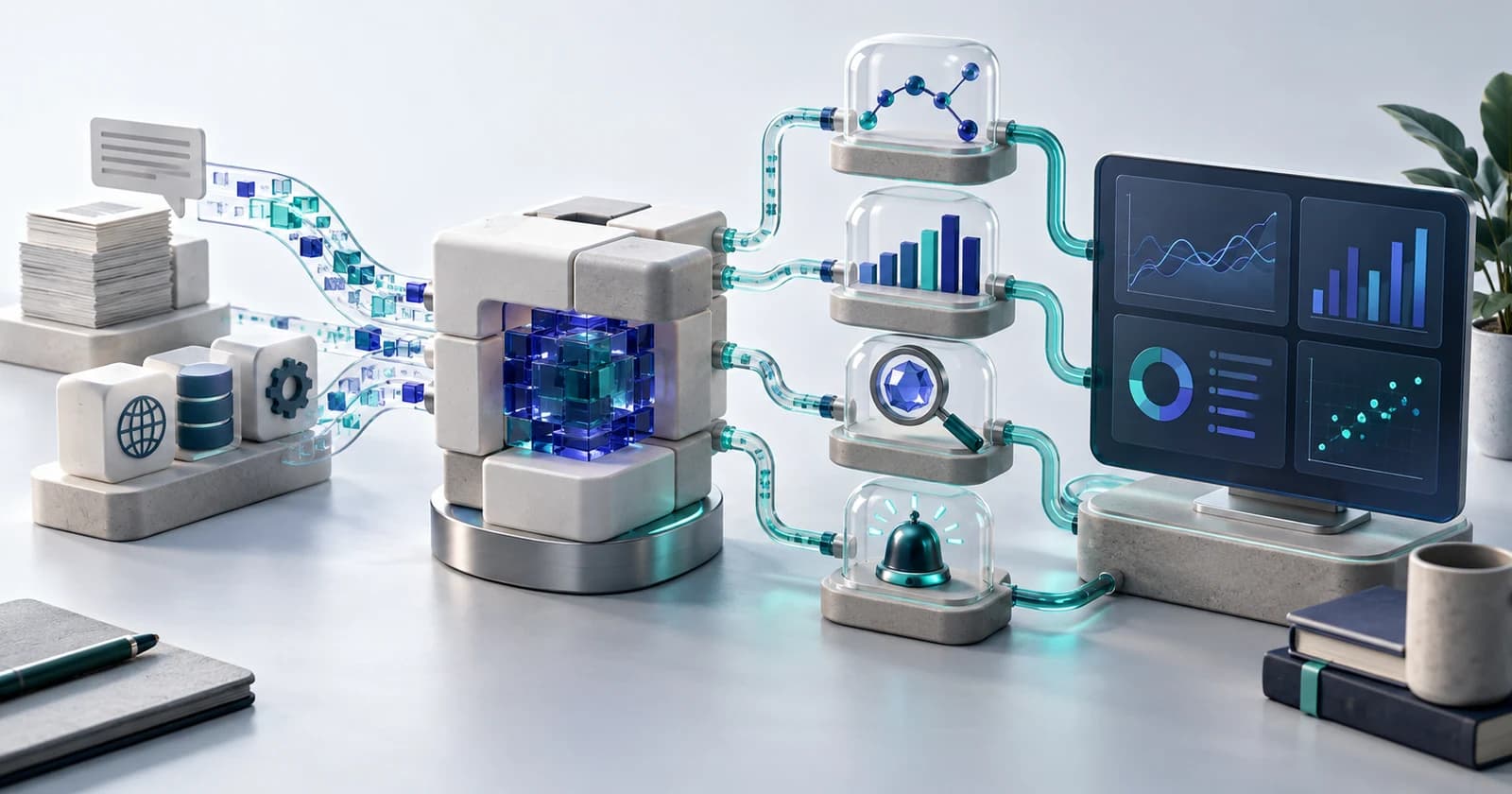
This is why LLM observability has emerged as its own category. It is not a replacement for APM; you still need to know if your servers are up. It is a parallel layer that captures the LLM specific signals that determine whether your AI system is doing what it was designed to do.
The AI governance guide for production LLM systems covers how observability fits into a broader compliance and audit framework, which is particularly relevant for regulated industries.
Section 02 · Metrics
The four metric categories that matter
Not all LLM metrics are equally useful. After instrumenting a number of production systems, four categories consistently determine whether an observability setup is actionable.
Traces and spans
A trace is the full record of one user request as it flows through your system: the initial query, the retrieval step, the prompt construction, the model call, and the final response. Each component within the trace is a span with its own timing and payload. Traces let you see exactly what happened during a specific request, essential when a user reports a bad output and you need to reconstruct the path that produced it.
Token usage and cost per query
LLM APIs charge by the token. Without per query token tracking, you have no ability to forecast cost, identify which users or query patterns are expensive, or set budget alerts before an unexpected spike hits your invoice. A query that uses 10,000 tokens costs 50 times more than a query that uses 200 tokens. You want to know which queries are in which category.
Latency at the 50th and 95th percentile
The average latency of your LLM calls is almost meaningless. The 95th percentile is the number that determines user experience under load. A system with 800ms median latency and 8,000ms p95 latency is one that a significant fraction of users experience as broken. Track p50 and p95 separately, and set alerts on p95 rather than average.
Output quality metrics
This is the hardest category and the one that most teams skip. Output quality metrics include faithfulness (does the output accurately reflect the retrieved context?), groundedness (is every claim in the output supported by source documents?), and coherence (is the output semantically sensible?). These require either a judge model call (using a second LLM to evaluate the primary one) or a reference dataset for comparison.
The LLM agent evaluation framework covers how to build evaluation pipelines that produce these metrics at scale.
Section 03 · Tools
Tool landscape: the four main options
The LLM observability tooling space is moving fast, but four tools cover the majority of production use cases.
Arize Phoenix
Open source, runs locally or on your infrastructure, and has the tightest integration with evaluation workflows. Phoenix captures traces, supports evaluation datasets, and lets you run judge model evaluations against historical traces to measure quality over time. Strong choice if you want full data control and a deep evaluation integration. Works with LangChain, LlamaIndex, and raw OpenAI or Anthropic API calls via OpenTelemetry.
Langfuse
Open source (self hosted or cloud), LangChain native via a callback handler, and very fast to set up. Langfuse captures traces and spans automatically when you add the callback to your LangChain chains. It supports user feedback collection (thumbs up or down from UI) which can seed your evaluation dataset. Strong choice for teams already in the LangChain ecosystem who want to be instrumented in under an hour.
Helicone
Proxy based: you route your LLM API calls through Helicone's proxy instead of calling the model API directly. Zero code changes required if you are calling the API directly; one environment variable swap. Captures cost, latency, and token metrics automatically. Does not require you to instrument your application. Weaker on evaluation and trace level debugging than Phoenix or Langfuse. Strong choice for fast setup with minimal engineering effort, especially if you have a mix of model providers.
Datadog LLM Observability
Managed, enterprise compliance focus, integrates with Datadog's existing APM and alerting infrastructure. Strong choice if you are already a Datadog shop and want LLM observability in the same platform as your infrastructure monitoring. More expensive than the open source options. Has the strongest compliance and audit log story for regulated industries.
| Tool | Model | Setup effort | Evaluation depth | Compliance story |
|---|---|---|---|---|
| Arize Phoenix | Open source | Medium | High | Self hosted |
| Langfuse | Open source | Low (LangChain) | Medium | Self hosted or cloud |
| Helicone | SaaS | Very low | Low | Cloud |
| Datadog LLM Obs | SaaS | Medium | Medium | Enterprise managed |
Section 04 · Implementation
How to wire observability into a LangChain or LangGraph stack
The mechanics depend on which tool you choose, but the pattern is similar across all of them: instrument at the chain or graph level, not at the individual model call level.
With Langfuse and LangChain. Initialize a callback handler with your public and secret keys, then pass it into the chain invocation as part of the callbacks config. The callback handler intercepts every LangChain event, model calls, retrieval steps, tool invocations, and logs them to Langfuse. No other code changes required.
With Arize Phoenix and LangGraph. Phoenix uses OpenTelemetry. You register a tracer provider once at application startup with a project name and the Phoenix collector endpoint. LangGraph instruments automatically once the tracer provider is registered. Every node execution becomes a span in the trace.
With Helicone. Replace the base URL in your OpenAI or Anthropic client initialization to point at the Helicone proxy endpoint, and pass your Helicone auth key in the default headers. All subsequent API calls route through Helicone's proxy and appear in the dashboard automatically.
The important point: instrument at the start of the project, not after something goes wrong. Retroactively instrumenting a production LLM system to debug a live issue is frustrating in proportion to how much it would have cost to add from the beginning.
Section 05 · Compliance
Regulated industries and compliance
For healthcare, finance, and legal applications, LLM observability serves two functions that go beyond engineering convenience: it is the audit trail that demonstrates your AI system behaved as designed, and it is the detection layer that identifies compliance violations before they scale.
In practice this means: every LLM call must be logged with the full prompt, the retrieved context, the model response, and a timestamp. The log must be tamper evident (immutable once written) and retained for the regulatory period applicable to your industry. Any output that triggered a human review should link the review decision back to the original LLM trace.
Self hosted tools (Phoenix, Langfuse) give you full control over where logs are stored and who has access. Datadog LLM Observability's enterprise tier has SOC 2 and HIPAA compliance documentation if your organization requires managed infrastructure with formal compliance certifications.
If you are building for a regulated industry and are not sure how observability fits into your broader AI governance framework, the AI systems architecture service covers compliance aware system design as a first class concern.