Section 01 · The Problem
When retrieval ignores business rules
A RAG system can retrieve the right topic from the wrong tenant, the wrong date window, or a document the user is not authorized to see — and sound completely confident doing it.
Quick answer
How does metadata filtering work in RAG? Metadata filtering restricts which documents a vector store searches at query time. You attach structured fields to documents at ingest, then apply filter conditions when querying. The filter can run before vector search (prefilter), after it (postfilter), or both — each approach trades recall, latency, and cost differently.
A RAG system that returns semantically correct but scopally wrong results fails in the worst possible way. The answer looks good. The source documents are real. The model is confident. And the content belongs to a different tenant, a deprecated policy version, or a document the user is not authorized to see.
Most RAG bugs fall into two categories: embedding quality and retrieval scope. Embedding quality gets the attention because it is visible in evaluation runs. Retrieval scope gets overlooked until it causes an incident — a support agent surfacing a competitor's SLA from a shared knowledge base, or a healthcare RAG retrieving a patient record outside the permitted care team.
Metadata filtering is the mechanism that enforces scope. You attach structured fields to each document at ingest time — tenant ID, document type, date, region, access tier, or any dimension relevant to your domain — and then filter by those fields at query time. The filter decides which documents the vector store even considers. Get the filter strategy wrong and you pay in recall (the right answer is indexed but filtered out) or in precision (the wrong scope answer makes it through).
The four strategies below are not a menu of equal options. They occupy different positions in the recall, latency, and cost space, and the right choice depends on the strictness of your rule, the size of your filtered corpus, and what failure mode you can tolerate.
Section 02 · Strategy One
Prefilter: narrow the candidate set before vector search
The vector store applies your filter first, then runs similarity search only within the passing documents.
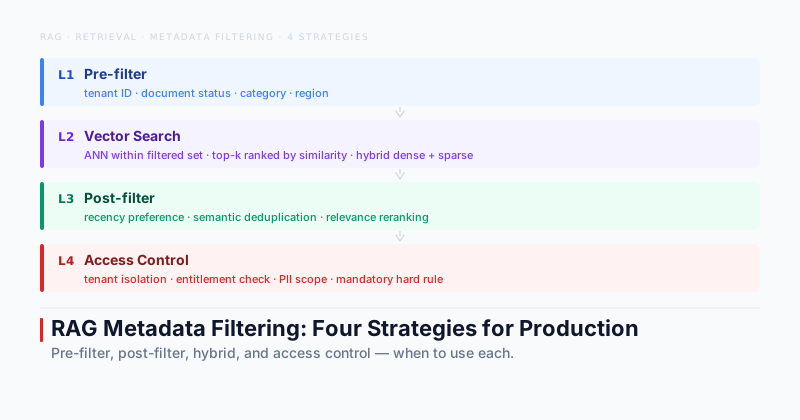
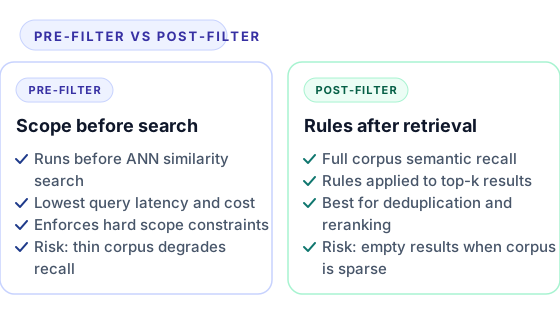
Prefilter applies the metadata condition before the similarity search runs. The vector store first applies the filter to its index, then runs approximate nearest neighbor search only within the passing documents.
This is the fastest and most compute efficient strategy. The similarity search operates on a smaller candidate pool, which reduces both index traversal time and the number of embeddings compared. For large corpora where the filter carves out a well-populated subset, prefilter performs well on both precision and latency.
The risk is recall degradation. If the filter is too narrow — a date window with few documents, a niche category tag, or a combination of multiple strict conditions — the candidate pool shrinks until the similarity search has too little to work with. The model returns a confident but thin answer, or nothing at all, because the relevant documents are filtered before they can be compared semantically.
Prefilter is the right default for dimensions where the filter carves a meaningful but not trivially small partition of the corpus: tenant ID in a multitenant system, document category in a well-populated taxonomy, or region in a geographically partitioned knowledge base. The signal that prefilter is working is high retrieval precision with low latency. The signal that it is failing is a high rate of empty result sets or answers that seem to miss obviously relevant context.
One operational note: the effectiveness of prefilter depends on how your vector database indexes metadata. Most production systems — Pinecone, Qdrant, Weaviate, Chroma — support filtered ANN (approximate nearest neighbor) with varying index structures. Some use inverted indexes over metadata fields for fast cardinality based partitioning; others run the filter as a downstream pass over ANN results despite the name. Know which mode your database uses, because the latency profile differs.
Section 03 · Strategy Two
Postfilter: let semantics lead, rules follow
Run the full similarity search first, then apply your metadata conditions to the retrieved result set.
Postfilter inverts the order: the similarity search runs first across the full index, returning the top k candidates, and the metadata filter is applied to that result set after retrieval.
The benefit is maximum semantic recall. The embedding model has the full corpus to search, so it can surface documents that a strict prefilter would have excluded. If your corpus is sparse or your metadata taxonomy is imprecise, postfilter gives the similarity search the best possible chance of finding relevant content.
The failure mode is empty results at the worst moment. If the top k results all fail the filter condition, the final answer set is empty. The user asked a question, the RAG system retrieved semantically relevant documents, and then threw them all away because none were in the permitted scope. This tends to happen when the filter condition is strict and the corpus distribution is uneven — most of the indexed content on this topic happens to sit in the wrong partition.
Postfilter is the right choice when semantic relevance is more important than filter enforcement speed, the corpus is small enough that a full similarity search is inexpensive, or the filter condition is loose enough that most top k results will pass. Semantic deduplication is a natural fit: you run similarity search first to find candidates, then postfilter to remove results that are too similar to each other, keeping only the most distinct documents in the final context.
The k inflation trick is the standard production patch for empty postfilter results: retrieve more candidates than you need (top 50 instead of top 5) so the filter has more material to work with. This increases compute cost but reduces the chance of a zero result set. If you find yourself inflating k significantly to avoid empty sets, that is a signal to move to hybrid.
Section 04 · Strategy Three
Hybrid pre+post: the production default
A prefilter enforces hard scope constraints. A postfilter shapes the final result set composition. Most production RAG systems need both.
Hybrid combines both passes. A prefilter restricts the candidate pool to the permitted scope, the similarity search runs within that pool, and a postfilter enforces additional rules on the result set.
This is the default for most production RAG systems because it handles the failure modes of both approaches without requiring a choice between them. The prefilter enforces hard scope constraints — tenant, authorization, mandatory dimensions — while the postfilter handles softer constraints that benefit from seeing the semantic ranking first.
A typical hybrid implementation for a multitenant document assistant: prefilter by tenant ID and document status (active only), run similarity search to get the top 20 candidates, then postfilter by recency or user preference. The prefilter guarantees isolation; the postfilter shapes the context window composition.
The design question in hybrid is which conditions belong in the prefilter and which belong in the postfilter. The rule of thumb: conditions that are categorical, high cardinality, and non negotiable go in the prefilter. Conditions that are ranked, fuzzy, or context dependent go in the postfilter. Authorization and tenant isolation always belong in the prefilter — never in the postfilter, where a system bug could let a semantic match slip through before the rule is applied.
Hybrid adds complexity to the query pipeline, but the operational overhead is manageable. Most vector database SDKs support chained filter conditions, and the most important hygiene is documenting which conditions run at which stage so that future engineers do not accidentally migrate an authorization check to the downstream pass.
Section 05 · Strategy Four
Structured only: when vectors cannot enforce hard rules
Some retrieval requirements need deterministic exact-match lookups, not approximate similarity search.
Some retrieval requirements cannot be satisfied by approximate vector search, regardless of filter strategy. When the requirement is exact match — return this specific document ID, this exact version, this record with these precise field values — a structured only query is more reliable than asking a vector store to get it right semantically.
Structured only filtering skips the similarity search entirely and queries the metadata fields directly, much like a SQL WHERE clause. The result is deterministic: the system returns exactly the documents whose fields match the condition, in whatever order the index specifies.
This is the right strategy for compliance driven retrieval. A contract system that must return the exact current version of a policy document cannot afford approximate matching — retrieving an older version that is semantically close to the current one introduces liability. A financial system that must pull a specific transaction record needs an exact ID lookup, not a document that looks like the right transaction.
Structured only also handles date exact retrieval, jurisdiction exact regulatory lookups, and any domain where the retrieval requirement is a specification rather than a search. The downside is that it cannot handle queries where the user does not know the exact identifier — for those, you need semantic search back in the loop. Hybrid systems often use structured only as a first pass to handle the easy cases, and fall back to prefiltered similarity search when no exact match is found.
Section 06 · Special Case
Access control: the highest stakes filter of all
Tenant isolation, entitlement, and PII scope constraints are not retrieval preferences. They are hard prefilters that must run before any semantic search.
Access control filtering is in a category by itself, not because the mechanics differ, but because the consequences of getting it wrong are categorically different from a recall miss.
Tenant isolation, entitlement checks, and PII scope constraints must run as hard prefilters — mandatory, non negotiable, applied before any semantic search. There is no hybrid approach where an authorization check runs post retrieval. If a semantic match surfaces a document the user is not permitted to see before the authorization check runs, you have already exposed that document to the model. Whether or not the model surfaces it in its response, the data has been processed.
The correct implementation is an authorization filter that is injected at the infrastructure layer, not at the application layer. The query pipeline should receive the user's resolved permissions as a structured filter condition — a list of permitted tenant IDs, document access tiers, or entitlement tags — and that condition is merged with every query before it reaches the vector store. Application code should not be able to issue a query without the authorization filter, because any code path that bypasses it becomes a vulnerability.
Tenant isolation in a multitenant RAG system is the most common access control requirement. The standard pattern is a tenant scoped namespace or collection per tenant in the vector database, or a tenant ID field that is enforced as a mandatory prefilter on every query. Namespace isolation is more robust because it makes cross tenant access structurally impossible; field based filtering is more flexible but requires enforcement discipline.
Entitlement filtering handles cases where different users within the same tenant have different document access. A knowledge base where some documents are restricted to senior staff requires a field that encodes the required entitlement level, enforced as a prefilter using the requesting user's resolved entitlements. PII scope constraints follow the same pattern — documents containing personal data are tagged at ingest, and the filter enforces that only users with the appropriate data processing role can retrieve them.
The AI governance framework for production LLMs covers the broader compliance layer that access control filters fit into. If your RAG system operates in a regulated domain — healthcare, finance, legal — access control filtering is not an engineering optimization, it is a compliance requirement with a documented audit trail.
Section 07 · Decision Guide
Choosing the right strategy
Most production systems use more than one strategy. The question is which filter type handles which query condition.
The four strategies are not mutually exclusive and most production systems use more than one. The question is which filter type handles which query condition.
Start with authorization. Any condition that concerns who is allowed to see this document goes into a mandatory prefilter, enforced at the infrastructure layer, before any other filter runs.
For business rule filters — date range, document category, geographic scope, status — the default is prefilter unless the filter carves out a corpus that is too small for reliable retrieval. A date window of the last seven days on a corpus with ten thousand active documents works well as a prefilter. The same filter on a corpus with eighty documents produces sparse results and belongs in a hybrid pass with a wider prefilter and a date postfilter to prefer recent results.
Postfilter earns its place when semantic relevance needs to run first — semantic deduplication, relevance weighted blending, or any condition that depends on seeing the ranked results before applying the rule.
Structured only handles the cases where you know exactly what you are looking for and approximate matching would introduce correctness risk.
A well-designed chunking strategy determines what metadata is available to filter on. If documents are chunked without preserving tenant ID, document date, or access tier in the chunk metadata, no filter strategy can enforce those constraints. The ingest pipeline and the query pipeline have to be designed together — the filters you need at query time must be stored at ingest time.
The hybrid search approach extends this further: when you combine dense vector search with sparse lexical search, the filter conditions apply to both retrieval passes, and the metadata at ingest needs to support both retrieval modes.
If you are designing a RAG system with complex access control requirements or a multitenant isolation model, the AI Systems Architecture service covers the full design — ingest pipeline, vector store configuration, filter enforcement, and audit logging.