Section 01 · Definition
What arrays with loops actually mean
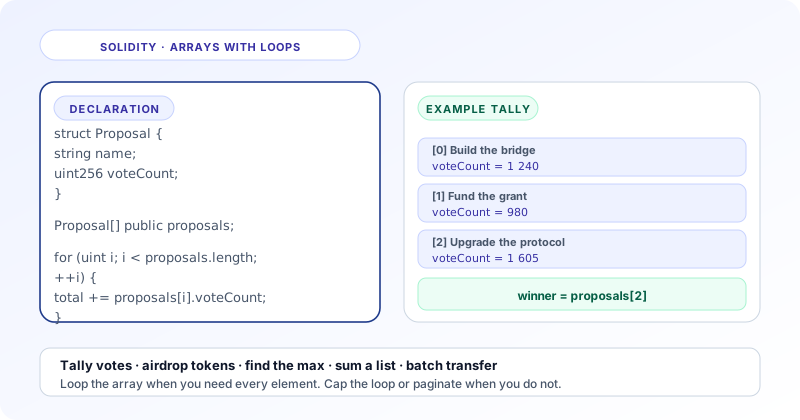
An array on its own holds the data. A loop walks the data. Putting the two together is how you compute over a list of records on chain — but every iteration costs gas, so the safety question matters as much as the syntax.
Quick answer
What is a loop in Solidity? A loop in Solidity is a control flow statement that repeats a block of code while a condition holds. The three available shapes are for, while, and do while. Loops are most often used to walk an array, sum a running total, find a maximum, or perform a batch operation. Every iteration consumes gas, so loop bounds must be small or paginated to avoid hitting the block gas limit.
The pattern is everywhere: tallying votes across proposals, computing the total supply of a token across holders, finding the highest bidder in an auction, distributing a reward to a list of recipients. All of them are arrays plus loops.
uint256[] public scores;

function totalScore() external view returns (uint256 total) {
    uint256 len = scores.length;          // cache once
    for (uint256 i; i < len; ++i) {
        total += scores[i];
    }
}
That five line function shows the canonical shape: declare the array, cache its length, set up a counter, walk the indices, accumulate. Every other loop in this guide is a variation of this pattern with a different body.
For the standalone primitives, see arrays in Solidity and mapping in Solidity. This piece assumes you know how to declare an array and focuses on the iteration patterns you will actually write in production.
Section 02 · Syntax
for, while, and do while in Solidity
The three loop shapes look almost exactly like their JavaScript or C counterparts. Pick the one that matches your stop condition, then cache the length and use unchecked where you can prove safety.
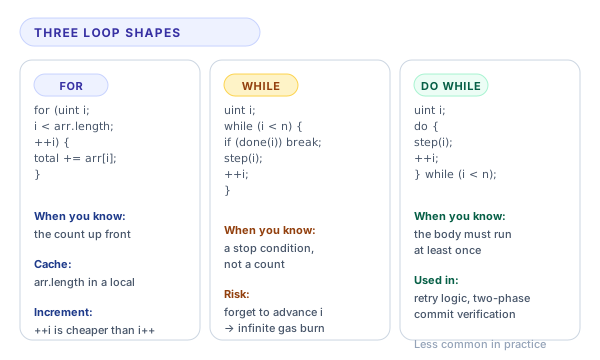
The for loop is the workhorse. You declare the counter, the stop condition, and the increment all in one line, and the body runs as long as the condition holds.
for (uint256 i; i < arr.length; ++i) {
    // body
}
The while loop is for cases where you do not know the iteration count up front. A delegation chain walk, a binary search, or a state driven retry loop are typical examples.
address current = msg.sender;
while (delegations[current] != address(0)) {
    current = delegations[current];
}
// current is now the head of the delegation chain
The do while loop runs the body once before checking the condition. It rarely appears in on chain code because most Solidity loops require the condition to hold from the start. You may see it in retry helpers and verification routines that must execute one iteration unconditionally.
Three optimisations every loop should have
First, cache arr.length in a local variable before the loop — repeated SLOAD reads on a storage array are wasteful. Second, prefer ++i over i++ because the prefix form does not create a temporary copy. Third, wrap the increment in unchecked { ++i; } when you can prove the counter cannot overflow, which it cannot if the loop bound is anything practical. Together these three changes cut a typical loop's gas by 15 to 30 percent.
Section 03 · Worked example
Tallying votes across an array of proposals
The companion to the voting registry from the mapping piece. Here the goal is to find the proposal with the highest vote count by iterating the proposals array.
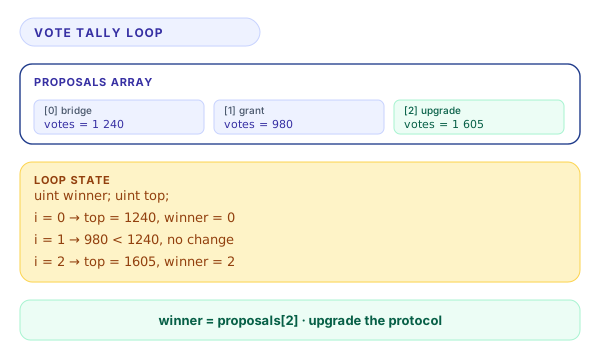
You already have the mapping with struct setup from the companion piece on mapping with struct. Two structs, two mappings, and a parallel proposals array. The contract now needs a function that returns which proposal won. That is a for loop with a running max:
struct Proposal {
    bytes32  name;
    uint128  voteCount;
    uint64   endsAt;
}

Proposal[] public proposals;

function winningProposal()
    public
    view
    returns (uint256 winnerIndex)
{
    uint256 winningCount;
    uint256 len = proposals.length;
    for (uint256 i; i < len; ++i) {
        if (proposals[i].voteCount > winningCount) {
            winningCount = proposals[i].voteCount;
            winnerIndex = i;
        }
    }
}

function winnerName() external view returns (bytes32) {
    return proposals[winningProposal()].name;
}
A few details earn their keep. The function is view, so calling it through eth_call costs the user no real gas. The loop reads each proposal once. If two proposals tie, the first one found wins because the comparison is strict greater than. This matches the behaviour of the canonical OpenZeppelin governor contract, where ties are resolved by declaration order.
What if you also want to know how many votes the winner received? Return both:
function winnerWithCount()
    external
    view
    returns (uint256 winnerIndex, uint256 winningCount)
{
    uint256 len = proposals.length;
    for (uint256 i; i < len; ++i) {
        if (proposals[i].voteCount > winningCount) {
            winningCount = proposals[i].voteCount;
            winnerIndex = i;
        }
    }
}
That is the same loop with two named return values. The compiler initialises both to zero, so the first iteration always sets them. The pattern generalises to any walk that returns running aggregates: total supply, average, count above a threshold, first matching index.
Section 04 · Common patterns
Six loop patterns you will write again and again
Different problems call for different loop bodies. These six cover the great majority of array iteration you will do on chain.
Sum a running total
Add every element into an accumulator. Used for total supply across holders, total stake across positions, total fees collected. The body is one line: total += arr[i]. Bound the array size or you will hit the gas limit.
Find the maximum or minimum
Track a running winner and update it when a new element beats the current best. Used for vote tallies, top bidder lookups, highest grade in a registry. Always specify tie breaking behaviour explicitly so the contract is deterministic.
Filter into a memory array
Walk the storage array and copy matching elements into a fresh memory array. Memory is cheaper to write than storage. Useful when an off chain caller wants only the active proposals, the unsold NFTs, or the holders above a threshold.
Swap and pop to remove an element
Replace the element at index i with the last element, then pop. This avoids the O(n) shift you would need with delete. Standard for keeping the registered voters list compact when someone unregisters.
Batch transfer or batch update
Walk a list of recipients and perform a small operation on each: send a token, increment a counter, set a flag. ERC1155 batch operations and many airdrop contracts use this shape. Cap the batch size in the function signature to avoid the unbounded loop bug.
Walk a delegation or chain
Use a while loop that follows pointers from one record to the next until it reaches a terminator. Vote delegation chains, position liquidation queues, and linked list patterns all use this shape. Always bound the walk with a safety counter that reverts after a maximum number of hops.
Section 05 · The big bug
Why unbounded loops are the most expensive Solidity mistake
If you remember one thing from this guide, remember this: a loop whose bound is controlled by users will eventually exceed the block gas limit, at which point every call to the function reverts and the contract logic becomes permanently broken.
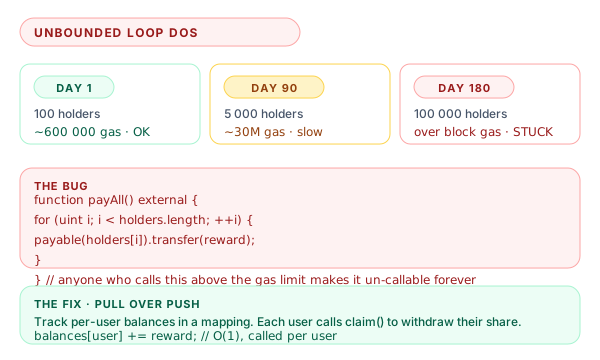
The pathology is always the same. A function loops over an array. The array grows over time as users register, claim, or stake. The gas cost grows linearly with the array length. At some point the cost exceeds the block gas limit (currently 30 million on Ethereum mainnet), and from that moment every transaction calling the function reverts before it can finish. There is no upgrade path that does not involve migrating state to a new contract.
// DO NOT WRITE THIS in production.
//
// distributeRewards loops over every holder. The contract works fine
// at 100 holders. At 100 000 holders the function becomes uncallable
// forever and the rewards locked in the contract are stuck.
function distributeRewards() external {
    uint256 perUser = address(this).balance / holders.length;
    for (uint256 i; i < holders.length; ++i) {
        payable(holders[i]).transfer(perUser);
    }
}
User controlled array length
Any array that grows whenever a user calls a public function is a candidate for this bug. Voter registries, holder lists, NFT mint trackers, leaderboards. If a malicious actor can pad the array with fake entries, the bug is even easier to trigger.
External calls inside the loop
transfer, call, and any external interaction inside a loop multiplies the per iteration cost by the cost of the called function. An expensive external call combined with a long array hits the gas limit fast. It is also a reentrancy surface.
Reverting on a single failure
A loop that reverts the entire transaction when one element fails is brittle. One bad recipient or one rejected transfer takes down the whole batch. Either skip and emit, or pay each recipient through a pull pattern instead.
Section 06 · The safe alternative
Two fixes: pagination and pull over push
When an unbounded loop becomes a risk, you have two well known workarounds. They cover almost every real case.
The first fix is pagination. Instead of one function that walks the entire array, expose a function that walks a window. The caller passes the start index and the count, the function processes that slice, and a separate state variable tracks the next start. This works well for one time operations like distributing a fixed reward pool.
uint256 public nextRecipient;

function distributeBatch(uint256 batchSize) external {
    uint256 end = nextRecipient + batchSize;
    if (end > holders.length) end = holders.length;
    for (uint256 i = nextRecipient; i < end; ++i) {
        payable(holders[i]).transfer(rewardPerUser);
    }
    nextRecipient = end;
}

function distributionDone() external view returns (bool) {
    return nextRecipient == holders.length;
}
The second fix, almost always preferred, is pull over push. Track per user balances in a mapping and let each user pull their own share when they want it. This shifts the gas cost from the protocol to each user, eliminates the loop entirely, and removes the reentrancy surface created by external calls inside a batch.
mapping(address => uint256) public claimable;

function recordReward(address user, uint256 amount) external onlyAuthorized {
    claimable[user] += amount;
}

function claim() external {
    uint256 amount = claimable[msg.sender];
    require(amount > 0, "nothing to claim");
    claimable[msg.sender] = 0;        // effects before interactions
    payable(msg.sender).transfer(amount);
    emit Claimed(msg.sender, amount);
}
The pull pattern is exactly the mapping with struct shape from the companion piece. You replace one expensive batch loop with one O(1) write per user during accrual, and one O(1) withdraw per user during claim. The total work done across all users is the same. The difference is that no single transaction has to do all of it.
Section 07 · Full contract
Complete example: StudentRegistry smart contract
A school grade tracker where a teacher registers students with scores. The contract uses for loops for all four common array patterns: compute the class average, find the top student, filter passing students, and batch update grades. Deploy on Remix, add five students, and try every read function.
// SPDX-License-Identifier: MIT
pragma solidity ^0.8.24;

/// @title StudentRegistry
/// @notice On-chain grade tracker demonstrating four array + for-loop patterns:
///         1. Accumulate  — class average
///         2. Find max    — top student
///         3. Filter      — passing students
///         4. Batch write — bulk grade update
///         Capped at MAX_STUDENTS to keep loops gas-safe.
contract StudentRegistry {

    // ── Constants ────────────────────────────────────────────────────
    uint256 public constant MAX_STUDENTS   = 50;
    uint256 public constant PASSING_SCORE  = 50;

    // ── State ────────────────────────────────────────────────────────
    address public teacher;

    struct Student {
        string  name;
        uint256 score;   // 0–100
        bool    active;
    }

    Student[]                        public students;
    mapping(address => uint256)      public studentIndex;  // wallet => array index
    mapping(address => bool)         public isRegistered;

    // ── Events ───────────────────────────────────────────────────────
    event StudentAdded(uint256 indexed index, string name, address wallet);
    event ScoreUpdated(uint256 indexed index, uint256 newScore);
    event BatchScoreUpdated(uint256 count);

    // ── Modifiers ────────────────────────────────────────────────────
    modifier onlyTeacher() {
        require(msg.sender == teacher, "not teacher");
        _;
    }

    constructor() { teacher = msg.sender; }

    // ── Write ────────────────────────────────────────────────────────

    /// Register a new student with an initial score.
    function addStudent(
        address _wallet,
        string calldata _name,
        uint256 _score
    ) external onlyTeacher {
        require(students.length < MAX_STUDENTS, "class full");
        require(!isRegistered[_wallet],         "already registered");
        require(_score <= 100,                  "score must be 0-100");

        studentIndex[_wallet] = students.length;
        isRegistered[_wallet] = true;
        students.push(Student({ name: _name, score: _score, active: true }));
        emit StudentAdded(students.length - 1, _name, _wallet);
    }

    /// Update the score of a single student.
    function updateScore(uint256 _index, uint256 _score) external onlyTeacher {
        require(_index < students.length, "invalid index");
        require(_score <= 100,            "score must be 0-100");
        students[_index].score = _score;
        emit ScoreUpdated(_index, _score);
    }

    /// Pattern 4: batch write — update all scores at once from an array.
    /// The scores array must match the students array length exactly.
    function batchUpdateScores(uint256[] calldata _scores) external onlyTeacher {
        uint256 len = students.length;
        require(_scores.length == len, "length mismatch");
        for (uint256 i = 0; i < len; ) {
            require(_scores[i] <= 100, "score must be 0-100");
            students[i].score = _scores[i];
            unchecked { ++i; }
        }
        emit BatchScoreUpdated(len);
    }

    // ── Read ─────────────────────────────────────────────────────────

    /// Pattern 1: accumulate — compute the class average score.
    function classAverage() external view returns (uint256 average) {
        uint256 len = students.length;
        if (len == 0) return 0;
        uint256 total;
        for (uint256 i = 0; i < len; ) {
            total += students[i].score;
            unchecked { ++i; }
        }
        average = total / len;
    }

    /// Pattern 2: find max — return the top-scoring student.
    function topStudent()
        external view
        returns (string memory name, uint256 score, uint256 index)
    {
        uint256 len = students.length;
        require(len > 0, "no students");
        for (uint256 i = 0; i < len; ) {
            if (students[i].score > score) {
                score = students[i].score;
                name  = students[i].name;
                index = i;
            }
            unchecked { ++i; }
        }
    }

    /// Pattern 3: filter — return only students whose score >= minScore.
    function passingStudents(uint256 minScore)
        external view
        returns (string[] memory names, uint256[] memory scores)
    {
        uint256 len = students.length;

        // First pass: count qualifiers.
        uint256 count;
        for (uint256 i = 0; i < len; ) {
            if (students[i].score >= minScore) {
                unchecked { ++count; }
            }
            unchecked { ++i; }
        }

        // Second pass: fill result arrays.
        names  = new string[](count);
        scores = new uint256[](count);
        uint256 j;
        for (uint256 i = 0; i < len; ) {
            if (students[i].score >= minScore) {
                names[j]  = students[i].name;
                scores[j] = students[i].score;
                unchecked { ++j; }
            }
            unchecked { ++i; }
        }
    }

    /// Return the total number of registered students.
    function studentCount() external view returns (uint256) {
        return students.length;
    }

    /// Return all student names and scores in one call.
    function allStudents()
        external view
        returns (string[] memory names, uint256[] memory scores)
    {
        uint256 len = students.length;
        names  = new string[](len);
        scores = new uint256[](len);
        for (uint256 i = 0; i < len; ) {
            names[i]  = students[i].name;
            scores[i] = students[i].score;
            unchecked { ++i; }
        }
    }
}
Quick Remix walkthrough: deploy, call addStudent five times with scores 45, 70, 85, 50, 60, then try classAverage (returns 62), topStudent (returns the student with 85), and passingStudents(50) (returns the four students at 70, 85, 50, 60). Each function is a different for loop pattern reading the same underlying array.
Section 08 · The third option
When the right answer is to not loop on chain at all
Some computations are simply too expensive to do on chain. The fix is to compute the result off chain, then post just the answer.
If your loop produces a single number — a Merkle root, a sum, an aggregate score — you can compute that number off chain and submit it on chain along with a proof. The contract verifies the proof in constant time and stores the result. This is how every serious airdrop is structured in 2026.
bytes32 public merkleRoot;

function setRoot(bytes32 newRoot) external onlyOwner {
    merkleRoot = newRoot;
}

function claim(uint256 amount, bytes32[] calldata proof) external {
    bytes32 leaf = keccak256(abi.encodePacked(msg.sender, amount));
    require(verify(proof, merkleRoot, leaf), "bad proof");
    require(!claimed[msg.sender], "already claimed");
    claimed[msg.sender] = true;
    token.transfer(msg.sender, amount);
}
Off chain you build the full holder list and compute the Merkle root. On chain you store one bytes32. Each user submits a proof of their entry, the contract verifies it in O(log n) hashes regardless of total participants, and the transfer happens. A holder list of one million users is no more expensive on chain than a list of one hundred.
Three rules for choosing the strategy
If the loop body is one cheap step and the array bound is small and fixed, write the loop on chain. If the loop body is small and the array grows over time, paginate or switch to pull over push. If the loop produces an aggregate over a large user controlled set, compute off chain and verify a proof on chain. Get this choice right and the bug class disappears entirely.