
Section 01 · Definition
What is mapping(address => bool) in Solidity?
It is a per-address flag store. Every address starts at false. You set it to true to grant approval and back to false to revoke it.
Quick answer
In one sentence: mapping(address => bool) is Solidity's standard whitelist: every address begins at false, you flip approved addresses to true, and any function can check the flag in one SLOAD before deciding whether to proceed.
The bool type occupies a single bit of meaning but a full 32-byte storage slot when stored alone. In a mapping, each address key produces a separate slot, so each flag is one slot. The cost to check a flag is exactly one SLOAD — the same as reading a uint256 balance. The flag-check itself adds negligible gas after the slot is loaded.
Beyond whitelists, the same pattern handles any one-time or binary state per address: has claimed, has registered, is paused, is operator. If the state can be answered with yes or no and it is per account, a bool mapping is the right type.
// Flag patterns — all use mapping(address => bool)
mapping(address => bool) public isWhitelisted;   // KYC / presale gate
mapping(address => bool) public hasClaimed;       // airdrop one-time claim
mapping(address => bool) public isOperator;       // delegated operator
mapping(address => bool) public isFrozen;         // freeze by admin
mapping(address => bool) public hasVoted;         // one vote per address
Section 02 · The whitelist pattern
Building a whitelist with mapping(address => bool)
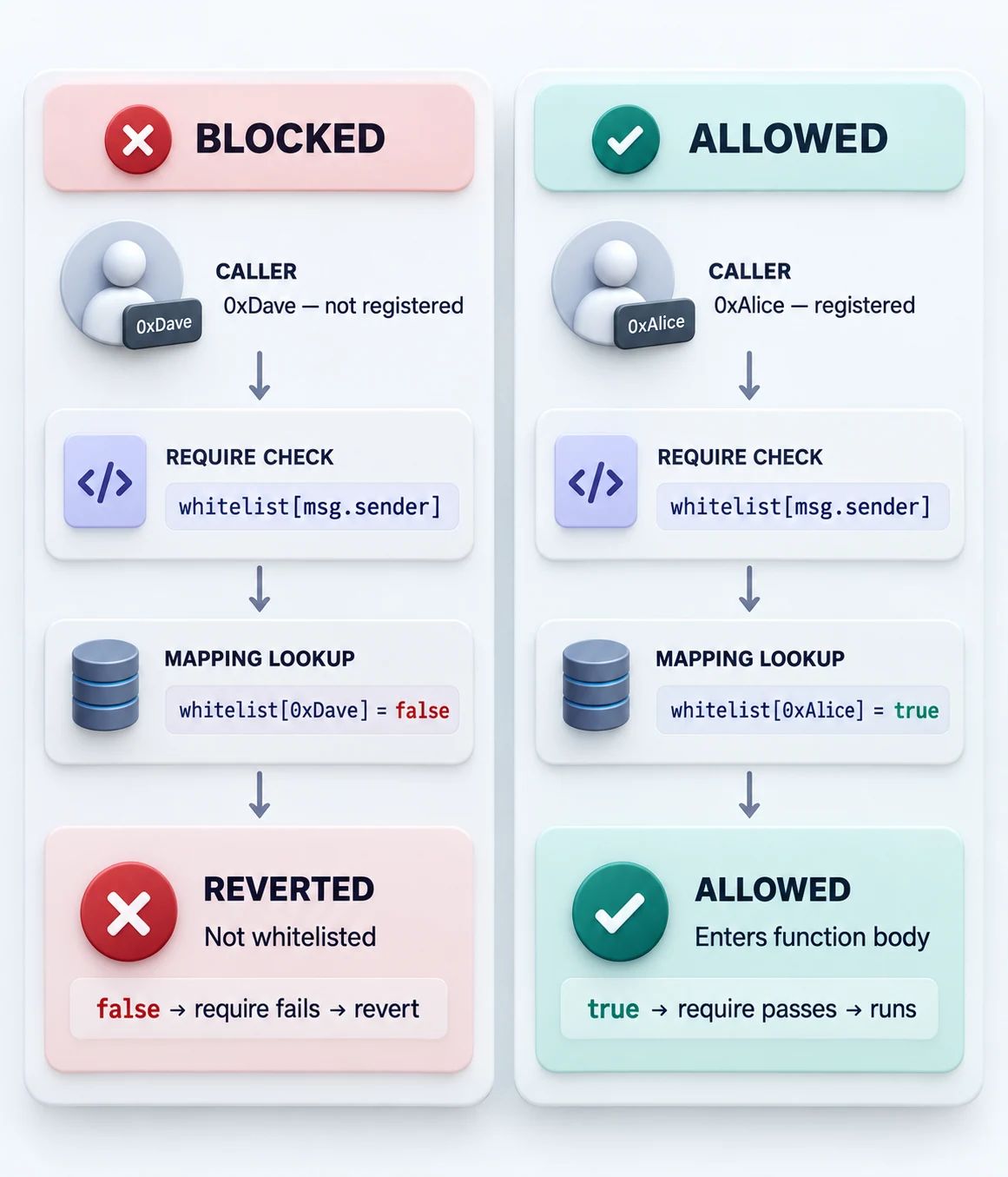
Three pieces make a complete whitelist: the mapping, a management function behind an access check, and a modifier that gates protected functions.
// SPDX-License-Identifier: MIT
pragma solidity ^0.8.24;

contract Whitelist {
    address public admin;

    mapping(address => bool) public isWhitelisted;

    event Added(address indexed account);
    event Removed(address indexed account);

    constructor() { admin = msg.sender; }

    modifier onlyAdmin() {
        require(msg.sender == admin, "not admin");
        _;
    }

    modifier onlyWhitelisted() {
        require(isWhitelisted[msg.sender], "not whitelisted");
        _;
    }

    // ── Management (admin only) ──────────────────────────────────────

    function add(address _account) external onlyAdmin {
        require(_account != address(0), "zero address");
        require(!isWhitelisted[_account], "already listed");
        isWhitelisted[_account] = true;
        emit Added(_account);
    }

    function addBatch(address[] calldata _accounts) external onlyAdmin {
        for (uint256 i = 0; i < _accounts.length; i++) {
            if (_accounts[i] != address(0) && !isWhitelisted[_accounts[i]]) {
                isWhitelisted[_accounts[i]] = true;
                emit Added(_accounts[i]);
            }
        }
    }

    function remove(address _account) external onlyAdmin {
        require(isWhitelisted[_account], "not listed");
        isWhitelisted[_account] = false;
        emit Removed(_account);
    }

    // ── Gated action ────────────────────────────────────────────────

    function protectedAction() external onlyWhitelisted {
        // only addresses in the whitelist reach this code
    }
}
addBatch is safer with a length cap
An unbounded loop over a calldata array can exceed the block gas limit if the caller passes thousands of addresses. Add a cap: require(_accounts.length <= 200, 'batch too large'). This keeps gas consumption predictable and prevents accidental or malicious denial of service on the admin function.
Section 03 · Role access control
Multiple bool mappings for role-based access
When a contract has more than two permission levels, one bool mapping per role is cleaner than a single uint8 role field.
A typical DeFi protocol has at least three actor types: the admin who sets parameters, the operator who can trigger automated actions, and the user who interacts with the protocol. Each gets its own bool mapping rather than a shared enum or integer.
// SPDX-License-Identifier: MIT
pragma solidity ^0.8.24;

/// @title RoleAccess — multi-role access control via bool mappings
contract RoleAccess {
    address public owner;

    mapping(address => bool) public isAdmin;
    mapping(address => bool) public isOperator;
    mapping(address => bool) public isMinter;

    event RoleGranted(string role, address indexed account);
    event RoleRevoked(string role, address indexed account);

    constructor() {
        owner = msg.sender;
        isAdmin[msg.sender] = true;
    }

    modifier onlyOwner() {
        require(msg.sender == owner, "not owner");
        _;
    }

    modifier onlyAdmin() {
        require(isAdmin[msg.sender], "not admin");
        _;
    }

    modifier onlyOperator() {
        require(isOperator[msg.sender] || isAdmin[msg.sender], "not operator");
        _;
    }

    modifier onlyMinter() {
        require(isMinter[msg.sender] || isAdmin[msg.sender], "not minter");
        _;
    }

    // ── Role management (owner only) ─────────────────────────────────

    function grantAdmin(address _account) external onlyOwner {
        isAdmin[_account] = true;
        emit RoleGranted("admin", _account);
    }

    function grantOperator(address _account) external onlyAdmin {
        isOperator[_account] = true;
        emit RoleGranted("operator", _account);
    }

    function grantMinter(address _account) external onlyAdmin {
        isMinter[_account] = true;
        emit RoleGranted("minter", _account);
    }

    function revokeAdmin(address _account) external onlyOwner {
        require(_account != owner, "cannot revoke owner");
        isAdmin[_account] = false;
        emit RoleRevoked("admin", _account);
    }

    function revokeOperator(address _account) external onlyAdmin {
        isOperator[_account] = false;
        emit RoleRevoked("operator", _account);
    }

    function revokeMinter(address _account) external onlyAdmin {
        isMinter[_account] = false;
        emit RoleRevoked("minter", _account);
    }

    // ── Role-gated actions ───────────────────────────────────────────

    function adminAction() external onlyAdmin {
        // admin-only logic here
    }

    function operatorAction() external onlyOperator {
        // operator or admin logic here
    }

    function mintToken(address _to) external onlyMinter {
        // minter or admin logic here
    }
}
Section 04 · Full contract
Complete example: PresaleGate with bool mappings
A presale contract uses three bool mappings — whitelist approval, purchase record, and refund eligibility — wired together into one deployable contract.
// SPDX-License-Identifier: MIT
pragma solidity ^0.8.24;

/// @title PresaleGate
/// @notice Manages a token presale with whitelist, purchase tracking,
///         and refund eligibility using three bool mappings.
contract PresaleGate {

    // ── State ────────────────────────────────────────────────────────
    address public owner;
    uint256 public pricePerToken;       // in wei
    uint256 public tokensSold;
    uint256 public totalTokens;
    bool    public saleActive;

    // ── Bool mappings ────────────────────────────────────────────────
    mapping(address => bool) public isWhitelisted;    // KYC approved
    mapping(address => bool) public hasPurchased;     // one purchase per address
    mapping(address => bool) public isRefundEligible; // refund window open

    // ── Purchase records ─────────────────────────────────────────────
    mapping(address => uint256) public tokensBought;
    mapping(address => uint256) public amountPaid;

    // ── Events ───────────────────────────────────────────────────────
    event Whitelisted(address indexed account);
    event Purchased(address indexed buyer, uint256 tokens, uint256 paid);
    event RefundIssued(address indexed buyer, uint256 amount);
    event SaleToggled(bool active);

    // ── Constructor ──────────────────────────────────────────────────
    constructor(uint256 _price, uint256 _supply) {
        owner           = msg.sender;
        pricePerToken   = _price;
        totalTokens     = _supply;
    }

    modifier onlyOwner() {
        require(msg.sender == owner, "not owner");
        _;
    }

    modifier onlyWhitelisted() {
        require(isWhitelisted[msg.sender], "not whitelisted");
        _;
    }

    modifier saleIsActive() {
        require(saleActive, "sale not active");
        _;
    }

    // ── Management ───────────────────────────────────────────────────

    function addToWhitelist(address _account) external onlyOwner {
        require(_account != address(0), "zero address");
        isWhitelisted[_account] = true;
        emit Whitelisted(_account);
    }

    function toggleSale() external onlyOwner {
        saleActive = !saleActive;
        emit SaleToggled(saleActive);
    }

    function grantRefund(address _buyer) external onlyOwner {
        require(hasPurchased[_buyer], "no purchase");
        isRefundEligible[_buyer] = true;
    }

    // ── Purchase ─────────────────────────────────────────────────────

    /// @notice Purchase tokens. Whitelisted addresses only, one purchase per address.
    function purchase(uint256 _tokenAmount)
        external payable onlyWhitelisted saleIsActive
    {
        require(!hasPurchased[msg.sender], "already purchased");
        require(_tokenAmount > 0, "zero amount");
        require(tokensSold + _tokenAmount <= totalTokens, "insufficient supply");
        uint256 cost = _tokenAmount * pricePerToken;
        require(msg.value == cost, "incorrect payment");

        hasPurchased[msg.sender]  = true;
        tokensBought[msg.sender]  = _tokenAmount;
        amountPaid[msg.sender]    = msg.value;
        tokensSold               += _tokenAmount;

        emit Purchased(msg.sender, _tokenAmount, msg.value);
    }

    // ── Refund ───────────────────────────────────────────────────────

    /// @notice Claim a refund if the owner granted refund eligibility.
    function claimRefund() external {
        require(hasPurchased[msg.sender], "no purchase");
        require(isRefundEligible[msg.sender], "not eligible for refund");

        uint256 refundAmount = amountPaid[msg.sender];
        hasPurchased[msg.sender]    = false;
        isRefundEligible[msg.sender] = false;
        amountPaid[msg.sender]      = 0;

        (bool sent, ) = payable(msg.sender).call{value: refundAmount}("");
        require(sent, "refund failed");

        emit RefundIssued(msg.sender, refundAmount);
    }

    // ── View ─────────────────────────────────────────────────────────

    function remainingSupply() external view returns (uint256) {
        return totalTokens - tokensSold;
    }
}
Notice how the three bool mappings each carry a distinct semantic weight: isWhitelisted gates entry, hasPurchased prevents double purchases, and isRefundEligible controls the refund window. Each is one storage slot per address. Combining all three into a single uint8 role field would be more gas efficient but far harder to read and audit — the clarity tradeoff is usually worth the extra slot.
Section 05 · Common mistakes
Three bool mapping mistakes to watch for
Checking isWhitelisted[address(0)]
The zero address is the default for uninitialised address variables. If your contract ever passes address(0) to an isWhitelisted check — perhaps because a state variable was not initialised — and isWhitelisted[address(0)] happens to be true, the gate passes silently. Always validate user-supplied addresses with require(_addr != address(0)) before any mapping read that influences access control.
Using bool instead of a counter for claimed-once logic
hasClaimed[msg.sender] = true is perfect for one-time claims. But if you later need to allow a second claim window or a reset, you now have a bool with no way to track how many times the claim was made. Consider whether a uint256 claimCount[msg.sender] serves your roadmap better — you can still gate on claimCount[msg.sender] == 0 for the first claim.
Setting a bool before an external call
The checks-effects-interactions pattern requires you to update state before any external call. hasPurchased[msg.sender] = true must come before any ETH transfer or token mint, not after. If you set the bool after the call, a reentrancy attack can call your function again before the flag is set and run the purchase logic twice.