Section 01 · Definition
What is the string type in Solidity?
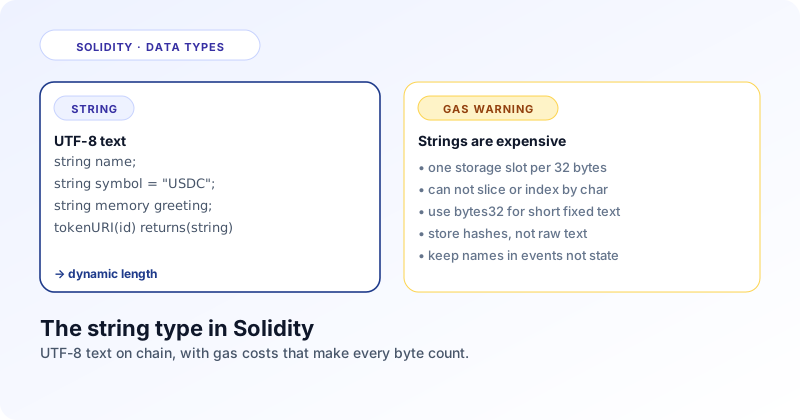
string is the type for variable-length UTF-8 text. It looks familiar to anyone coming from JavaScript or Python, but it is much more limited.
Quick answer
What is string? string is Solidity's dynamic UTF-8 text type. Under the hood it is a thin wrapper over the bytes type, with the convention that the bytes form a valid UTF-8 sequence. Solidity does not let you index a string by character or call .length on it directly — it has no character-level operations at all.
string public name = "MudassirCoin";
string public symbol = "MUDK";
string public baseURI = "ipfs://QmXyz.../";

function setName(string calldata newName) external {
    name = newName;
}
A string declared at contract level lives in storage. A string parameter to an external function lives in calldata (cheapest), and a string used inside a function lives in memory. Choosing the right location is one of the first gas optimisations a beginner learns. The full Solidity guide covers data locations end-to-end.
Section 02 · Storage cost
Why on-chain strings are expensive
Every additional 32 bytes of string payload is a fresh storage write. Long strings can dominate a contract's gas profile.
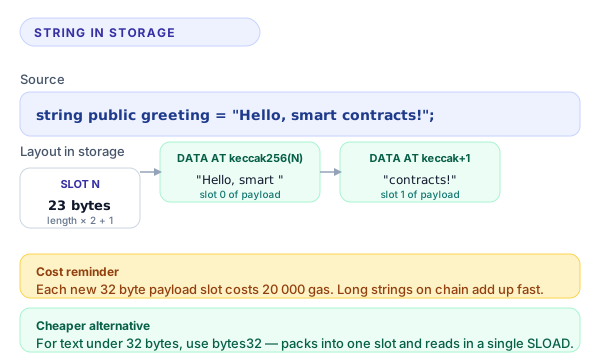
The first 31 bytes of a string can fit alongside the length in a single slot. Anything longer is laid out at a separate location computed from keccak256(slot), chained 32 bytes at a time. A 200-character description costs roughly seven storage writes — at a typical 20 000 gas per fresh slot that is 140 000 gas just for the text.
Rule of thumb for text on chain
If the text is for humans (a description, a long name, marketing copy) — store it off chain on IPFS or Arweave and put only the content hash on chain. If the text is for machines (a 4-byte selector, a 32-byte commitment) — use bytes4 or bytes32 directly. Reach for the string type only when the field is short, named, and shown to wallets directly (a token name or symbol).
Section 03 · What you can and cannot do
The thin Solidity string API
Solidity gives you almost no built-in string functions. The few operations available all happen through the underlying bytes representation.
string memory greeting = "Hello, smart contracts!";

// Length — count of bytes (NOT characters when there are non-ASCII chars)
uint256 byteCount = bytes(greeting).length;     // 23

// Equality — compare hashes, never == or !=
bool same = keccak256(bytes(greeting)) == keccak256(bytes("Hello, smart contracts!"));

// Concatenation — string.concat in 0.8.12+
string memory full = string.concat("Hi ", "there!");

// Char-by-char access — read the underlying bytes
bytes1 firstByte = bytes(greeting)[0];          // 0x48 ('H')
Notice how every operation goes through bytes(...). That is the only legal way to inspect a string's contents. Higher-level operations such as substring extraction, case conversion, or regex matching do not exist; libraries like OpenZeppelin's Strings fill some of the gaps but stay deliberately small because every byte processed costs gas.
Section 04 · Real-world uses
Where string shows up in production code
Three patterns that justify using a string on chain — and one that does not.
// 1. ERC20 metadata
string public name;        // shown by wallets like MetaMask
string public symbol;      // 3-5 character ticker

// 2. ERC721 base URI
string public baseTokenURI;

function tokenURI(uint256 id) external view returns (string memory) {
    return string.concat(baseTokenURI, Strings.toString(id), ".json");
}

// 3. Revert reason
function withdraw(uint256 amount) external {
    require(balances[msg.sender] >= amount, "insufficient balance");
    // ...
}

// 4. ANTI-PATTERN — long descriptive text on chain
string public description = "This collection celebrates ..."; // 4 KB+ — DON'T
The first three are short, well-defined, and read by tooling. The fourth is the trap: long marketing copy belongs in an IPFS document referenced by tokenURI, not in contract storage.