
Section 01 · Introduction
Why colleges are replacing plastic ID cards with NFTs
A student ID card is a small object that touches almost every system on a college campus. When it fails — lost, expired, demagnetized — it blocks the student from food, study, and entry. The lifetime cost of plastic cards is bigger than it looks.
Quick answer
What is a student ID NFT? A student ID NFT is a soulbound ERC721 token issued by an admissions office to an enrolled student's wallet. The token carries the student's roll number, department, batch year, and current semester expiry. Campus facilities — gates, mess, library, gym, parking — read the contract to confirm the student is active and has access to that facility before letting them in. Fees overdue flips a single flag and locks every door automatically.
The current state of college IDs is a plastic card printed at the start of every semester, distributed in long queues at the bursar office, and reissued whenever a student loses it (which happens roughly once per student per year at most campuses). The replacement chain — fees clearance, card production, distribution — takes days.
An NFT student ID lives in the student's wallet on their phone. Losing the phone does not lose the ID; the student logs into a backup wallet and the same token is there. Reissuance is unnecessary. Semester renewal is one function call on the contract — no new cards printed, no queues, no laminated photos.
Same ERC721 base contract as a starting point — the work is in the per facility access map and the fees gate.
Roll number becomes the tokenId
Hashing the roll number into the tokenId means lookups are deterministic. The verifier always knows where to find a given student's record. No central registry of tokenId-to-student needs to be maintained.
Section 02 · The Contract
One ERC721 contract per institution
A student record, a per facility access map, two roles. Roughly 80 lines of Solidity covers the core.
// Student ID NFT — soulbound, semester scoped
contract StudentId is ERC721, AccessControl {
    bytes32 public constant ADMISSIONS_ROLE = keccak256("ADMISSIONS_ROLE");
    bytes32 public constant SCANNER_ROLE = keccak256("SCANNER_ROLE");

    struct Student {
        string rollNumber;
        string department;     // "CS", "EE", "BBA"
        uint16 batchYear;
        uint64 validUntil;     // end of current semester
        bool feesPaid;         // gate for campus access
    }

    mapping(uint256 => Student) public student;
    mapping(uint256 => mapping(string => bool)) public access; // tokenId => facility => allowed

    event Issued(uint256 indexed id, address indexed wallet, string rollNumber);
    event AccessGranted(uint256 indexed id, string facility, address by);
    event AccessRevoked(uint256 indexed id, string facility, address by);
    event ChargeBilled(uint256 indexed id, string facility, uint256 rupees);

    constructor() ERC721("Student ID", "SID") {
        _grantRole(DEFAULT_ADMIN_ROLE, msg.sender);
    }

    function issue(
        address wallet,
        string calldata rollNumber,
        string calldata department,
        uint16 batchYear,
        uint64 validUntil
    ) external onlyRole(ADMISSIONS_ROLE) returns (uint256 id) {
        id = uint256(keccak256(bytes(rollNumber)));
        student[id] = Student(rollNumber, department, batchYear, validUntil, true);
        _safeMint(wallet, id);
        emit Issued(id, wallet, rollNumber);
    }
}
The Student struct stores everything a campus scanner needs to authorize entry at a glance: roll number for display, department for analytics, batch year for graduation timing, validUntil for the semester gate, feesPaid for the bursar gate. The access map handles per facility permissions independently.
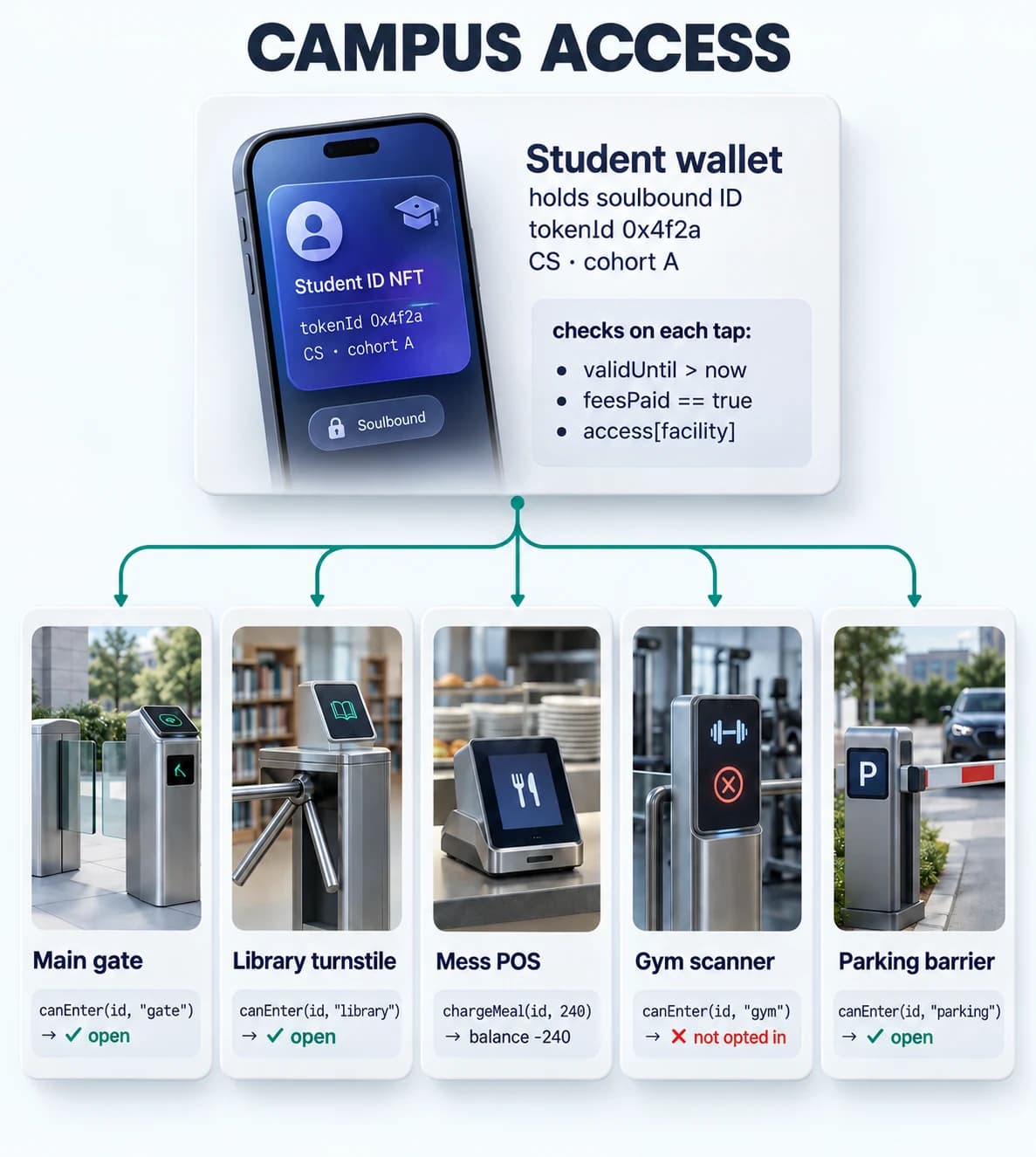
Two roles split the trust. ADMISSIONS_ROLE wallets sit inside the admissions office and can issue new IDs, update student data, set fees status, and grant facility access. SCANNER_ROLE wallets sit inside the canteen and dorm POS systems and can only charge a meal or log an entry. Compromising a scanner cannot inflate a student record; compromising admissions can.
Section 03 · Campus Access Logic
canEnter — the one function every gate calls
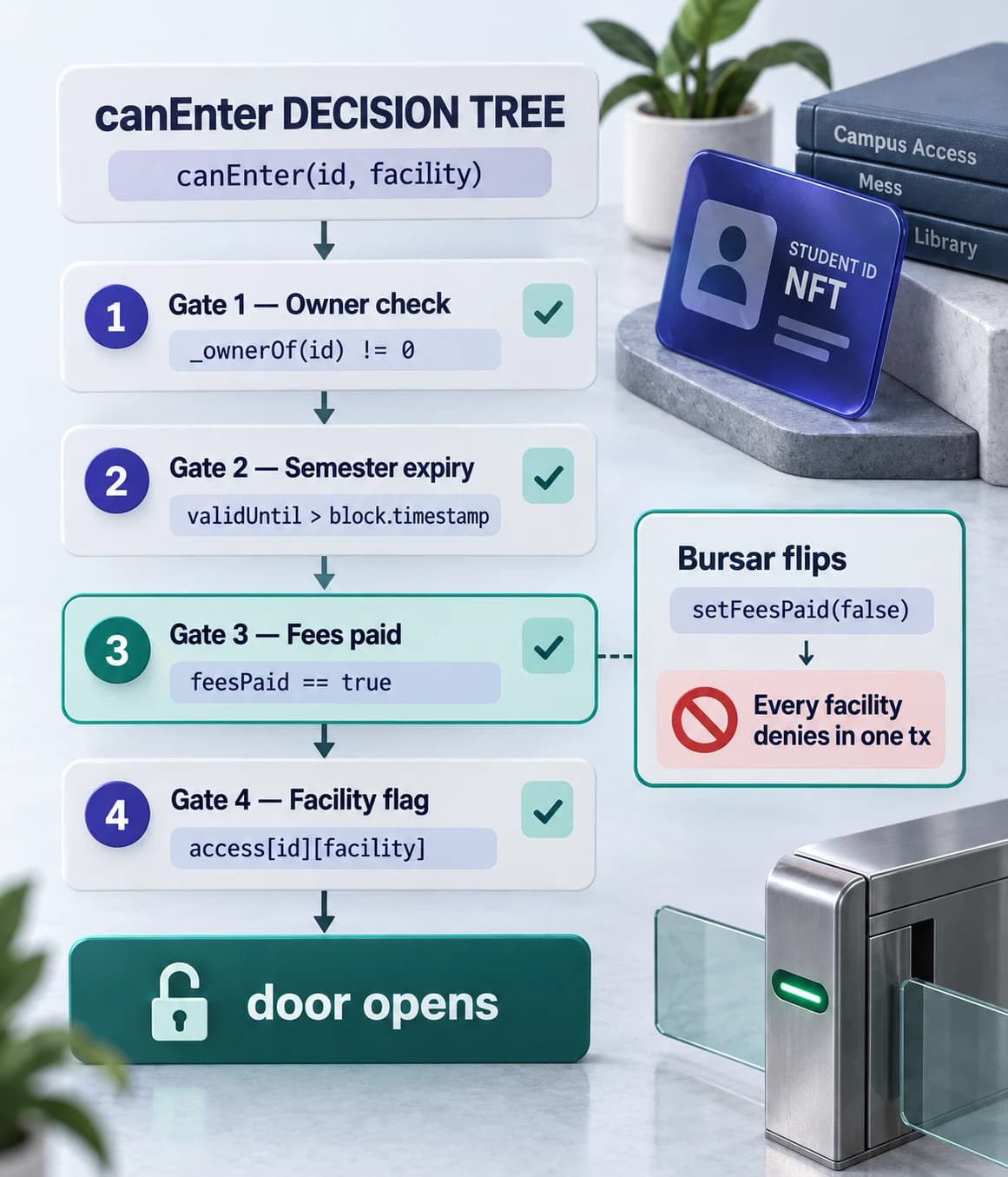
Every scanner across campus runs the same read. Three checks gate every door, every time.
// Campus scanner taps the wallet — door opens if all gates pass
function canEnter(uint256 id, string calldata facility)
    public
    view
    returns (bool)
{
    if (_ownerOf(id) == address(0)) return false;
    Student memory s = student[id];
    if (s.validUntil < block.timestamp) return false;
    if (!s.feesPaid) return false;
    return access[id][facility];
}

// Library, mess, gym, parking — admin grants per facility
function grantAccess(uint256 id, string calldata facility)
    external
    onlyRole(ADMISSIONS_ROLE)
{
    access[id][facility] = true;
    emit AccessGranted(id, facility, msg.sender);
}

// Fees overdue — admissions flips one bit, every door closes
function setFeesPaid(uint256 id, bool paid)
    external
    onlyRole(ADMISSIONS_ROLE)
{
    student[id].feesPaid = paid;
}
canEnter folds three conditions into a single return. Owner check confirms the wallet actually holds a valid ID. Expiry check enforces semester scoping — a student who has not re registered cannot enter. feesPaid check is the bursar gate. The per facility flag is the final layer.
The composition matters. A student in good standing for the semester whose fees are clear but who has not been granted gym access still fails canEnter at the gym door — but passes at the library door. Each facility cares about its own flag, not the others.
| Facility | Default access | Set by | Notes |
|---|---|---|---|
| Main gate | All active students | Admissions on issue | Universal |
| Library | All active students | Admissions on issue | Quiet study rules off chain |
| Mess | Students on meal plan | Admissions on plan signup | Per meal billing via topUp |
| Gym | Students who opted in | Admissions on opt in | Optional fee gates gym access |
| Parking | Students with vehicles | Admissions on registration | Per vehicle slot off chain |
| Lab buildings | Students enrolled in lab courses | Admissions per semester | Auto revokes at semester end |
Section 04 · Mess and Charged Facilities
On chain running tabs without a cashier loop
The mess and the canteen are the highest volume systems on a college campus. Putting them on chain is the test of whether the model actually scales.
// Mess swipe — bill the canteen running tab
mapping(uint256 => uint256) public messBalance; // tokenId => rupees owed

function topUp(uint256 id) external payable {
    require(_ownerOf(id) != address(0), "ID: unknown");
    require(msg.value > 0, "ID: zero top up");
    // In a stablecoin model this would transferFrom USDC instead
    // Keeping payable here for narrative simplicity
    messBalance[id] += msg.value;
}

function chargeMeal(uint256 id, uint256 rupees)
    external
    onlyRole(SCANNER_ROLE)
{
    require(canEnter(id, "mess"), "ID: mess access denied");
    require(messBalance[id] >= rupees, "ID: top up first");
    messBalance[id] -= rupees;
    emit ChargeBilled(id, "mess", rupees);
}
A student tops up their meal balance through a single payable call (or a stablecoin transferFrom in a production setting). The canteen POS at lunch time scans the student wallet, reads canEnter(id, "mess"), confirms access, and calls chargeMeal with the rupee amount. The balance drops, the student gets the meal, the transaction lands in the block within seconds.
Library late fees use the same pattern
A book returned past the due date generates a chargeLibrary call. The student's library balance goes negative. The next book they try to check out is blocked at the canEnter check until they top up. No human in the loop.
Gym lockers, lab consumables, printer credits
Every campus service that meters usage today using a separate prepaid card maps cleanly to a charge function on the same contract. One wallet, one balance per service, one source of truth.
Hostel mess split between hostels works without sync
Hostel A and Hostel B run separate kitchens but the same student visits both occasionally. The contract serves both — the student's mess balance is one number, billed by either kitchen, settled by either. No nightly reconciliation between hostels.
Per facility events make audit trivial
Every ChargeBilled event names the facility, the amount, and the student. The bursar exports the events for the period and reconciles instantly. The current state of running tabs in cash and paper books makes this nearly impossible.
Section 05 · Semester and Graduation Lifecycle
What happens at registration, semester end, and graduation
The annual rhythm of a student ID is two transactions per student per year. Everything else is reads.
At semester start, admissions calls a setValidUntil function for each enrolled student, bumping the expiry to the end of the new semester. Students who registered for the semester are active; students who did not are automatically excluded by their expiry timestamp. The bursar runs a separate setFeesPaid pass after fee receipts clear.
Mid semester, almost nothing happens on the admissions side. Daily scanner activity does all the work — entries logged, meals charged, library checks. The admissions office only touches the contract when a student transfers departments, takes a leave of absence, or graduates.
At graduation, the student ID expiry runs out and the access flags become irrelevant. The NFT stays in the student's wallet as a historical record. The university may then issue a separate degree NFT to the same wallet — the two contracts coexist cleanly because the student wallet holds both tokens.
Section 06 · Integration
What the IT team actually builds
Three pieces: the contract, the admissions dashboard, the scanner firmware. The first two are small; the third is the actual investment.
Existing turnstile and POS hardware does not speak EVM RPC. The integration pattern is a small middleware service per scanner that exposes a local API the hardware can call, and the middleware translates to a contract read. A Raspberry Pi at each gate is enough — under thirty dollars in hardware per door.
The admissions dashboard is a thin internal web app. The most used screens are batch issuance at semester start, fees status updates, and per facility access toggles. The whole dashboard is a few hundred lines of code over the contract's ABI.
Deploy on a layer 2 to keep gas under control. A semester start with 5,000 students issuing roughly $50 of gas total. Daily campus activity — meals, entries, library — is under one cent per event. Even at full scale, the chain costs are negligible compared to plastic card replacement.
Section 08 · Next Steps
Pilot it at one hostel before rolling it across campus
A student ID system touches every part of the institution. Roll it out as a one hostel pilot first to find the unknown integration points.
We help universities, schools, and corporate campuses ship on chain identity and access systems, including the contract, the admissions dashboard, the scanner middleware, and the integration with existing student information systems. The pattern transfers to corporate badges, conference passes, and any environment where a single identifier needs to unlock many different facilities under one rule set.