Section 01 · The Decision
Why vector database selection matters for RAG
Your vector database is the retrieval layer of your RAG pipeline. Its performance, operational model, and cost at scale determine whether your RAG system is reliable, maintainable, and economically viable.
Quick answer
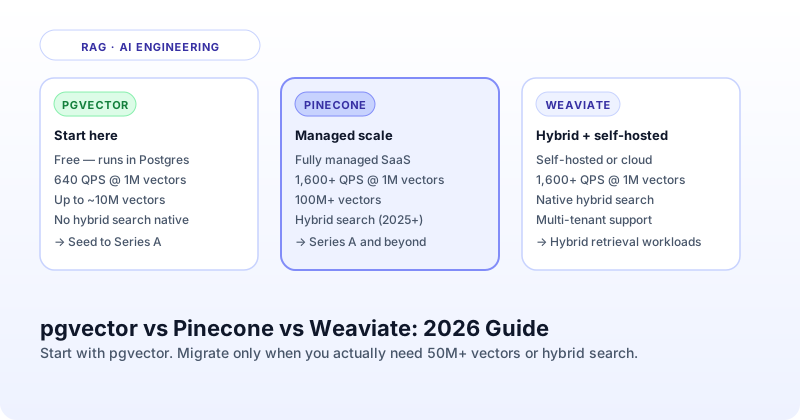
The short answer: Start with pgvector if you run Postgres — it is production grade up to roughly 10 million vectors and costs nothing to add. Use Pinecone when you need managed scale beyond that. Use Weaviate when you need native hybrid search or self-hosted control at large scale.
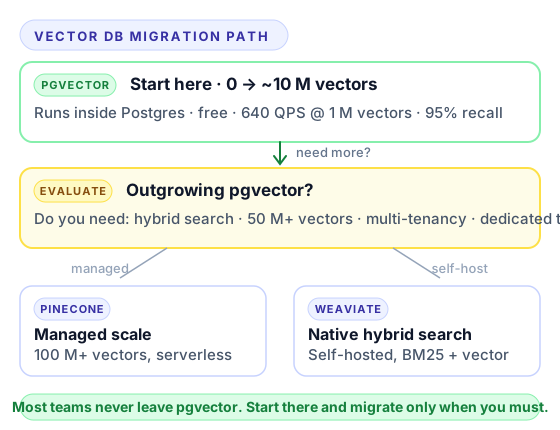
Most engineers choose a vector database by reading comparison articles that rank all options on all dimensions simultaneously. The more useful frame is the migration path: which option should you start with, and what should trigger a migration? If you want to filter the full landscape side by side, the Vector Database Comparison Matrix covers ten options by hosting, hybrid search, and price.
The answer is almost always pgvector first. It is a Postgres extension that runs inside your existing database. No new infrastructure. No new ops burden. No additional cost. Your existing backups, monitoring, and access controls cover it. At under 10 million vectors — which covers the vast majority of seed to Series A use cases — the performance is competitive with purpose-built vector stores.
Section 02 · Option 1
pgvector: start here unless you have a reason not to
pgvector adds vector storage and HNSW index support to PostgreSQL. You store vectors in a column alongside your existing data. Queries use SQL with a vector distance operator. The entire stack — vectors, metadata, relational data — lives in one database with one connection, one backup, one monitoring setup.
Use pgvector when
You already run Postgres. Your dataset is under 10 million vectors. You want to minimize infrastructure complexity. Supabase, Neon, and RDS all support pgvector natively. Companies including Instacart run pgvector in production at significant scale.
Migrate away from pgvector when
Your dataset exceeds 10 to 50 million vectors and single-node Postgres is showing latency degradation. You need native hybrid search without composing it manually with a BM25 index. You need multi-tenant vector isolation at scale.
Performance at 1 million vectors: pgvector achieves approximately 640 QPS with HNSW at 95% recall. Purpose-built vector stores achieve 1,600 QPS or more at the same recall level. At 1 million vectors, this difference rarely matters — query latency is low and throughput is rarely the bottleneck. At 50 million vectors, the gap becomes significant.
Section 03 · Option 2
Pinecone: the managed path to 100 million-plus vectors
Pinecone is a fully managed, serverless vector database. You create an index, insert vectors, and query — no infrastructure to configure or maintain. It scales transparently to hundreds of millions of vectors without operational changes. The SLA and support are the strongest of the three options.
Use Pinecone when
You need to scale beyond pgvector's practical ceiling and want the fastest time to production at scale without investing in infrastructure operations. Teams that have migrated from pgvector to Pinecone report the transition taking hours, not days — the API surface is straightforward.
Consider alternatives when
Cost is a primary constraint. Pinecone's serverless pricing is competitive at moderate scale but higher than self-hosted alternatives at large scale. If you can operate infrastructure reliably, Qdrant or Weaviate self-hosted will be cheaper per query at very high volumes.
Section 04 · Option 3
Weaviate: hybrid search native and self-hosted control
Weaviate ships hybrid search — BM25 plus vector similarity, fused with Reciprocal Rank Fusion — natively. You do not need to compose a separate BM25 index alongside your vector index. For production RAG systems that need hybrid retrieval (which is most of them), this is a significant operational advantage.
Use Weaviate when
You need native hybrid search without composing it manually. You want a self-hosted option for data sovereignty, compliance, or cost reasons. You are building a multi-tenant RAG system where vector spaces need to be isolated per tenant.
Consider alternatives when
You want the simplest possible managed service and do not need self-hosting. Weaviate's managed cloud offering is good, but Pinecone has a simpler API and a stronger SLA for teams that want fully managed without operational involvement.
Section 05 · Head-to-Head
The numbers that matter in production
| Dimension | pgvector | Pinecone | Weaviate |
|---|---|---|---|
| Deployment model | Self-hosted (Postgres extension) | Fully managed, serverless | Self-hosted or managed cloud |
| Hybrid search | Manual (compose with BM25 index) | Supported (added 2025) | Native — ships out of the box |
| Performance at 1M vectors | ~640 QPS, 95% recall | ~1,600+ QPS, 95% recall | ~1,600+ QPS, 95% recall |
| Practical scale ceiling | ~10 to 50M vectors (single node) | Hundreds of millions | Self-hosted: node-dependent; Managed: high |
| Cost model | Free (Postgres costs) | Free Starter; Standard from $50/mo minimum | Free self-hosted; paid Cloud priced on request |
| Multi-tenant support | Schema-level isolation | Namespace-based | Class-level isolation — strong |
| Migration from Postgres | Already there | Hours | Days |
At 1 million vectors, the quality differences between the three are small — all reach 95% recall with default settings. Choose based on your operational model preference and hybrid search requirements. At 50 million vectors, pgvector requires careful tuning and may need a migration; Pinecone and Weaviate handle it without changes.
Section 06 · Open Source Options
FAISS vs Chroma: vector database comparison for local and research workloads
FAISS and Chroma serve different needs. FAISS is a raw indexing library optimised for speed and research experimentation. Chroma is a developer-friendly embedded database built for LLM application prototyping.
FAISS (Facebook AI Similarity Search) is a C++ library with Python bindings that provides fast approximate nearest-neighbor search. It is not a database — it does not persist metadata, handle updates gracefully, or expose a query API. You manage the index file yourself. FAISS is the right tool when you need maximum throughput on a fixed dataset and are comfortable managing index state in code.
Chroma is an embedded vector database designed for LLM application development. It runs in-process with no separate server, persists vectors and metadata together, and exposes a Python and TypeScript client. It is the fastest way to wire up retrieval in a new RAG prototype because there is no infrastructure to stand up. The trade-off is that Chroma is not designed for large-scale production workloads — it does not shard across nodes, lacks access controls, and offers no SLA.
Use FAISS when
You are running batch similarity search on a fixed corpus where query throughput is the primary constraint. Research, recommendation systems, and offline embedding jobs are natural fits. Expect to write more infrastructure code around the index.
Use Chroma when
You are prototyping a RAG application and want to get retrieval working in an afternoon. Chroma handles persistence and metadata filtering without additional tooling. When you outgrow it, migrating to a production vector store is straightforward.
For a full side-by-side view including FAISS, Chroma, Qdrant, Milvus, and six more options against hosting model, hybrid search, and price, use the Vector Database Comparison Matrix.
Section 07 · Architecture Decision
Traditional databases vs purpose-built vector databases: how to choose in 2026
The choice is not binary. pgvector proves that a traditional relational database can handle production vector workloads. The question is where on the spectrum your requirements sit.
Traditional databases — Postgres, MySQL, MongoDB — were not designed for vector similarity search. They store structured data and optimise for exact match queries, aggregations, and joins. Adding a vector index to a traditional database (as pgvector does for Postgres) works well at moderate scale because it keeps your vectors colocated with your relational data, reuses existing backups and monitoring, and costs nothing extra if you already run that database.
Purpose-built vector databases — Pinecone, Weaviate, Qdrant, Milvus — were designed from the ground up for approximate nearest-neighbor search at scale. They offer purpose-optimised index structures (HNSW, IVF), native horizontal scaling, built-in hybrid search, and operational tooling that a traditional database with a vector extension cannot match at very large scale. The trade-off is a new piece of infrastructure to operate, a new cost center, and a data synchronisation problem if you still need relational data alongside vectors.
| Dimension | Traditional DB + vector extension | Purpose-built vector DB |
|---|---|---|
| Setup complexity | Low — already in your stack | Medium — new infrastructure |
| Scale ceiling | ~10 to 50M vectors (pgvector) | Hundreds of millions to billions |
| Hybrid search | Manual composition required | Native on most platforms |
| Metadata joins | Native SQL joins | Requires separate relational DB |
| Cost (at moderate scale) | Free if you run Postgres | Usage-based pricing |
| Operational overhead | Unified with existing DB ops | Separate cluster to manage |
The right answer for most teams in 2026 is to start with pgvector and migrate to a purpose-built vector database only when you have evidence that pgvector is the bottleneck. Premature migration to a purpose-built store adds operational complexity before you have the scale to justify it.