Section 01 · The Problem
Why standard software vendor evaluation frameworks miss for agentic AI
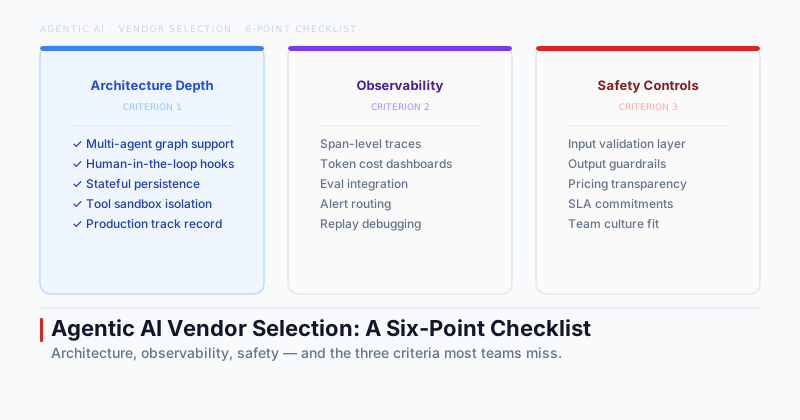
Standard software vendor evaluation frameworks fail for agentic AI because the risk surface is different. Use these six criteria: architecture depth, production track record, observability, safety and compliance controls, pricing model, and team fit with knowledge transfer.
Quick answer
Why does agentic AI need different evaluation criteria? Agentic AI systems fail in ways that bounded software does not: failure modes are non-deterministic, the blast radius of a wrong decision is larger because agents trigger downstream actions, and claimed expertise is much harder to verify. Standard procurement frameworks do not surface any of these risks.
Non-deterministic failure modes
An agent can pass every test case and still produce unexpected behavior in production on an edge case that was never in your evaluation set. That is not a bug in the traditional sense. It is the nature of systems that reason over open ended inputs.
Larger blast radius
A wrong SaaS result displays a wrong value. A wrong agent decision can trigger a downstream action: send an email, modify a record, initiate a workflow, call an external API. Errors compound across the action chain.
Harder to verify expertise
Any firm can put agentic AI on a website. The number of teams that have actually shipped these systems into production and built the observability to detect drift is far smaller than the number selling the capability.
Section 02 · Architecture Depth
Criterion 1: Can they explain their architecture clearly?
Architecture transparency is the first filter, and it eliminates more vendors than any other single test.
Ask the vendor to walk you through how their system is structured. Ask specifically: what is the agent loop design? How does the system decide when to call a tool versus when to reason further? What happens when a tool call fails mid task? How is context managed across a long running session?
A vendor with production depth names the loop structure, describes the decision logic, identifies where the system is most likely to behave unexpectedly, and explains the trade offs they accepted. A vendor without it answers with process language: “We use a robust agentic framework.” “Our orchestration layer manages tool calling.” These answers are not wrong. They are empty.
What to ask in the demo call: “Walk me through what happens when your agent takes an action that turns out to be wrong — what detects it, what halts the process, what happens next?”
Red flag one
The vendor cannot describe their agent loop design at the level of specific decision points. “Orchestration” is used as a noun without explaining what is being orchestrated or how.
Red flag two
Every architecture diagram is identical to generic AI framework documentation. Nothing is specific to your use case, data shape, or infrastructure.
Section 03 · Production Track Record
Criterion 2: Do they have production deployments of agentic systems?
This is not the same as asking whether they have built AI systems. Retrieval pipelines and classification models are not agentic systems. The engineering challenges are genuinely different.
Ask the vendor to name a specific production agentic deployment and tell you how long it has been in production, what the most significant incident was, and what monitoring is in place today.
The incident question is the critical one. A vendor with real production experience has had at least one: an agent in a reasoning loop burning API costs, a tool call sequence producing an unintended cascade, a context window truncating a mid task decision. These are normal. How they describe them tells you whether they have operated these systems or only built demos.
What to ask in the demo call: “Tell me about a production incident. What failed, how did you find out, and what changed after?”
Red flag one
The vendor has no production deployments to name — only pilots, proofs of concept, or internal tools. Pilots are not production. Three months in a sandbox with no real users is not a production track record.
Red flag two
They describe an incident at such a high level of abstraction it sounds like a risk register entry. “We encountered some challenges with edge cases and implemented additional guardrails” is designed to sound like a production story without being one.
Section 04 · Observability
Criterion 3: What is their observability and monitoring story?
Observability is the single most under evaluated criterion in agentic AI vendor selection, and it is the one that determines whether you can manage the system after deployment.
An agentic system without observability is one you are flying blind. You cannot see what the agent is reasoning about, which tools it called and in what order, where it got stuck, or where production behavior is drifting from evaluation behavior. Without that visibility, you cannot debug failures, tune performance, or demonstrate compliance.
Ask to see the monitoring dashboard for one of their production systems. If they do not have one to show you, that is your answer. If they do, look for: step level traces showing each agent action and outcome, tool call logs with latency and success rate, confidence signals at decision points, anomaly alerting, and session replay.
Good agentic AI consulting treats observability as a first class deliverable. The monitoring layer should be designed before the agent loop is coded, not retrofitted after a production incident forces the question.
What to ask in the demo call: “Show me what you can see when an agent session goes wrong in production. Walk me through an actual example.”
Red flag one
The vendor's observability story is “we log everything.” Logging is not observability. Observability means structured traces, queryable step data, and monitoring that surfaces anomalies without manual log searches.
Red flag two
They have observability tooling but it is entirely internal. Your operations team cannot access production traces, and the vendor has not thought about what you will need to manage the system after handover.
Section 05 · Safety Controls
Criterion 4: How do they handle safety, failures, and compliance?
Safety and compliance controls in agentic AI need to be structural — demonstrable before you ask for them, not configured into existence after you request them.
Ask what safety controls exist by default. Ask how the system is prevented from acting outside a defined scope, whether there is a human in the loop checkpoint for high risk actions, and how it handles adversarial inputs designed to redirect its behavior.
For regulated deployments, also ask what data is logged, where it is stored, who has access, and what audit trail exists for every agent action.
Vendors who have built for enterprise clients have answers ready because previous clients required them. Vendors being asked for the first time will commit to addressing these in the build — which tells you exactly where they are in their maturity.
What to ask in the demo call: “What happens when a user sends an input designed to push the agent outside its intended scope? Walk me through the specific control that prevents it.”
Red flag one
Safety controls are described as a configuration layer that will be “tuned to your requirements” during implementation. The controls do not exist yet. You are not buying a safety architecture — you are buying a promise to build one.
Red flag two
The vendor has not thought about what happens when the agent is uncertain. There is no halt condition, no escalation path, no confidence threshold that triggers a human review. An agent that always proceeds regardless of confidence will make consequential decisions in conditions it was not designed for.
Section 06 · Pricing and Team Fit
Criteria 5 and 6: Pricing model and team fit
These two criteria share a common failure mode: they look fine in the proposal and become problems after the contract is signed.
Pricing model
Agentic AI pricing comes in several structures with very different risk profiles at scale. Fixed fee shifts delivery risk to the vendor. Time and materials is flexible but drifts without scope discipline. Per call or per token pricing looks cheap at proposal volumes and can become the dominant operational cost in production.
Ask not “what is the price?” but “what does this look like at three times our projected usage?” If the vendor cannot model that, resolve it before you sign.
Also ask who owns the cost when the agent is inefficient. An agent using five reasoning steps where two would suffice burns your API budget. Unless efficiency is a contracted commitment, you absorb it entirely.
Team fit and knowledge transfer
The handover is where most agentic AI vendor relationships break down. You end up with a system you cannot maintain because the institutional knowledge lives entirely in the vendor's heads.
Ask what documentation your team will have at handover: architecture decision records, agent loop documentation, tool call specifications, evaluation datasets, and runbooks for common failure modes. Ask whether key delivery team members are available for questions after handover.
When hiring an agentic AI consultant, the knowledge transfer commitment matters as much as the technical delivery. A vendor who resists documenting their architecture is structuring your dependency on them, not building your capability. For many enterprises, the prior question is choosing between an AI engineer and a consultant for the specific scope.
Red flag one (pricing)
The vendor can tell you what the build costs but cannot model operational cost at 10x your projected usage. That gap will cost you money.
Red flag two (team fit)
The vendor's knowledge transfer plan is “we will document as we go.” Documentation produced under deadline pressure covers what was built, not why decisions were made. The most valuable documentation for an agentic system is the architecture decision log explaining why the loop is designed the way it is.
Vendor selection shapes every downstream decision: system performance, operational reliability, time to diagnose issues, and how much institutional knowledge your team retains. If you want a technical review of a vendor proposal you have received, agentic AI consulting is where that conversation starts.