Section 01 · The Right Question
The decision is not about cost — it is about timeline and risk
Most teams approach this as a cost comparison. That is the wrong frame. The real variables are: how fast do you need to ship, how much does a wrong hire cost you, and how long will this work last?
Quick answer
The short answer: If you have a scoped AI project and need production delivery in weeks rather than months, consulting is almost always the right answer. Hire full-time when the AI work is permanent and foundational to your product.
The pressure to hire an AI engineer is real in 2026. Boards ask about it. Investors ask about it. But hiring is a slow and expensive process, and AI engineers — particularly those with production agentic AI experience — are scarce and expensive. The median AI engineer salary in 2026 is $185,000, rising to $260,000 or more for senior roles with agentic AI experience. A mis-hire costs you the recruiting fee, three to six months of salary, and the time lost while the team adapts.
A consultant solves a different problem. They arrive with the skills, the production experience, and the framework fluency already in place. They do not need a ramp period. They deliver working systems, not just code. The engagement ends when the work is done.
Section 02 · What Each Option Delivers
Side-by-side: what you actually get
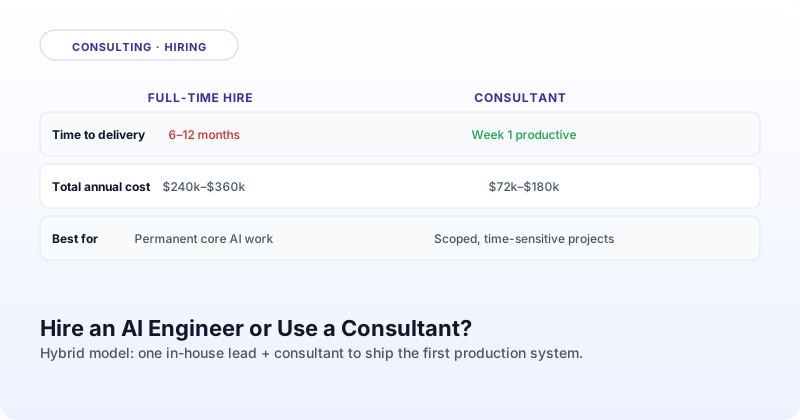
| Dimension | Full-time hire | Consultant |
|---|---|---|
| Time to first delivery | 4 to 9 months (recruiting + ramp) | 1 to 3 weeks |
| Ongoing cost | $200k to $320k per year total comp | $6k to $18k per month (retainer) |
| Project cost | High — paid regardless of output | Scoped — paid for delivery |
| Knowledge retention | Stays in-house permanently | Leaves with the consultant |
| Flexibility | Hard to unwind if direction changes | Engagement ends when scope ends |
| Specialization depth | Generalist over time | Deep in current production patterns |
| Best for | Permanent core capability | Scoped delivery, exploration, rescue |
Section 03 · The Decision Variables
Three variables that decide the answer
Timeline
Building an in-house AI team from scratch — sourcing, interviewing, offering, onboarding, and ramping — typically takes 6 to 12 months before first production delivery. If your go-to-market window is shorter than that, a consultant is not a compromise; it is the only realistic option.
Risk
If the product direction might change in the next 6 months — which is normal at seed and Series A — a full-time hire with a specific specialization becomes the wrong spec the moment the product pivots. A consulting engagement ends cleanly. A full-time hire does not.
Duration
For projects under 18 months, consulting is typically cheaper than a full-time hire when you factor in recruiting fees (15 to 25% of first-year salary), ramp time (2 to 4 months of reduced productivity), and the total compensation package. For work that will continue for years, full-time is the better investment.
Section 04 · Signals
Signs you need a consultant right now
You have a scoped deliverable with a deadline
If the board wants an AI-powered feature in the next product release, a consultant can design and ship it. An in-house hire will still be in the interview loop when that deadline passes.
Your prototype is failing to scale to production
A working demo that breaks under real load or real data is an extremely common situation. A consultant with production experience diagnoses and fixes these issues in days, not the months it would take a new hire to learn the codebase first.
You need senior expertise for a specific phase
Architecture design and production hardening require seniority. You might not need that seniority permanently. A consultant delivers the senior architectural guidance for the phase that needs it, then steps back.
You are evaluating before committing
A consulting engagement is an effective way to validate whether you actually need an in-house AI team. If the project delivers value, you have the evidence to justify the hire. If it does not, you have not committed to a full-time salary.
Section 05 · When to Hire
Signs you should hire full-time
AI is the core product, not a feature
If your entire business model depends on AI-driven functionality that will evolve continuously, you need in-house engineers who accumulate institutional knowledge over time. A consultant cannot replace a full-time team for a company whose product is fundamentally an AI system.
You are past Series A with consistent AI work
At Series B and beyond, with a stable roadmap and ongoing AI work that spans years, the economics flip. A full-time senior AI engineer at $240,000 total comp costs less over three years than a consultant retainer at the same seniority level.
Security and IP requirements prohibit consulting
Some regulated industries and government contracts require all technical staff to be direct employees. If your contracts require it, the choice is made for you.
Section 06 · The Hybrid Model
What most seed-stage startups actually do
The most common pattern for seed to Series A startups building their first production AI system: hire a strong product or engineering lead in-house — someone who can own the roadmap, work with customers, and manage the technical direction long-term. Engage a consultant to design the architecture, ship the first production system, and hand it over.
The in-house lead provides continuity, product context, and stakeholder management. The consultant provides deep technical expertise and production delivery speed. After the initial build, the in-house lead runs the system day to day. The consultant moves to a reduced advisory role or ends the engagement entirely.
This model ships faster than trying to hire a senior AI engineer, costs less than a full in-house team for the initial phase, and leaves the startup with a working production system and an in-house owner. See the full guide to hiring an agentic AI consultant for how to evaluate and structure a consulting engagement.
Section 07 · Hire Generative AI Engineers
Hire generative AI engineers: what the role actually requires
Generative AI engineering is distinct from classical machine learning engineering. The skills, the tools, and the production patterns are different enough that a senior ML engineer is not automatically the right hire for a generative AI project.
When you hire generative AI engineers, you are looking for production competency in a specific stack: prompt engineering and chain of thought design, LLM API integration and cost optimization, RAG pipeline architecture (chunking, embedding, retrieval, reranking), agentic workflow orchestration (LangGraph, CrewAI, or custom), and LLM observability tooling (LangSmith, Arize Phoenix, or Langfuse). A classical ML engineer who has trained transformer models on GPU clusters may not have any of this.
Hire generative AI engineers: what makes this role scarce
The scarcity of qualified generative AI engineers in 2026 is structural, not temporary. The field is barely four years old from a production engineering standpoint. Most people who claim to be generative AI engineers are either prompt engineers (no systems depth), data scientists who used an LLM API once, or classical ML engineers who have not shipped a production agentic system. The engineers who have shipped production RAG pipelines, agentic workflows, and LLM observability stacks at scale are rare — and their compensation reflects it. Hiring for demonstrated production delivery rather than familiarity with LLM APIs is the single most important qualification signal.
Hire generative AI engineers: freelance vs full-time
For a single project or a time-bounded engagement, hiring freelance generative AI engineers is often faster than a full-time search and produces better results — a senior freelancer arrives with production experience and no ramp time. For ongoing product development where the AI system will evolve continuously, a full-time engineer who accumulates institutional knowledge is the better long-term investment. The hybrid model (consultant to ship the first system, full-time to own it long term) is what most serious seed to Series A startups use.
Section 08 · AWS AI Engineers
Hire AWS AI engineers: when cloud platform specialization matters
AWS AI engineers bring a specific combination of Amazon Bedrock, SageMaker, and broader AWS services expertise that is valuable when your production AI system needs to run on AWS infrastructure.
The search volume for "hire aws ai engineer" (210 monthly searches, KD 17) reflects a real hiring pattern: organizations that have standardized on AWS as their cloud infrastructure often specifically need engineers who can architect AI systems within the AWS ecosystem, not just in the abstract. The relevant AWS services for production AI in 2026 include Amazon Bedrock (managed foundation model access for Claude Sonnet 4.6, Titan, and Llama), SageMaker (training, fine-tuning, and endpoint hosting), Bedrock Agents (managed agentic workflow orchestration), and Knowledge Bases for Amazon Bedrock (managed RAG infrastructure).
AWS AI engineer vs generalist AI engineer: when the platform matters
An AWS AI engineer is not simply a generalist AI engineer who happens to prefer AWS. The platform-specific knowledge — Bedrock model access patterns, SageMaker pipeline architecture, IAM permission models for AI agents, VPC networking for secure LLM calls, and cost optimization through Reserved Instances and Spot for training workloads — takes significant time to develop. If your production system must run on AWS (due to existing infrastructure, compliance requirements, or enterprise agreements), hiring an engineer with demonstrated AWS AI delivery experience is meaningfully faster than bringing in a generalist who will learn the platform on your project.