
Section 01 · Definition
Define adoption as changed work, not tool access
The distinction between deployment and adoption determines whether AI investment produces outcomes or activity logs.
Quick answer
What is an AI adoption strategy? An AI adoption strategy combines executive sponsorship, readiness assessment, governed pilots, role specific training, workflow redesign, internal champions, production integration, and metrics for both usage and business impact. The goal is changed work and measurable outcomes, not licenses issued or isolated experiments.
A well designed AI adoption strategy moves teams from tool access to sustained use inside real workflows. Without one, organizations end up with a cluster of licenses, a handful of enthusiastic early adopters, and no measurable change to how work actually gets done. The gap between deploying AI and embedding it into operations is where most enterprise initiatives stall.
Deployment and adoption describe different things. Deployment is the technical act of making AI available. Adoption is the behavioral and operational change that follows when people integrate AI into how they complete real work. An organization can deploy AI completely and achieve zero adoption.
The distinction matters for planning. Technical deployment has a clear completion point. Adoption does not. It requires ongoing investment in enablement, feedback cycles, workflow redesign, and governance. Microsoft defines enterprise AI adoption as integrating AI into operations, workflows, products, and decision making at scale, with sustained use and business outcomes rather than isolated deployment.
Adoption programs that do not anchor to specific business outcomes tend to drift into usage theater. Teams report activity such as logins, prompts submitted, and features activated without connecting that activity to productivity, cost, quality, or revenue change. Anchoring to outcomes from the start forces every program element to justify itself against something that matters to the business.
Section 02 · Readiness
Assess readiness before broad rollout
Gaps in data, governance, workforce capability, or infrastructure do not become visible until rollout is already underway. Finding them before is cheaper.
Rushing to broad rollout without a readiness baseline is the single most common cause of stalled adoption programs. Organizations discover mid-rollout that data is fragmented, that employees do not understand how to use AI for their specific tasks, or that governance questions have no answers. Addressing these gaps after scale begins is significantly more expensive than addressing them before.
Before investing in broad deployment, a structured AI readiness assessment gives you a reliable view of what the organization can actually support.
Readiness has a human dimension that technical audits miss. Even when infrastructure is sound, adoption fails when business teams cannot connect AI to their actual work, when employees do not have the skills to use it effectively, or when leadership has not committed to the sustained investment adoption requires.
Microsoft describes AI readiness as the ability to implement, govern, secure, and scale AI across people, processes, data, and technology, supported by measurable business goals. Each of those dimensions requires explicit assessment before you can design a rollout.
On the technical side, readiness assessment covers four areas: data quality and availability, governance and compliance requirements, security controls, and the infrastructure needed to run AI at operational scale. A gap in any of these areas becomes a scaling blocker. Identifying gaps during assessment rather than during rollout prevents the kind of mid-program redesign that consumes budgets without producing outcomes.
Section 03 · Pilots
Use pilots to learn how work should change
A pilot is not a proof of concept. It is a structured environment for learning which workflows AI actually improves before committing to change them at scale.
Pilots serve a specific purpose in adoption strategy. They are not proof of concepts designed to demonstrate that AI works. They are controlled environments designed to learn how work should change before you commit to changing it at scale.
The output of a well run pilot is not a success metric. It is a set of workflow patterns, a list of use cases where AI meaningfully changed how work gets done, and a list of cases where it did not. Both are valuable.
A bounded initial audience makes it possible to observe behavior, gather feedback, and adjust before patterns become entrenched at scale. HELLENiQ Energy began with a smaller experimental audience, used those findings to shape its adoption approach, then created a community of roughly 600 employees to explore practical AI use cases. The size of the pilot matters less than the quality of observation. A tight group with clear workflow instrumentation and active feedback loops produces more usable adoption data than a large group measured only by usage counts.
The most valuable output of a pilot phase is a map of real workflow use cases. Not hypothetical use cases identified by a strategy team, but actual tasks that employees applied AI to during the pilot and that produced better or faster results. HELLENiQ Energy gathered more than 70 employee and business inspired use cases as participants applied AI to daily tasks. This map drives two critical downstream decisions: which workflows to prioritize for production integration, and what training needs to cover before the broader rollout.
Section 04 · Governance
Design governance and leadership into adoption
Rules introduced after problems emerge are rules that do not work. Governance needs to exist before employees encounter edge cases in real workflows.
Governance introduced after problems emerge is governance that does not work. Rules about acceptable use, data handling, output review requirements, and accountability for AI decisions need to exist before employees encounter edge cases in real workflows.
Leadership involvement in AI adoption is not symbolic. It determines whether adoption becomes a sustained operational investment or a program that peaks at pilot stage and then slowly loses momentum. Establishing a sound AI governance framework for production is the foundation every scaling effort needs.
Executive sponsors do two things that governance structures cannot. They signal organizational priority, which drives resource allocation and middle management behavior. And they provide escalation paths when adoption hits blockers that individual teams cannot resolve on their own.
Microsoft recommends establishing governance early, investing in data readiness, building cross functional teams, and prioritizing workforce enablement when scaling enterprise AI. These are not tasks that get completed and checked off. They are ongoing commitments that require executive ownership to persist through the friction of scaling.
Cross functional governance means that legal, compliance, HR, security, and business operations have agreed on the rules governing AI use before those rules are tested by the organization operating at scale. Without pre-agreed rules, every edge case becomes a negotiation. Negotiating governance at the edge case level, while employees wait for answers, is a reliable way to destroy adoption momentum.
Section 05 · Capability
Build capability through champions and role specific learning
General AI literacy is not the same as the specific skill needed to use AI for a finance analyst's variance reporting or an operations manager's capacity planning.
Central training programs produce general AI literacy. They do not produce the specific skill needed for a finance analyst to use AI for variance reporting, or for an operations manager to use it for capacity planning. Role specific learning addresses the actual tasks people need to do differently, not AI as a general concept.
Champions are employees who tested AI in real workflows during the pilot phase and built enough fluency to support peers during broader rollout. They are not a replacement for formal training. They are the mechanism by which formal training translates into daily practice.
BCG argues that adoption improves when employees help shape pilots and can carry successful practices back into their teams. Champions who were part of the pilot process have firsthand knowledge of where AI improved their work, which makes their peer support credible in a way that external trainers cannot replicate.
Microsoft recommends role specific AI literacy, internal learning communities, and early adopters who can support peers and spread effective practices across teams. The champion network is the operational form this recommendation takes.
Effective training is built around the specific tasks employees need to complete differently after adoption. It uses real workflows rather than abstract AI demonstrations. It addresses the error patterns people encounter when applying AI to their actual work, not hypothetical misuse scenarios. This requires collaboration between whoever designs training and whoever manages the workflows being changed.
Section 06 · Measurement
Measure breadth, depth, and the path to production
One metric produces misleading conclusions. High active user counts with no business outcome change indicate adoption theater.
Adoption measurement organized around a single metric produces misleading conclusions. High active user counts with no business outcome change indicate adoption theater. Strong productivity gains in one team with no spread to others indicate a local success that has not become an organizational capability.
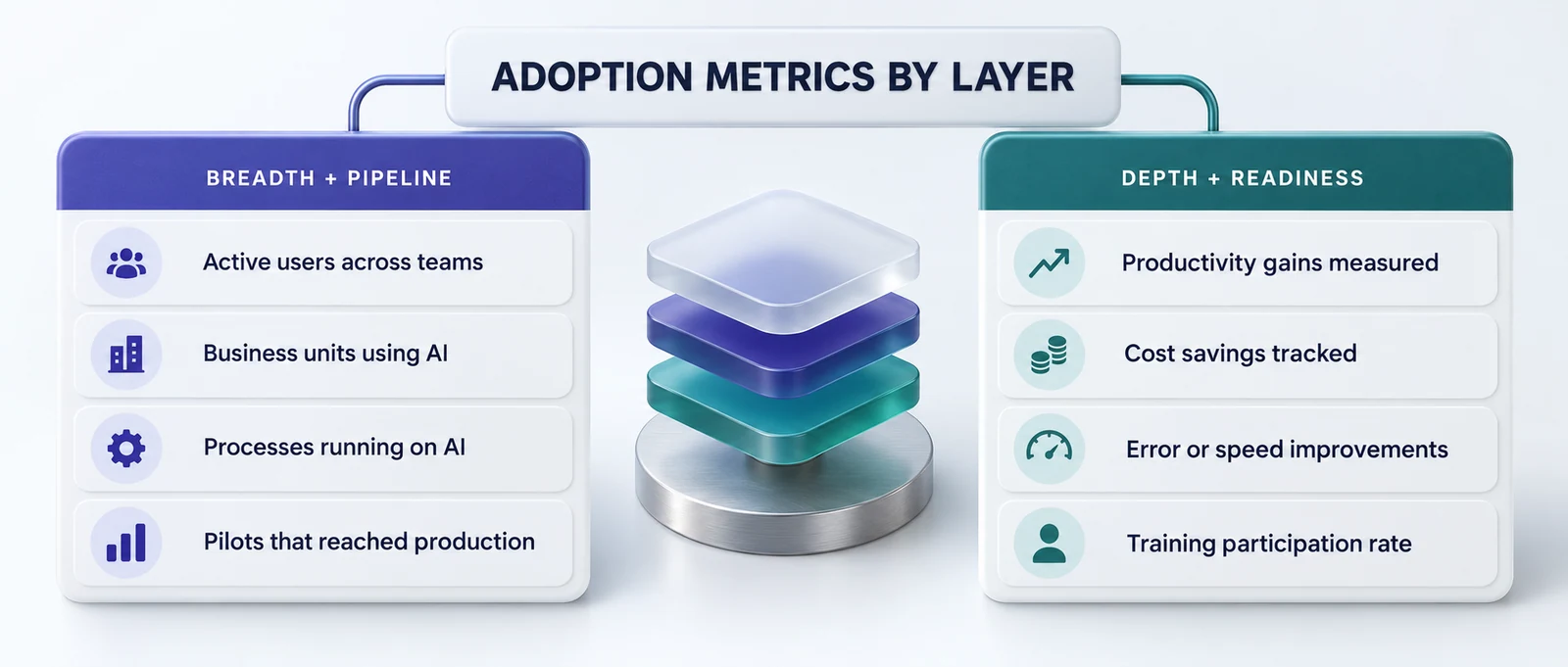
Breadth metrics include active users across business units, the number of processes that run on AI, and the proportion of pilots that reach production. These metrics are necessary to understand whether adoption is spreading. They are insufficient to confirm that adoption is working.
A team can have high active user counts because compliance requires logging in. Pilots can reach production because someone decided they were ready, not because they were. Breadth metrics answer the question of whether adoption is happening. They do not answer the question of whether adoption is worth having.
Depth metrics connect adoption to the outcomes the organization cared about when it decided to invest in AI. Productivity improvements, cost reductions, error rate changes, process speed, revenue impact, and customer experience changes are all valid depth metrics, depending on the workflows being changed.
Microsoft recommends measuring adoption breadth, business impact, pilot to production progression, and workforce readiness rather than relying on one usage metric. The combination matters because breadth without depth means activity without value, and depth without breadth means value that has not scaled.
Workforce readiness as a metric tracks whether the organization is building the ongoing capability needed to sustain and expand adoption, not just operate it at its current level. Training participation, capability assessment scores, and champion network health are all indicators of whether the organization can continue to scale adoption or whether it has hit a capability ceiling.
When you are evaluating whether to build AI capability in house or source it externally, the build vs buy decision framework provides a structured way to assess the tradeoffs before committing to either path.
If you are working through what sustained AI adoption actually requires for your organization, the agentic AI consulting engagement is designed to take you from where you are to a production scale system with measurable outcomes.