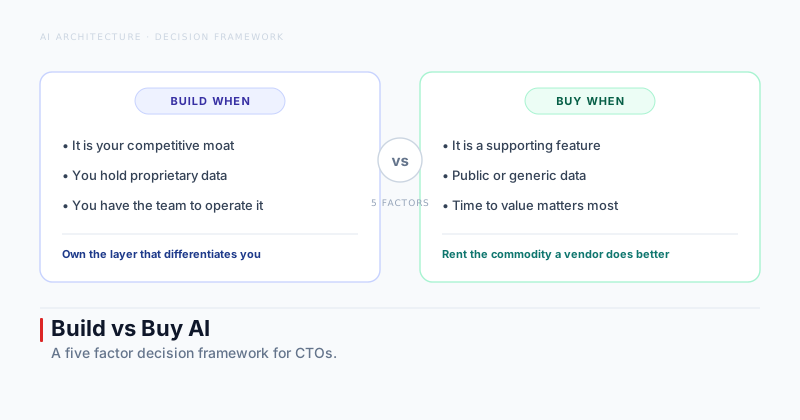
Section 01 · Definition
What build vs buy AI actually means
The phrase makes it sound binary. The real question is which parts of the stack you build and which parts you rent, and a framework exists to tell you where that line falls.
Quick answer
Should I build or buy AI? Build when the AI capability is your competitive moat and you have the data, talent, and time to own it. Buy when AI supports the business but is not what customers pay you for. Most teams end up hybrid: buy the platform, build the differentiating layer on top.
The phrase build vs buy makes it sound like a binary, and that framing is where most teams go wrong. The real question is which parts of your AI stack you build and which parts you rent. Almost nobody trains a foundation model anymore, and almost nobody should hand their entire product logic to a closed vendor. The decision lives in the middle, and the job of a framework is to tell you where the line falls for your specific situation.
A CTO who treats this as a procurement exercise will optimize for the wrong thing. Procurement asks which option is cheaper this quarter. Architecture asks which option you can still live with in two years, after the data has grown, the team has turned over, and the vendor has raised prices twice. The build vs buy AI decision is an architecture decision wearing a budget costume, and the cost line is only one of five inputs.
Section 02 · The rule
Build when AI is your moat, buy when it is not
Before the scoring, one rule resolves most cases on its own. The honest test is whether a customer would switch if the feature were slightly worse.
Before the scoring, there is a rule that resolves most cases on its own. Build the AI capability when it is your competitive moat. Buy it when it is not.
If your product is an AI product, where the quality of the model output is the reason customers choose you over a competitor, then the model, the data pipeline, and the evaluation rig are your core intellectual property. Outsourcing them to a vendor means outsourcing the thing your business is supposed to be best at. A fraud detection company that buys its fraud model from a third party has no business. That capability has to be built and owned.
If AI is a feature inside a product that sells on something else, the logic flips. A project management tool that adds an AI summary feature does not win or lose on summary quality the way an AI writing tool does. The summary is a convenience, not the moat. Building a custom summarization stack there means spending senior engineering time on a capability a vendor will sell you for a fraction of the cost, and the result earns no premium because customers did not come for it.
The trap is that everything feels strategic when you are close to it. The honest test is whether a customer would switch to a competitor if the feature were slightly worse. If yes, it is closer to a moat and leans build. If they would barely notice, it is a feature and leans buy. The AI readiness assessment framework walks through how to separate the capabilities that differentiate you from the ones that merely support you.
Section 03 · The framework
The five factor decision framework
When the moat rule does not settle it cleanly, score the decision across five independent factors so one loud argument cannot dominate a decision that has five inputs.
When the moat rule does not settle it cleanly, score the decision across five factors. Treat each one separately, because a capability can be strategic and still be wrong to build if you lack the talent to operate it. The factors are independent, and the value of scoring them apart is that it stops one loud argument from dominating a decision that has five inputs.
Strategic importance
Is this capability the reason customers pick you, or a supporting feature? Strategic and differentiating leans build. Supporting and commodity leans buy. This factor carries the most weight, because getting it wrong means either renting your moat or building a commodity.
Data advantage
Do you hold proprietary data a vendor cannot replicate, and would a model trained on it beat a general purpose one? A real data moat is the strongest reason to build, because it is the one advantage a vendor literally cannot sell you. No data edge weakens the case for build sharply.
Time to value
How fast does the business need this live? Buying is measured in weeks, building in quarters. If a market window is closing or a customer commitment is near, the delay of building has a price that belongs in the decision, not as an afterthought.
Talent readiness
Do you have engineers who can build this and, more importantly, operate it after launch? Building an AI system you cannot maintain is worse than buying, because the failure shows up six months later as a model quietly rotting with nobody watching it.
Total cost of ownership
What is the real cost over two years, not the sticker price? Build carries ongoing maintenance, retraining, monitoring, and on call. Buy carries usage fees that scale with success and the cost of leaving. Compare the lifetime numbers, not the launch numbers.
The mistake the generic frameworks make is stopping at this list. A list of factors is not a decision. What turns it into a tool is forcing a score on each one, which is the next step.
Section 04 · Scoring
The scoring rubric
Score each factor toward build or buy, add the columns, and read the zeros before you trust the totals. The point is to force a position on every factor, not to do arithmetic.
Score each factor on a simple scale. A clear lean toward build is two points for build, a clear lean toward buy is two points for buy, and a genuine toss up is one point each. Add the columns and the totals usually point somewhere obvious. The value is not the arithmetic; it is that scoring forces you to commit a position on each factor instead of waving at the whole decision.
| Factor | Leans build when | Leans buy when |
|---|---|---|
| Strategic importance | The capability is your moat and customers choose you for it | AI is a supporting feature, not the reason customers stay |
| Data advantage | You hold proprietary data a vendor cannot replicate | Public or generic data, where a general model already wins |
| Time to value | You can wait a quarter or two for a better fit | The business needs it live in weeks, not months |
| Talent readiness | You have engineers who can build and operate it | No team to maintain the system after launch |
| Total cost of ownership | Lifetime build cost beats vendor fees at your scale | Vendor pricing is lower than the cost of owning it |
A few totals are worth reading carefully. A high build score that hides a single zero on talent readiness is a warning, not a green light, because a system nobody can operate fails regardless of how strategic it is. A high buy score with a strong data advantage is the classic signal to look at the hybrid path rather than buying wholesale, because you may be about to rent away your only real edge. Look at the zeros before you trust the totals.
Section 05 · The hybrid path
Buy the platform, build the layer
For most teams the right answer is neither pure build nor pure buy. It is to rent the commodity layers and build the thin one that carries your advantage.
For most teams the right answer is neither pure build nor pure buy. It is to buy the commodity layers and build the thin layer that carries your advantage. This is not a compromise that splits the difference; it is usually the architecturally correct decision, and the frameworks that present build and buy as opposites miss it entirely.
The commodity layers are the ones where a vendor has economies of scale you will never match. Foundation models are the clearest example. Buy access to them from a provider rather than training your own, because the cost and talent required to compete there are out of reach for all but a handful of companies. The same logic applies to managed vector databases, hosting, observability tooling, and the undifferentiated plumbing of an AI system. Renting these frees your team to spend its time where the spend actually returns something.
The layer you build is the one that encodes what only you know. That is the retrieval logic tuned to your documents, the evaluation rig that measures quality the way your domain defines it, the orchestration that strings tools together for your specific workflow, and any fine tuning on data a competitor cannot get. This is where your data advantage and your domain knowledge turn into a product edge. A team that buys the platform and builds this layer gets to market faster than a pure build and keeps the moat a pure buy would have surrendered. The shape of that layer is exactly what an AI systems architecture engagement is meant to define, so the build effort lands on the parts that differentiate rather than on plumbing a vendor already sells.
Section 06 · Time to value
The cost of delay teams forget to price
Time is the factor teams underweight, because it does not show up on the build estimate. The honest comparison includes the value lost while you build.
Time is the factor teams underweight, because it does not show up on the build estimate. A build plan accounts for engineering months and infrastructure. It rarely accounts for the value the business did not capture during the quarters the bought version would already have been running. That gap is the cost of delay, and it is often larger than the line items on the build budget.
The honest comparison is not build cost versus buy cost. It is build cost plus the value lost to delay versus buy cost plus the cost of switching later if you outgrow the vendor. Buying is reversible at a price. Building is reversible too, but the sunk effort makes teams hold onto a custom system long past the point where a vendor would serve them better. Name both costs out loud, because the one you cannot see is the one that distorts the decision.
Grade the decision on two years, not two months
A build that looks cheaper on a quarterly budget often loses once you price the delay before launch and the maintenance after it. A buy that looks expensive per seat often wins once you account for the engineering time it frees and the speed it buys. The right unit of analysis is the lifetime of the capability, not the cost of standing it up.
When the decision is close and the stakes are high, the cheapest move is to get a second opinion from someone who has built the thing the vendor is selling, before the contract or the build plan is locked. That is the same discipline behind running real AI vendor due diligence on a shortlist, and behind deciding early whether you even have the team to build, which is the heart of the hire AI engineers or use a consultant question. Decide the sourcing strategy before you decide the vendor, not after.