
Section 01 · Scope
Define the Agent’s Job and Authority First
An agent’s scope defines what it can do and what it cannot do. Getting that boundary right before anything else is the difference between a governable system and a liability.
Quick answer
The short answer: AI agent development services should be evaluated as production engineering, not prompt assembly. A credible provider defines agent scope, tool permissions, integration boundaries, human review points, evaluation criteria, observability, and security controls before autonomy expands. The buyer question is whether the agent stays useful, auditable, and controllable across real workflows.
Most early stage agent projects treat scope as flexible: the agent should handle as much as the model can manage. That framing leads to agents with broad permissions and no clear stopping conditions, which creates liability and operational chaos when the system is used on real data.
The right starting point is a bounded job description. What workflow does the agent handle? What are the exact inputs? What is the agent authorized to read, modify, or trigger? What happens when a task falls outside scope? DevTrios, working on production systems in CRM and ERP environments, characterizes production agents as systems with clearly defined tasks, direct enterprise integrations, scoped permissions, logging, controls, and human escalation as explicit design elements rather than retrofitted additions.
Separating useful autonomy from unnecessary autonomy requires making this boundary explicit before selecting a framework. An agent that searches, summarizes, and drafts a reply is different from one that searches, summarizes, drafts, and sends. The second system requires a human review checkpoint before the send action. The first does not. Treating both as equivalent because both use a language model is a common and costly mistake.
The job scope is also what allows a development partner to estimate cost, risk, and timeline accurately. A vague mandate produces vague engineering, vague evaluation, and vague results. If a prospective partner has not asked you to define the authority boundary before quoting a timeline, that is a signal worth taking seriously.
Bound the workflow before choosing a framework
Framework selection follows scope definition, not the other way around. A framework that excels at multistep research workflows may be poorly suited to a short, deterministic data extraction task. Choosing the framework first and fitting the workflow to it is the inverse of sound architecture.
Once the workflow is bounded, the framework decision reduces to a smaller set of questions: does the framework support the tool types the workflow requires, does it expose the tracing and callback hooks needed for observability, and does the team deploying it have production experience with it?
Separate useful autonomy from unnecessary autonomy
Every action the agent takes autonomously is an action your team is responsible for. Autonomy is appropriate where the agent’s judgment is reliable, the action is reversible, and the cost of an error is low. Autonomy requires a human gate where reliability is uncertain, the action is irreversible, or the consequence of error is significant.
That separation should be documented before the pilot begins, agreed upon by the business stakeholders who own the affected workflows, and enforced in the permission system rather than expressed only in the system prompt.
Section 02 · Security
Design Identity, Permissions, and Escalation Paths
Permissions are the structural backbone of a safe agent. Every tool call and system write should be authorized explicitly, scoped to the minimum necessary, and logged.
SPR’s production agent controls include trust boundaries, identity models, permissioning, escalation paths, role based access control, restricted tool use, and human review as design requirements rather than optional governance additions. Mobilions describes scoped permissions, approvals, rate limits, logging, and human review checkpoints as part of the engineering contract. These controls determine what the agent can actually do in production.
The identity model becomes more important as agents integrate with multiple downstream systems. An agent acting on behalf of a user should hold that user’s permissions, not elevated service account access. An agent acting on behalf of an organization should operate under a defined service identity with audit trails. When identity is undefined, agents typically inherit the credentials of the developer or service account that deployed them, which is almost always too broad.
Escalation paths define what happens when the agent encounters something outside its confidence boundary or authority limit. A production agent without explicit escalation paths either stops with an error or continues with an action that exceeds its authority. Neither outcome is acceptable in a workflow that touches real systems. The guardrail architecture for production agents treats escalation as a permissions system problem rather than a model behavior problem, which is the correct framing.
Least privilege for tools and data
The tool list available to the agent should contain exactly the tools the workflow requires and nothing else. Adding tools speculatively because they might be useful later expands the attack surface and makes the permission model harder to reason about.
Data access follows the same principle. If the agent’s workflow requires reading customer records from a single CRM object type, the access grant should cover that object type only, not the full CRM schema.
Human review for consequential actions
Some actions require human approval before execution regardless of model confidence. Financial transactions above a defined threshold, outbound customer communications, configuration changes in production systems, and data deletions are the common categories.
The approval mechanism should be part of the agent’s architecture from the start: a queue, a notification, and an explicit approval token the agent checks before proceeding. Building this retroactively after a production incident is both more expensive and less reliable.
Section 03 · Observability
Treat Evaluation and Observability as Product Features
Evaluation is how you know whether the agent is doing the right thing. Observability is how you know what it is actually doing. Both are engineering deliverables, not byproducts of a capable model.
Verensoft describes production agent engineering as including evaluation datasets, output validation, confidence thresholds, approval gates, failure handling, and monitoring of runs, tool calls, decisions, outputs, costs, and failures. SPR lists benchmarks, red teaming, human review quality assurance, session logs, tool use telemetry, evaluation dashboards, and cost and performance tracking as production controls. Together these constitute the operating layer that makes an agent governable.
The evaluation dataset comes first. Before the pilot runs, a set of inputs with known correct outputs should exist. That dataset drives the test suite, the threshold design, and the release gate. Without it, every evaluation question becomes subjective, and production regressions go undetected until a user reports them.
Observability means you can trace every agent run: what was the input, what did the model reason, what tools were called, what those tools returned, and what action the agent took. That trace is also what a structured agent incident response process depends on when something goes wrong. An agent you cannot trace is an agent you cannot debug, audit, or improve.
Cost observability is separate and frequently skipped until the bill arrives. Token spend per run, per step, and per task type should be tracked from the first production run. Agents that appear inexpensive in demos often cost five to ten times more in production because context windows grow substantially across real multistep workflows.
Evaluation datasets and success metrics
An evaluation dataset is not a QA checklist. It is a representative sample of real inputs the agent will encounter, paired with expected outputs or outcome criteria. It grows as the agent runs in production and encounters edge cases.
Success metrics should cover both correctness—does the agent produce the right output—and behavior—does it use the right tools, escalate appropriately, and stay within authorized boundaries. Agents can produce superficially correct outputs through unauthorized means. Both dimensions require measurement.
Tracing tool calls, costs, and failures
Tracing infrastructure should capture the full chain: input, plan, tool calls and their responses, model reasoning steps, and final output. That chain allows engineers to replay a failed run, identify exactly where the failure occurred, and understand whether it was a model error, a tool error, or a permission error.
Cost tracking should be granular enough to identify which step types drive spend. For most agents, a small fraction of step types accounts for the majority of token consumption. Identifying those early allows cost optimization to be targeted rather than speculative.
Section 04 · Integration
Integrate Agents into Real Systems Safely
Production agents do their work by calling real systems: APIs, enterprise databases, CRM platforms, workflow tools, and knowledge stores. The integration design determines both how much the agent can accomplish and how much operational risk it carries.
SPR describes enterprise agent integration as spanning APIs, ERP, CRM, ITSM, CI/CD, and data platforms, with policy controls governing both retrieval and actions. The distinction between retrieval and action matters operationally. Retrieval carries read risk. Writes and triggers carry operational risk. The permission system should treat those differently, and human review should apply more scrutiny to write and trigger actions than to reads.
Knowledge access requires a retrieval design that treats the knowledge base as an input with its own quality constraints. Stale documents, inconsistent metadata, and missing access controls in the underlying knowledge store surface as incorrect agent behavior. Fixing the retrieval layer often requires fixing the source data first, which the development engagement must account for in scope and timeline.
Governed action execution means the agent verifies authorization before triggering any action. A purchase order, an outbound notification, a system configuration change: each should have an explicit authorization check, an audit record, and a human approval gate where the business process requires one. Building this into the production agent architecture from the start is significantly less expensive than retrofitting it after a deployment.
APIs, enterprise systems, and knowledge access
The integration surface is where most production failures originate. A model that behaves correctly in isolation can produce incorrect behavior when tool responses are delayed, malformed, or incomplete. Integration tests that exercise the full tool call cycle, not just the model’s reasoning, are necessary before the pilot goes live.
Rate limiting, retry logic, and timeout handling on every tool call are not optional. An agent that calls an API without a timeout will hang indefinitely when the API is slow or unresponsive. The failure mode is invisible in a demo environment and visible immediately in production.
Section 05 · Scale
Industrialize Before Scaling Autonomy
A successful pilot proves the agent works in controlled conditions. Industrialization proves it works in production at the scale and reliability the business requires. The gap between those two states is where most agent projects stall.
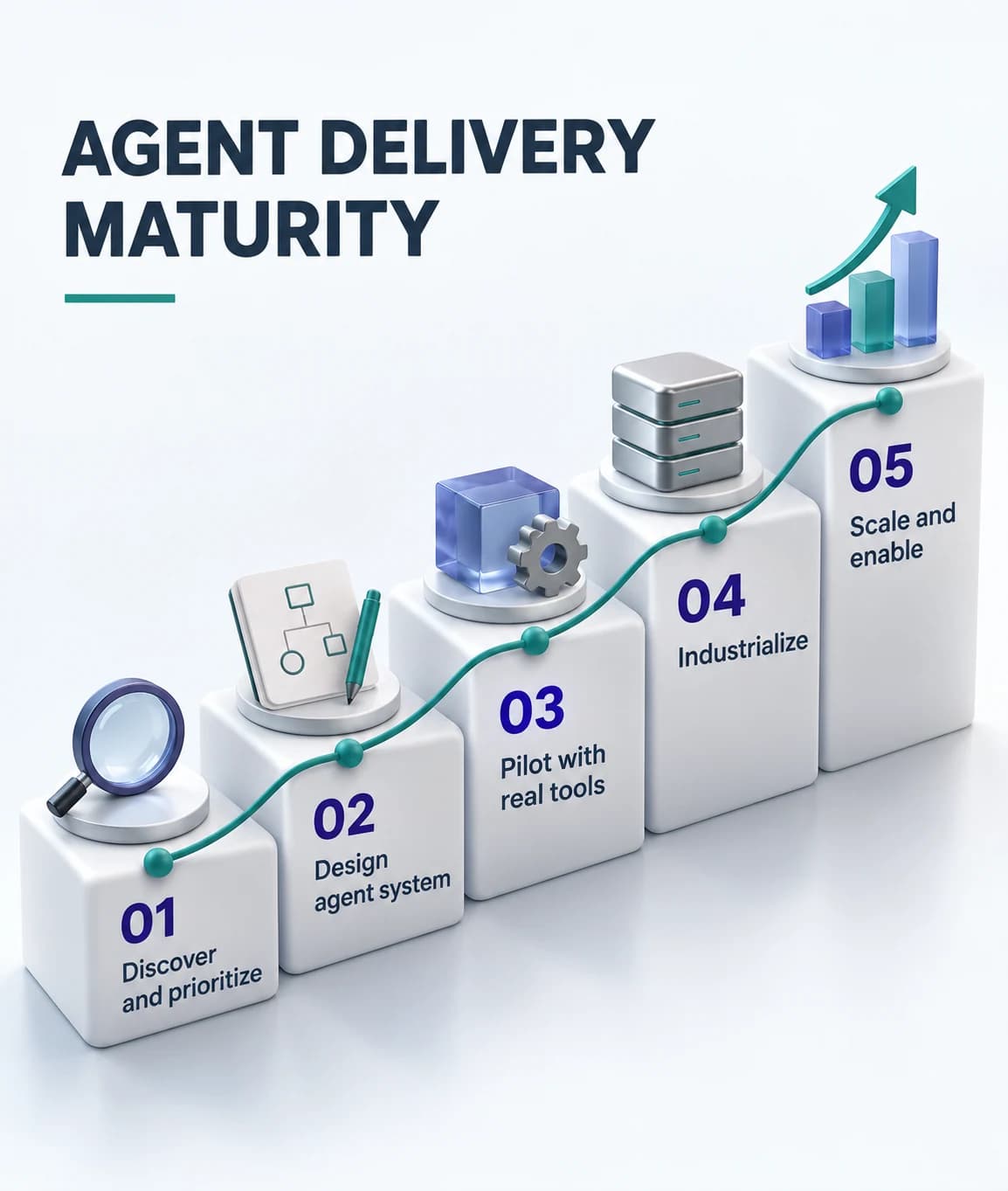
SPR’s delivery sequence moves from discovery and agent design to a pilot with real data and real tools, then industrialization with security hardening, observability, MLOps tooling, and feedback mechanisms before broader rollout. Each stage gates the next. Moving directly from pilot to scale without the industrialization layer is the primary cause of production agent failures.
Security hardening at this stage means the agent’s code, dependencies, integration credentials, and model access are governed by the same controls as any other production system. Credentials should be rotated, stored in a secrets manager, and scoped to minimum access. The model provider relationship should be covered by a data processing agreement appropriate to the sensitivity of the data the agent handles.
Feedback loops close the gap between production behavior and expected behavior. Every run produces data about where the agent succeeded, where it hesitated, where it escalated, and where it failed. That data should feed back into the evaluation dataset, the threshold design, and the prompting or fine-tuning strategy on a defined cadence. An agent without a feedback loop drifts over time as the underlying models, tools, and data change.
The rollout design is also part of industrialization. Expanding from a small cohort of real users with measured outcomes before moving to full traffic is the pattern that works consistently. Launching to full traffic from the pilot is the pattern that generates production incidents.
Pilot with real data and tools
A pilot that does not use real data and real tools is not a pilot. It is a demonstration. The value of a pilot is discovering what happens when the agent encounters the actual variability of real inputs: ambiguous queries, missing fields, slow API responses, and unexpected data formats. Controlled synthetic data hides all of those.
The pilot should run on a small but representative slice of the actual workflow, with real users and real system integrations. The evaluation dataset should be populated from those runs, not from synthetic examples designed to make the agent look capable.
Section 06 · Selection
Use Vendor Selection Criteria Tied to Operations
The most reliable way to distinguish a capable AI agent development partner from a capable demo builder is to ask operational questions rather than technical ones. Demo quality correlates weakly with production reliability.
Ask how the provider defines and enforces tool permissions. Ask to see an example evaluation dataset and the success threshold associated with it. Ask how the provider structures escalation when the agent is not confident. Ask what observability tooling ships with the delivery. Ask how incident response is structured and what the rollback procedure looks like for a failed agent action.
Providers who answer those questions with specifics understand production engineering. Providers who redirect to model benchmarks, platform partnerships, or the sophistication of their demo workflows are still operating in demo mode. The agent built with a demo focused provider will eventually require rebuilding by a production focused one.
The vendor selection process should also include operating cost estimation. Ask for a token spend estimate per workflow, a cost tracking plan, and an alert threshold design. An engagement that does not include cost modeling is incomplete and will surface that gap in the first production month.
If your team is evaluating AI agent development partners and wants a technical review of what production-grade delivery actually requires, that work starts with a conversation through Agentic AI Consulting.