
Quick answer
What is an AI agent in blockchain? An AI agent in a blockchain context is an autonomous software program that can read onchain state, reason over it, and take action by submitting transactions or triggering contract calls. The agent's logic runs offchain, onchain, or in a hybrid arrangement depending on the integration pattern chosen.
Section 01 · The core problem
Why putting AI agents onchain is harder than it sounds
The premise sounds straightforward. Blockchains enable trustless coordination. AI agents enable autonomous action. Put them together and you have autonomous trustless systems. The problem is that these two technologies make opposing assumptions about computation.
A blockchain is a deterministic state machine. Every node in the network must reach the same result when it executes the same transaction. That is the foundation of consensus. If you call a function with the same inputs, you must always get the same output. Nondeterminism breaks the protocol.
A large language model is nondeterministic by design. Sampling introduces randomness. The same prompt produces different outputs across runs. Temperature, system prompt drift, model updates, and API latency all mean that two nodes calling the same AI model at the same time will not agree on the result. You cannot run a neural network inside an EVM smart contract and expect consensus to hold.
This is not a solvable problem with better hardware or faster inference. It is a structural mismatch. AI agents and blockchains inhabit different computational worlds, and any architecture that puts them together must explicitly choose where each piece of logic runs and how trust flows between them.
The cost problem
Onchain computation is expensive. EVM gas fees price execution by opcode. Running even a shallow neural network inside a smart contract would cost orders of magnitude more than any practical application justifies. This forces the actual AI reasoning offchain in every production system.
The verification problem
If the AI agent runs offchain, how does the onchain system verify that the agent behaved correctly? A smart contract can verify a cryptographic signature but it cannot verify that a language model followed its instructions. The gap between 'the agent submitted a valid transaction' and 'the agent reasoned correctly' is the core verification problem in onchain AI agent design.
Understanding these three structural constraints — determinism, cost, and verification — is what separates practical onchain AI agent architecture from the hype layer.
Section 02 · Architecture overview
The three integration patterns for AI agents and blockchain
Given these constraints, production systems have converged on three integration patterns. Each makes a different tradeoff between practicality, auditability, and trustlessness.
The patterns are not a progression from simple to advanced. Each exists because it fits a specific set of requirements. Choosing the wrong pattern for your requirements is the most common architectural mistake in this space.
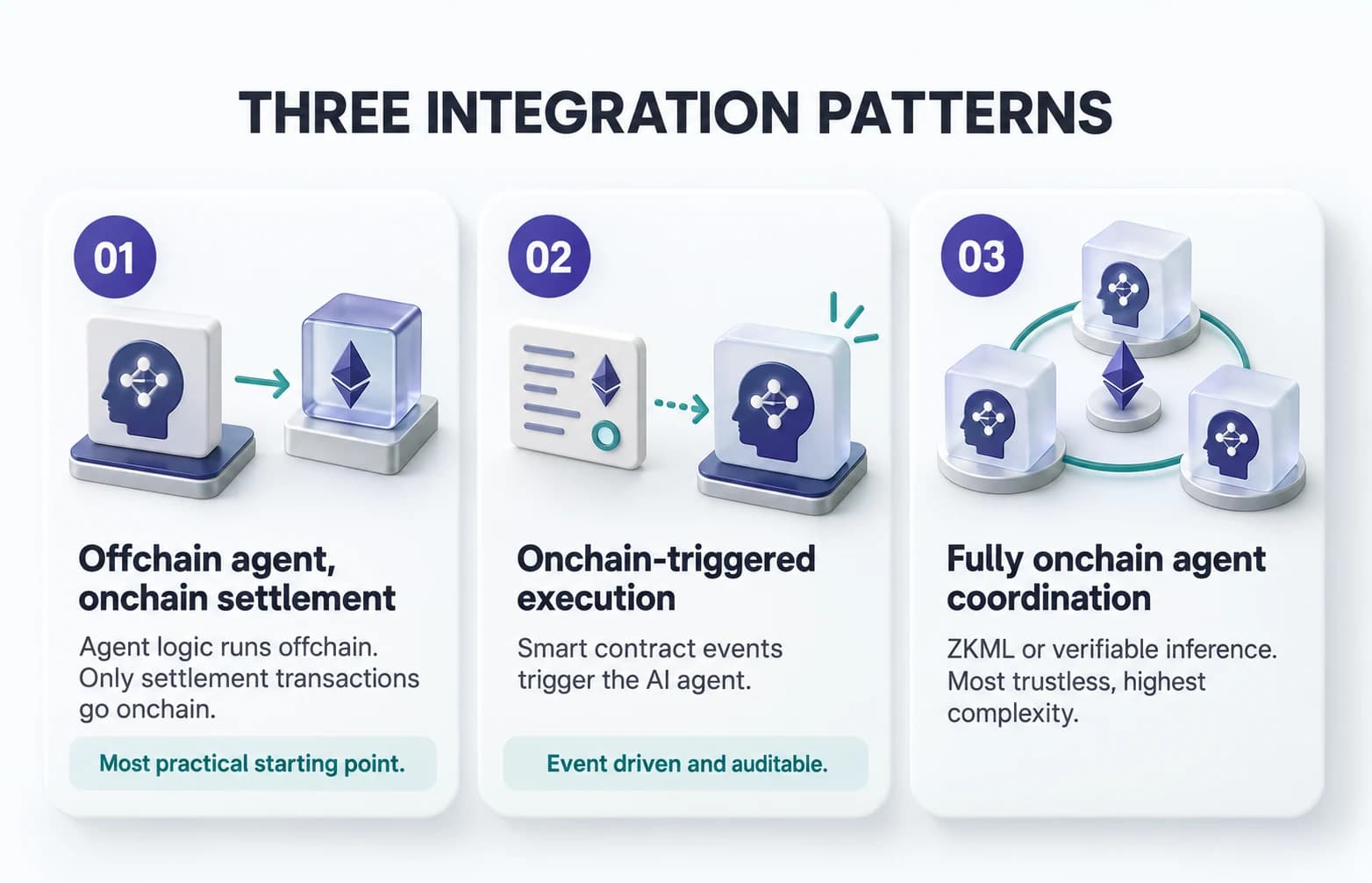
The sections below treat each pattern in detail: what runs where, what the trust model looks like, and where each one breaks down.
Section 03 · Pattern 1
Pattern 1: Offchain agent, onchain settlement
In this pattern, the AI agent runs entirely in a conventional offchain environment. The blockchain is not involved in the agent's reasoning or tool use. Only the outcome reaches the chain.
The typical flow looks like this. A user or protocol triggers the agent with a task. The agent reasons over available data, calls external APIs, makes decisions across multiple steps, and arrives at a conclusion. That conclusion is translated into a signed transaction or a structured payload and submitted to a smart contract. The contract records the outcome, transfers value, or updates state.
What makes this pattern work is that the smart contract does not need to trust the agent's reasoning. It only verifies the signature. The agent holds a private key via a wallet SDK, and the contract treats the agent's transaction the same as any other signed transaction. Trust is established by key custody, not by verifying inference.
Why this is the right starting point
The offchain environment is unrestricted: you can use any language model, any agent framework, and any tooling. Latency is acceptable because the agent does not wait for block confirmation during its reasoning loop. Costs are low because expensive AI calls happen offchain.
Where this pattern breaks down
An observer looking at the onchain record sees a transaction from an address. They cannot verify what reasoning produced it. If the agent misbehaves or is compromised, the evidence is in the offchain logs, not in the immutable ledger. Key custody is also the primary attack surface: a compromised private key means an attacker can submit arbitrary transactions on the agent's behalf.
For teams exploring how offchain agent systems connect to production infrastructure, the AI systems architecture service covers trust boundary design as part of the engagement.
Section 04 · Pattern 2
Pattern 2: Onchain-triggered agent execution
In this pattern, the smart contract is the source of truth for when the agent should act. A contract event or a state transition serves as the trigger that kicks off agent execution.
The agent observes the chain, detects the trigger, runs its reasoning loop, and submits a response transaction back to the contract. Two canonical examples illustrate the pattern well.
DeFi rebalancing agent
A vault contract holds assets and emits events when collateral ratios move outside defined bands. An agent process monitors the chain for these events, receives the trigger, reasons over current market data and available liquidity, computes the optimal rebalancing transactions, and submits them. The contract validates and executes.
Dispute resolution agent
A smart contract escrow holds funds and emits a dispute event when one party files a claim. An agent receives the event, retrieves the attached evidence from a content addressable storage layer, reasons over the claim, and submits a resolution decision. The contract uses the signed decision to release or return the funds.
The event driven character of this pattern is what makes it auditable. The trigger is onchain. The agent's response is onchain. The relationship between cause and effect is recorded and verifiable even if the agent's internal reasoning is not. For regulated applications and governance systems, this auditability is often sufficient.
The latency tradeoff
The agent's reasoning loop adds delay between the onchain event and the onchain response. In markets that move fast or protocols where timing is critical, this gap matters. The standard mitigation is to separate the reasoning from the execution: compute candidate actions during normal operation and use the agent to select among them at trigger time rather than generating from scratch.
This pattern is the right architectural choice when the triggering logic is complex enough to warrant a smart contract but the response logic is too dynamic or too dependent on context to be expressed as a deterministic contract function. The agentic AI consulting service often recommends this pattern for DeFi protocols, DAO tooling, and onchain governance systems where auditability of the trigger is the core requirement.
Section 05 · Pattern 3
Pattern 3: Fully onchain agent coordination
This pattern attempts to bring the agent's reasoning itself onchain — not just the inputs and outputs. The goal is trustless verification: any observer should be able to confirm that the agent ran the correct model and produced the correct output, without trusting the operator's server.
Two technical approaches exist today.
Zero knowledge machine learning
A zero knowledge proof is generated offchain that proves a specific neural network, with specific weights, was applied to a specific input and produced a specific output. The proof is compact and can be verified by a smart contract cheaply and deterministically. The inference still runs offchain, but the correctness of the inference is cryptographically attested. Frameworks actively being built include EZKL, Modulus, and Risc Zero.
Optimistic execution with fraud proofs
Analogous to how optimistic rollups handle transaction validity, the agent submits its result onchain, a challenge window opens, and any verifier can rerun the inference and challenge an incorrect result. This approach shifts trust from the initial submission to the economic cost of mounting a fraud.
Why this pattern is not yet the default
ZKML proof generation for current language model sizes is orders of magnitude slower than standard inference. A proof for a modest transformer model can take minutes to hours on current hardware. The frameworks are improving rapidly, but production deployment for large models is still ahead of where the tooling is today.
The fully onchain pattern is the right choice when the application genuinely requires trustless verification of the agent's reasoning, not just its outputs. Prediction markets, onchain insurance oracles, and decentralized governance systems that allocate significant value based on AI decisions are the natural candidates.
For most teams, this pattern is a directional goal rather than today's starting point. The practical path is to launch with Pattern 1 or Pattern 2, instrument the offchain reasoning thoroughly, and migrate toward verifiable inference as the tooling matures and the stakes justify it.
The multiagent design patterns guide covers how agent coordination topologies translate into blockchain governance structures for teams thinking about multiagent onchain systems.
Section 06 · Decision
Trade-off map: when each pattern fits
The three patterns sit at different positions on two axes: operational complexity and trustlessness. Pattern 1 has the lowest complexity and the lowest trustlessness. Pattern 3 has the highest of both.
| Requirement | Pattern 1 | Pattern 2 | Pattern 3 |
|---|---|---|---|
| Agent logic runs offchain | Yes | Yes | Partial (proof offchain) |
| Trigger lives onchain | No | Yes | Yes |
| Reasoning is cryptographically verifiable | No | No | Yes |
| Production-ready tooling today | Yes | Yes | Partial |
| Suitable for decentralized trustless systems | No | Limited | Yes |
| Typical time to first deploy | Days to weeks | Weeks | Months or longer |
Teams building a first integration should default to Pattern 1. It is the fastest path to a working system and allows you to validate the agent's usefulness before investing in trust infrastructure.
Teams with event driven smart contract systems and auditability requirements should move to Pattern 2. The additional complexity over Pattern 1 is modest and the auditability gain is significant.
Teams building decentralized infrastructure where the agent's correctness must be verifiable by third parties without trust in the operator should plan for Pattern 3, with a realistic timeline for when ZKML tooling will meet their model size and latency requirements.
The hybrid approach
One pattern that is often overlooked is the hybrid: Pattern 1 or Pattern 2 for execution, with an independent verification layer that replicates the agent's reasoning and posts a hash of the result onchain. This does not give you the full trustlessness of ZKML, but it creates an auditable record that can be disputed if the agent misbehaves. It is a practical middle ground for many applications.
The most important thing to understand is that none of these patterns eliminates the fundamental tension between probabilistic AI reasoning and deterministic onchain state. Every architecture is a choice about where that tension lives and who bears the trust assumption. Making that choice deliberately, rather than hoping the tension goes away, is what separates a thoughtfully designed onchain AI agent system from one that will cause problems in production.