Section 01 · The models
What AI consulting engagement models are and why they matter
An engagement model defines how the vendor prices risk, how the buyer pays for results, and what either party can do when scope shifts. Getting this allocation right before signing matters more than most buyers expect.
Quick answer
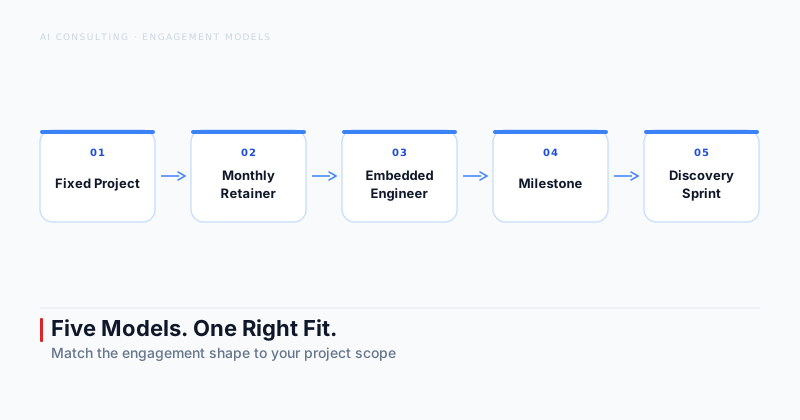
What are the main AI consulting engagement models? The five models are: fixed project SOW, monthly retainer, embedded engineer, milestone based delivery, and discovery sprint. Selection depends on scope clarity first, then engagement duration and budget flexibility. A clearly scoped deliverable suits a fixed project; an evolving or unknown scope suits a retainer or discovery sprint.
Most buying mistakes happen not because buyers choose a bad vendor but because they sign a contract shaped for a different problem. A startup that does not yet know whether it needs a production RAG pipeline or a multiagent orchestration layer should not sign a fixed project SOW. It needs a discovery sprint first, or a retainer scoped around research deliverables. The model comes before the proposal, not after.
A fixed project places scope risk on the vendor. A retainer places flexibility value on the buyer. An embedded model places integration cost on both sides. Getting this allocation right before signing matters because renegotiating it midway requires either a formal change order or a new contract — and both slow delivery at exactly the moment teams can least afford it.
Section 02 · Fixed project
Fixed project SOW: when scope is locked before work starts
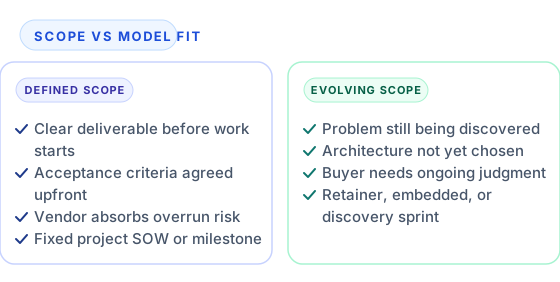
A fixed project covers a clearly defined set of deliverables for a fixed price and timeline. The vendor is responsible for hitting the deliverables within the agreed parameters — and absorbs the overrun if the estimate was wrong.
The model works when you can write a two or three page scope document that the vendor can price accurately. Production deployments of already designed architectures, performance tuning of live systems, and security audits with defined coverage all fit this shape. The risk transfer is real: if the vendor underestimates the work, they absorb the cost difference, not you.
The model breaks when scope is a moving target. AI projects are often discovery driven, particularly in early stages when the problem definition changes as the team builds understanding. Adding scope mid project requires a formal change order, which slows delivery and strains the relationship. If you cannot write a complete scope document before requesting a proposal, a fixed project contract is the wrong choice.
When to use it
You have a defined deliverable, a clear acceptance criterion, and no expectation that scope will expand materially during delivery.
When to avoid it
You are still learning what you need to build, the model or architecture is not yet chosen, or the engagement requires ongoing iteration after the initial delivery.
Section 03 · Monthly retainer
Monthly retainer: continuous architecture ownership
A monthly retainer buys a defined number of hours or days per month at an agreed rate, with a rolling engagement that either party can end on notice.
Retainers appear more expensive per hour when you look at a single month in isolation. They become less expensive per unit of value across a six or twelve month engagement because you are not repricing scope each time you need the vendor's attention. The overhead of repeated scoping and contracting disappears, and the vendor builds context over time that makes each engagement cycle faster.
The risk in a retainer is underdirection. Buyers who do not define what success looks like at the start of each month end up with a vendor who is busy but not productive. A well structured retainer has monthly objectives, a defined review cadence, and clear renewal criteria. Before the retainer starts, understanding what to look for in the vendor's engagement terms matters as much as the rate — the post on how to evaluate an AI consulting proposal covers the contract terms and red flags that separate strong vendors from expensive ones.
When to use it
Your AI roadmap is evolving, you need continuous architecture guidance, or you want an ongoing advisory relationship without repricing scope each quarter.
When to avoid it
You have a single clearly defined deliverable and no further work planned. A fixed project is the simpler and often cheaper structure for that work.
Section 04 · Embedded engineer
Embedded engineer: when you need a team member, not a vendor
An embedded engagement places a senior AI engineer inside your team for a defined number of days per week — attending standups, writing code, participating in architecture reviews.
This is meaningfully different from a retainer: the retainer gives you advisory access, while the embedded model gives you execution capacity with daily team integration. The distinction matters when deciding between hiring and bringing in external help. A full time hire takes three to six months to find, onboard, and reach productive velocity. An embedded engagement can start in weeks. If you want a clear breakdown of when to hire versus when to use external AI talent, the guide on hiring AI engineers versus using a consultant covers the decision in detail.
Embedded engagements carry the highest monthly rate of the five models because you are paying for full team integration and execution capacity, not just advisory access or a fixed deliverable. The premium is justified when the work requires daily collaboration, when the engineer needs deep codebase familiarity, or when you are building toward a full time hire and want to reduce the risk of a permanent commitment by running a working period first.
When to use it
You need execution capacity on a specific AI subsystem, you want someone building inside your team without a permanent hire, or you are evaluating whether to bring on a full time person.
When to avoid it
The work is advisory, architecture, or audit focused. Paying embedded rates for work that could be done at advisory rates is the most consistent way buyers overpay for AI consulting.
Section 05 · Milestone based
Milestone based delivery: tie payment to delivery gates
A milestone based engagement works like a fixed project but breaks payment into tranches tied to demonstrated delivery checkpoints.
You pay a portion at scoping, a portion at a defined technical gate, and the remainder at final delivery. The model is common in regulated contexts and when a buyer wants payment to follow proof rather than a calendar date. The appeal is alignment: the vendor gets paid when they deliver, not just when time passes.
The practical challenge is defining milestones that are both meaningful and unambiguous. A milestone of “model accuracy reaches 85 percent” sounds clear but immediately raises questions about which dataset, which evaluation protocol, and what happens if 84.6 percent is achieved. Poorly defined milestones create disputes at exactly the moment both sides most need trust. Vendors price milestone engagements at a slight premium over comparable fixed project work because the deferred payment structure shifts cash flow risk onto them.
When to use it
You want payment tied to demonstrable technical progress, you are in a regulated context requiring delivery evidence, or you are working with a new vendor and want payment gated on proof points.
When to avoid it
You cannot define unambiguous, measurable acceptance criteria for each milestone. Vague milestones generate disputes faster than almost any other contract term.
Section 06 · Discovery sprint
Discovery sprint: when the problem shape is not clear
A discovery sprint is a time boxed, fixed price engagement scoped around research, evaluation, and recommendation rather than production delivery.
Use a discovery sprint when you know you need AI capability but have not yet determined what to build. A founder who suspects their support workflow could benefit from automation but does not know whether to build a classifier, a retrieval pipeline, or an agent needs a discovery sprint before they need a delivery vendor. The sprint defines the right problem before committing budget to solving the wrong one.
Discovery sprints are often the cheapest engagement to start and the highest value to complete. They scope every subsequent engagement correctly, which means the money you avoid spending on misdirected fixed project work typically exceeds the cost of the sprint. Some vendors credit the sprint fee against a subsequent delivery engagement as an incentive to continue. The output is a document, an architecture decision record, or a focused proof of concept — not a live system.
When to use it
You know you want AI capability but the architecture, model selection, or problem definition is not settled. Spend a small amount on clarity before a large amount on execution.
When to avoid it
You have already completed a technical discovery and have a documented architecture. Running another discovery phase on a solved problem does not add value.
Section 07 · Matching the model
How to match the AI consulting engagement model to your project
The two variables that determine the right model are scope clarity and engagement duration. Use this decision table as a starting point, then adjust for the three common mismatches below.
| Scope | Duration | Right model |
|---|---|---|
| Well defined deliverable | Under 3 months | Fixed project SOW |
| Well defined deliverable | Over 3 months, sequential | Milestone based |
| Evolving, roadmap driven | Ongoing | Monthly retainer |
| Needs daily team integration | Ongoing | Embedded engineer |
| Not yet defined | 2 to 6 weeks | Discovery sprint |
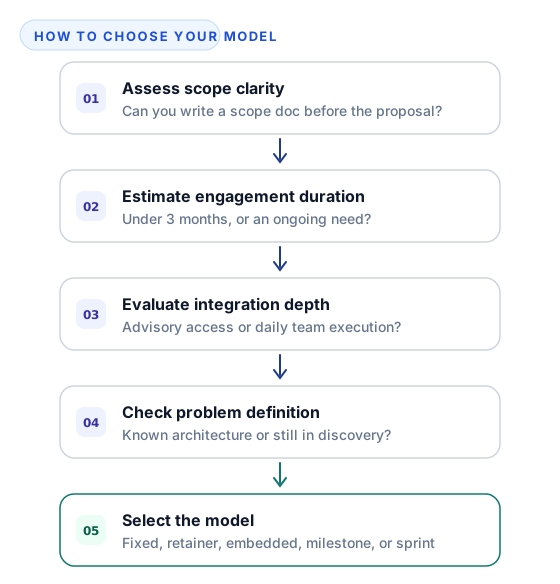
Three situations consistently lead buyers to pick the wrong model. The first: thinking scope is well defined when it is not. Early stage AI work almost always reveals unknown unknowns once development starts. If there is meaningful uncertainty about the model, dataset, or architecture, lean toward a retainer or milestone model rather than a fixed project, even if the scope document looks complete.
The second: wanting an embedded engineer when you actually need an advisor. Embedded rates are significantly higher than advisory rates. If the vendor's primary deliverable is a recommendation, an architecture review, or a design document rather than code in your environment, pay advisory rates instead.
The third: skipping the discovery sprint because it feels like overhead. A two week discovery sprint is cheaper than one month of misdirected delivery work. If the problem is not defined correctly, the sprint pays for itself. Before requesting proposals under any model, understanding how to qualify the vendor matters as much as the contract structure. The post on AI consulting services and what to look for when hiring covers the qualification criteria and red flags that separate vendors worth engaging from those that will cost you time.
If you want help choosing and structuring an AI consulting engagement for your team, the Agentic AI Consulting service covers architecture, vendor selection, and engagement design from initial scoping through production delivery.