Quick answer
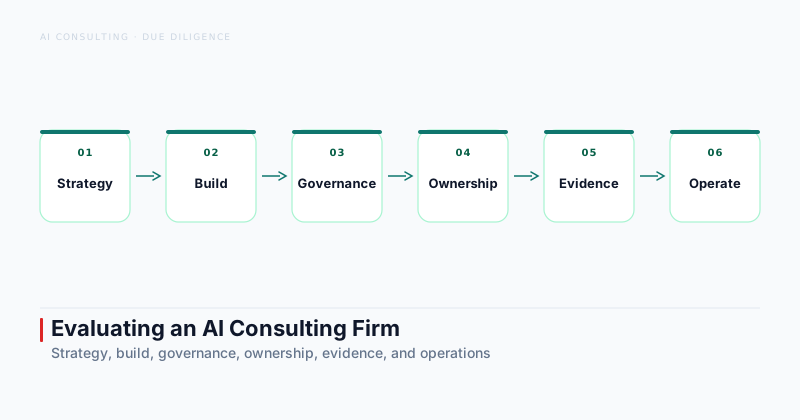
What should an AI consulting firm actually deliver? An AI consulting firm should help buyers reach production with less risk by combining strategy, architecture, engineering, governance, and operating support. The strongest firms show evidence of production delivery, define ownership clearly, avoid unnecessary vendor lock, measure outcomes, and explain exactly how a pilot becomes a maintainable system inside the client environment.
Section 01 · Scope
What a serious AI consulting firm should do
A consulting engagement spans readiness assessment, use case prioritization, architecture design, engineering, integration, governance, and operational support. Not every firm covers all of them. Understanding where a firm stops is as important as understanding where it starts.
Many AI consulting firms stop at strategy. Some focus only on engineering. A few aim to stay involved through production operations. The distinction matters because a gap in the delivery chain falls to the client. If the firm advises but does not build, you hire a separate engineering team. If the firm builds but does not govern, you own a system with no evaluation framework and no clear accountability for failure modes. If the firm builds and leaves, you own a system no one on your team can maintain.
Advisory, engineering, and operations
Consulting firms typically position themselves along a spectrum. At one end are pure strategy shops: they run workshops, produce roadmaps, and hand off to your internal team or a separate implementation partner. At the other end are firms that stay embedded through production, running evaluations, monitoring costs, and handling incident response for systems they shipped.
The right position on that spectrum depends on your team. If you have strong in house engineers who need architecture direction, a purely advisory firm may be appropriate. If you need someone to ship the system and hand it off in working condition, you want a firm that has done that before and can show you the evidence.
Why capability lists are not enough
Capability lists describe what a firm is willing to attempt. Production evidence describes what a firm has delivered and what those systems look like today. The two are not the same, and conflating them is the most common mistake buyers make when shortlisting AI consulting firms.
The questions to ask are specific: which client systems are still running? Who owns the infrastructure? Can the client operate the system without the consulting firm's involvement? What happens when the model fails or costs spike? A firm with genuine production experience can answer all of those questions with real examples. A firm that speaks in generalities cannot.
Section 02 · Strategy and Delivery
Comparing strategy depth and production capability
A firm that cannot prioritize problems before proposing architecture is likely to build a technically sound system for the wrong use case. Evaluating both dimensions before shortlisting saves significant time and cost downstream.
A capable AI consulting firm should be able to prioritize use cases before committing to architecture. That sounds obvious, but many firms move directly from the sales conversation to the implementation roadmap without spending serious time on prioritization. The result is a technically sound system built for the wrong problem.
Human Agency defines enterprise AI consulting as helping organizations design, build, deploy, and govern AI as a core business capability. That framing captures what genuine depth looks like: not a project with a defined end date, but an ongoing capability the organization owns and can extend. Firms that frame their engagements this way tend to think harder about long term maintainability than firms focused on shipping a working demo.
Can the firm prioritize the right problem
The first technical conversation with any prospective firm should reveal whether they prioritize problems or solutions. Leading with a solution — “we specialize in RAG pipelines” or “our platform supports multiagent orchestration” — is a signal that the firm may be optimizing for what they know how to build rather than what your organization actually needs.
The right approach starts with your data, your team, your compliance constraints, and your highest value opportunity. It does not commit to a technology stack until those inputs are understood. The firms that ask the harder questions in the sales phase are generally the firms that surface the harder problems during delivery.
Can the same team reach production
Knowing whether the team that scoped the project is the team that will build it is one of the most important questions a buyer can ask. Strategy and engineering are often separated in consulting firms: the senior practitioners who design the architecture hand off to a delivery team the buyer has not met.
That handoff creates information loss. It also creates accountability gaps. When something goes wrong in production, the strategy team may blame the delivery team and vice versa. The firms that avoid this pattern either keep the same senior practitioners embedded across the full engagement or have an unusually strong handoff protocol. Ask directly which is true for your engagement.
Section 03 · Technical Depth
Architecture, governance, and ownership
Tensaria structures enterprise AI work around discover, deliver, and govern — emphasizing working production systems, client ownership, governance evidence, and operational intelligence. That framing reflects something worth looking for in any firm: a delivery model where governance is built into the process, not bolted on at the end.
Governance in the context of AI systems means at minimum: an evaluation framework that measures whether the system is doing what it is supposed to do, a monitoring plan that surfaces failures and cost anomalies, and a governance structure that clarifies who is accountable for each category of failure. Firms that do not describe these components in their proposal are leaving them for the client to figure out.
Technical design and security posture
Architecture depth is revealed through conversations about failure modes, not through conversations about capabilities. Ask how the firm handles model degradation. Ask what the architecture looks like when the underlying model provider raises prices or changes a capability. Ask how tool permissions are scoped in an agentic system and what the access control model looks like for sensitive data.
Firms with genuine architecture experience will have immediate, specific answers. Firms with shallow experience will pivot to features and integrations.
On security: any AI system that processes business data should be designed with data isolation, access logging, and least privilege tool permissions from the start. Adding those controls after production is expensive and rarely complete. A firm that does not raise these topics unprompted in the architecture conversation is either assuming you have handled it yourself or has not encountered the failure modes that make it necessary.
IP, vendor lock, and operational control
MetaSys positions its AI consulting model around the principle that clients retain ownership of code, models, and infrastructure configuration. That level of ownership clarity is worth asking for explicitly from any firm you are evaluating. Some firms default to deploying systems on their own infrastructure or building dependencies on proprietary tooling. That is not inherently wrong, but it should be a conscious client decision, not a contractual default you discover after the engagement ends.
Vendor lock risk exists at several levels: infrastructure (whose cloud account), tooling (proprietary orchestration layers, evaluation platforms, model wrappers), and operational knowledge (is there documentation the client team can actually use?). Work through each level before signing.
Section 04 · Staffing
The delivery and staffing model
The staffing model tells you more about a consulting firm than the service page does. Firms that lead with senior practitioners in the sales process and maintain that seniority through delivery are structurally different from firms that sell with principals and staff with junior consultants once the contract is signed.
There is no universal right answer on staffing model. A large engagement with a fixed architecture phase followed by a long implementation run may be well served by a mixed team. A shorter, more exploratory engagement where the architecture is uncertain benefits from senior involvement throughout. The important thing is that the buyer knows what the actual team will look like before signing.
Senior Practitioners versus a Sales Heavy Staffing Model
The clearest signal of a sales heavy staffing model is a discovery process that involves multiple senior figures who disappear after the contract is executed. That transition is not always visible during evaluation. The way to surface it is to ask directly: who are the specific individuals who will build this system, and can I speak with them before we sign?
A firm confident in its delivery team will answer that question without hesitation. A firm that deflects, says the team is assembled after contract execution, or cannot name the specific practitioners should be evaluated carefully. This is not a minor detail. The practitioners who build the system determine its quality, its maintainability, and the knowledge that transfers to your team.
Embedded teams and accountability
Accountability in a consulting engagement is most clearly defined when the team is embedded rather than advisory. An embedded team attends the same incident reviews your team attends. They own specific components rather than influencing from the outside. They have skin in the outcome in the sense that failure is visible to them, not just to the client.
That does not mean every engagement requires full embedding. But it does mean the accountability structure should be explicit. Who is responsible if the system underperforms? Who is on call if there is a production incident during the handoff period? Firms that have answered those questions in previous engagements will have standard terms. Firms that have not will need the client to push for them.
Section 05 · Production Path
From pilot to steady state operations
Gain America describes a delivery path that runs from strategy and readiness through architecture, embedded delivery, observability, evaluation, cost governance, and steady state operation. That sequence is useful as a reference: it names every phase where a gap between the consulting firm's scope and the client's needs can create a problem.
The pilot to production transition is where most AI consulting engagements either prove their value or reveal their limits. Evaluating a firm on this dimension before signing is more informative than evaluating it on credentials or case study volume.
Evaluation, observability, and cost governance
An AI system in production without an evaluation framework is a system whose quality is unknown. Evaluation covers at minimum: does the system produce outputs that meet the acceptance criteria established during design? Are those criteria being monitored continuously or only measured manually during reviews? When outputs degrade, who notices first and how?
Observability adds a second layer: can you see what the system is doing at a component level? For agentic systems, that means tracing tool calls, measuring latency per step, and surfacing the decision points that led to a given output. Without observability, debugging a production failure requires reconstructing what happened from inference rather than evidence.
Cost governance is the third component, and it is often the one firms least emphasize in proposals. AI system costs at scale are not fixed. Token usage, embedding operations, retrieval volumes, and third party API calls all scale with usage in ways that are not always linear. A firm that does not describe a cost monitoring and alerting plan is leaving that responsibility with the client.
Handoff versus managed operation
Some firms hand off a working system and exit. Others stay on in a managed operations capacity, running evaluations, monitoring costs, and handling incidents. Both models are legitimate, but the buyer needs to know which one they are getting and plan internal capacity accordingly.
The handoff quality question is: what does “handed off” actually mean? Is there documentation the client's engineering team can use to extend the system? Has the client team been trained on the evaluation tooling? Is the system deployed to infrastructure the client controls and understands? A strong handoff answers yes to all three. A weak handoff means the system runs until it breaks and no one knows why.
Section 06 · Checklist
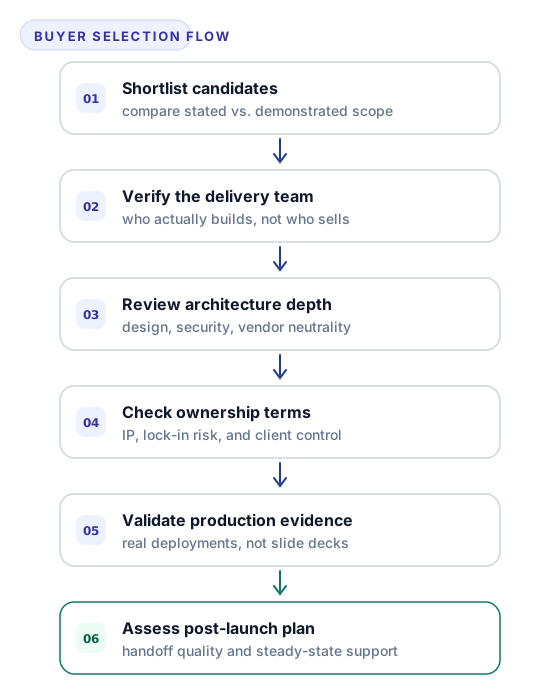
Buyer checklist: evidence, ownership, and risk
Before signing with any AI consulting firm, work through the following. This is the set of questions where weak answers most reliably predict a poor engagement outcome.
For a structured approach to evaluating the proposal document itself, the post on evaluating an AI consulting proposal covers the specific sections that matter most and what to look for in each. For pre-engagement supplier assessment, AI vendor due diligence gives a broader framework that applies here.
Evidence to request before signing
Ask for three to five production systems the firm has delivered. For each one, ask: is the system still running? Who owns the infrastructure? Can the client operate it without the firm's involvement? How long has it been in production? What does monitoring look like?
A firm with genuine production experience will answer those questions with specific, consistent detail. A firm with limited experience will speak in abstractions, reference proof of concepts rather than live systems, or deflect to the client relationship rather than the system's operational state.
Ask also for the governance documentation from a past engagement. What does the evaluation framework look like? What are the acceptance criteria? How are failures handled? Seeing real documentation from a real engagement tells you more than any capability description.
Questions about outcomes, ownership, and risk
Ownership
Who owns the code, the model configuration, and the infrastructure at the end of the engagement? Are there any licensing terms attached to tooling the firm introduces? If the answers are not immediate and clear, push for explicit contractual language before signing.
Outcomes
How does the firm define success for this engagement? What are the measurable criteria? What happens if those criteria are not met? A firm that cannot define measurable success is structuring an engagement where failure is definitionally impossible to demonstrate.
Risk
What are the three most common reasons similar engagements fail? A firm with real experience will have a direct, honest answer. That answer also tells you where to build buffer in your own planning.
If your organization is evaluating AI consulting partners and you want a senior perspective on the architecture decisions and delivery model before committing to a firm, I work with founders and CTOs as a fractional engagement. The conversation starts with the problem, not the stack. See how I work with agentic AI projects.