Section 01 · What Implementation Covers
What AI Implementation Services Actually Include
AI implementation services sit between strategy consulting and internal engineering — and the gap between the two is where most projects stall.
Quick answer
What are AI implementation services? AI implementation services take a defined business use case from planning or pilot status into a monitored production system. They cover readiness assessment, architecture, data and application integration, deployment, governance, evaluation, and adoption — with ownership of production outcomes, not just strategy recommendations.
Strategy work identifies which use cases are worth pursuing. Implementation work builds the production system, connects it to existing data and applications, and establishes the controls and ownership required to operate it safely. Buyers who treat these as the same engagement frequently discover that their advisory partner's scope ended exactly where the hard work was about to begin.
From Strategy Handoff to Production Ownership
AI advisory work delivers a prioritized roadmap and a rationale for each use case. What it does not deliver is a running system. An implementation engagement picks up at that handoff: it owns the architecture decisions, the data pipeline design, the integration with existing systems, the quality controls, and the transition to whoever operates the system after go live. The distinction matters for contracting and for scoping success criteria. A strategy deliverable is a document; an implementation deliverable is a system that works in production.
Iternal describes AI implementation services as moving an organization from an AI idea or stalled pilot to production with measurable business results, spanning assess, integrate, govern, and scale. That framing holds for clearly scoped engagements. The assess and integrate phases are where most projects stall — not because the technology is difficult, but because data access and systems constraints that were assumed during strategy turn out to be real blockers during implementation.
The Implementation Lifecycle Buyers Should Expect
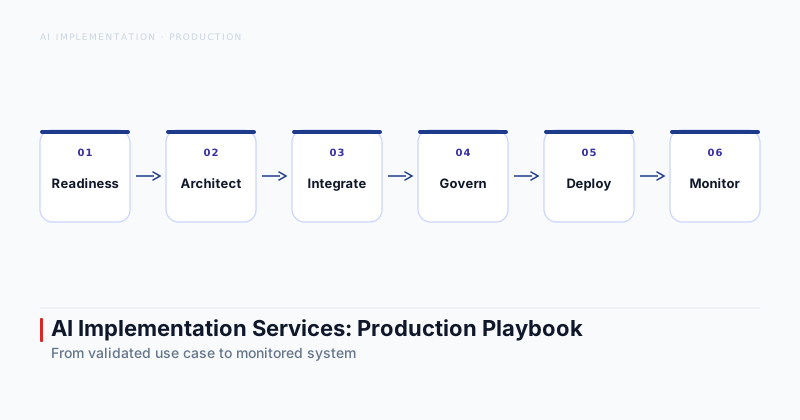
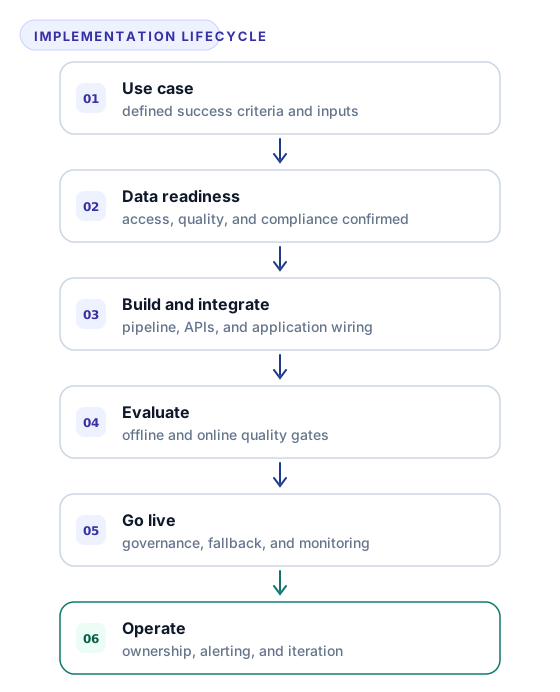
Most credible implementations move through six stages: use case definition with explicit success criteria, readiness assessment of data and systems, architecture design, integration and build, evaluation and governance setup, and deployment with adoption support. The stages do not always run sequentially — architecture decisions surface readiness gaps, and integration work frequently revises the initial design. What matters is that each stage has explicit completion criteria and a defined owner, not a fuzzy handoff to the next phase with no confirmation the prior one is actually done.
Section 02 · Before You Build
Readiness Before Build Work Starts
The most expensive mistake in AI implementation is starting the build before readiness is confirmed.
Readiness is not a confidence level — it is a structured check on three things: whether the use case is defined precisely enough to build toward, whether the data and systems required actually exist in usable form, and whether the organization has the operational capacity to run what gets built.
Use Case Definition and Success Criteria
A use case is ready to build when you can answer four questions: what question does the AI answer or what task does it perform, what inputs does it need, what does a correct output look like, and how will you measure whether the system is working in production. Any use case that cannot clear those four questions before design begins will require rework after the build starts. If your implementation partner is not asking these questions at the outset, that is a meaningful signal about their production experience.
Adiba describes AI implementation as connecting approved data, existing applications, and selected AI models or APIs into a controlled production system that includes evaluation, deployment, and monitoring. The starting point is approved data — which presupposes that data quality, access controls, and provenance have already been assessed before the first line of implementation code is written.
Data, Systems, and Operational Constraints
Data readiness has three parts: does the right data exist, is it in a usable format and accessible to the AI system, and does its use comply with legal and governance requirements. Systems constraints add a fourth question: what existing applications and workflows will the AI system need to read from or write to, and what does integration with those systems actually involve?
A readiness check that treats data access as an implementation detail — something the team will work out during the build — is not a readiness check. It is a deferred cost that will surface as scope creep or timeline slippage after the contract is signed. The AI readiness assessment framework describes how to run this check before implementation begins.
Section 03 · Architecture
Architecture and Enterprise Integration
Architecture decisions happen at three levels — and each level has choices that are costly to reverse.
The three levels are: which model or API handles the core task, how data gets to and from that model, and how the whole system integrates with the applications and workflows it needs to serve. A rigorous implementation defers only the decisions it must, commits to the ones that are stable, and documents the rationale for both — because the team that maintains the system is often not the team that built it.
Data Pipelines and Application Boundaries
The data pipeline is the operational backbone of a production AI system. It determines how data gets ingested, preprocessed, and delivered to the model; how model outputs get written back to downstream systems; and how the entire flow is monitored for failures or quality drift. A pipeline designed for a proof of concept typically cannot be scaled to production without significant rework — it lacks error handling, retry logic, schema validation, and the observability surface that production operations require.
Sphere states that production AI implementation includes data pipelines, access controls, MLOps monitoring, and integration with the tools a team already uses. Application boundary decisions — which systems the AI interacts with, through which interfaces, and under what authorization model — determine integration cost and operational risk. Getting these wrong late in the build is expensive; getting them wrong at go live is a production incident.
Model, API, and Deployment Choices
The choice between building on foundation model APIs versus fine tuning or hosting your own model is primarily a cost, control, and latency decision rather than a capability one for most production use cases. Deployments built on foundation model APIs typically reach production faster and carry lower operational overhead; fine tuning adds accuracy on narrow domains at the cost of retraining infrastructure and model governance. The build vs buy decision framework covers how to evaluate which path is appropriate for a given use case and organizational context.
Deployment architecture matters equally. Whether the system runs as a managed cloud service, a containerized workload, or an edge deployment determines where the operational burden sits and what failure modes the organization is responsible for managing. This decision should be made before the build starts, not after the first deployment fails.
Section 04 · Controls
Governance, Evaluation, and Production Controls
Governance and evaluation should be designed into the system — not added after the first production incident.
The Hackett Group describes end to end AI implementation as spanning strategic planning, data engineering, solution development, integration, and ongoing optimization after deployment. What that means in practice is that evaluation infrastructure, access controls, audit logging, and fallback handling should be specified at design time and validated before the system is declared ready for production. Teams that defer these to the end of the build consistently spend more time resolving them than they saved by avoiding them earlier.
Quality Gates Before Go Live
Two types of quality gates matter before a system goes live. Offline evaluation compares system outputs against a labeled set to confirm that accuracy, relevance, or task completion metrics clear a defined threshold. Online evaluation validates behavior under real inputs with real latency and throughput — a system that scores well offline but degrades under production load has not cleared the gate. Both types are necessary; neither alone is sufficient.
The acceptance criteria for go live should be defined with the business owner before the build starts, not negotiated after the system is built. Criteria that move after delivery is a contracting problem, not a technical one. Locking these early also protects the implementation partner: it removes the ambiguity that leads to perpetual scope additions under the guise of “not yet ready for production.”
Monitoring, Fallback, and Ownership
Production AI systems behave differently than their offline evaluations suggest. Inputs shift over time, model APIs change, integration dependencies fail, and user behavior deviates from the expected distribution. A monitoring plan that only checks system availability misses most of what actually goes wrong. The monitoring surface should cover output quality (sampled or continuous), latency, error rates, and data pipeline health — with alerts that surface the right signal to the right owner.
Fallback handling — what the system does when confidence is low, when a dependency is unavailable, or when an output fails a quality check — should be specified before deployment. Fallbacks improvised during an incident rarely work as intended. Specify the behavior, test it, and make it visible to whoever is on call.
Section 05 · Operating Model
Adoption and Operating Model
A production AI system that no one knows how to operate will not stay in production.
Adoption and the operating model are the parts of an implementation engagement that determine whether the system continues to deliver value after the vendor leaves — and whether the organization can troubleshoot, improve, and adapt it without going back to the original builder for every change.
Human Review and Change Management
For most enterprise AI applications, human review of model outputs is required — either as a formal control (every output is reviewed before action is taken) or as an exception path (outputs are acted on automatically unless flagged). Which model is appropriate depends on the consequences of an incorrect output and the volume at which the system operates. An implementation engagement that does not specify the human review model before deployment is leaving a governance gap.
Change management in AI implementation is less about training on new software and more about clarifying what the system does, what it does not do, and what humans are expected to do when the system is uncertain. Teams that understand the system's decision surface and its limits adopt it more reliably than those who receive only a user guide and a help desk contact.
Who Owns the System After Launch
The operational model should answer four questions: who monitors the system, who is responsible for output quality, who manages the data pipeline, and who approves changes to the model or prompt configuration. These responsibilities should be transferred to internal owners during the implementation engagement, not handed over in a document at the end of it. An engagement that concludes without a clear operating model — with defined owners and defined escalation paths — has delivered a system but not an implementation.
Section 06 · Vendor Evaluation
How to Evaluate an Implementation Partner
Vendor evaluations for AI implementation are frequently misaligned with what actually predicts delivery quality.
Advisory credentials, case study volume, and demo quality are poor proxies for whether a partner will own a production outcome. The evaluation should focus on one question: has this team shipped a system like this to production, and can they prove it?
Evidence of Production Delivery
The central question is whether the team has delivered an AI system to production in a domain and at a technical complexity similar to yours. Proof of concept delivery does not demonstrate this. A proof of concept requires a working model and a demonstration dataset — it does not require data pipeline engineering, access controls, monitoring, or change management. Asking for production references and asking those references specifically about system behavior after launch and incident handling will surface the difference.
Indicators of genuine production experience: the partner discusses monitoring infrastructure, fallback handling, and operating model transfer as standard scope; they ask about existing systems and constraints before proposing an architecture; their evaluation approach includes both offline and online quality gates; and they can describe at least one engagement that did not go as planned and how they resolved it.
Questions to Ask Before Signing
Before committing to an implementation engagement, get explicit answers to these: What does production delivery mean in your contract — a deployed system or a system meeting defined acceptance criteria? Who owns monitoring and output quality after delivery? What is your process if system performance degrades after launch? What is included in the data pipeline scope and what is out of scope?
A credible implementation partner will answer all of these in specifics, not reassurances. If the answers describe how they typically work rather than what the contract commits them to, treat that as a contracting gap to resolve before signing. The guide to evaluating an AI consulting proposal covers the full due diligence process for assessing vendor claims against contract language.
If you are scoping an implementation engagement or stress testing a vendor's proposal before you commit budget, the Agentic AI Consulting engagement covers exactly that — architecture review, scope validation, and independent assessment of what production delivery actually requires for your use case.