Section 01 · What It Solves
What AI Integration Consulting Actually Solves
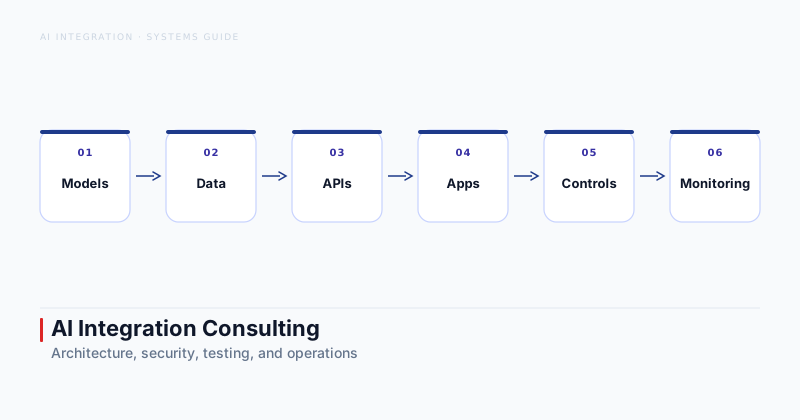
AI integration consulting connects models to production systems — not just APIs. The engagement addresses architecture, data, auth, testing, and operations.
Quick answer
What is AI integration consulting? AI integration consulting helps organizations embed AI into the systems and workflows they already run by connecting models with data, APIs, applications, authentication, business rules, and operational controls. Strong engagements address architecture, security, testing, rollout, monitoring, and maintainability so AI becomes part of production operations instead of another disconnected tool.
The distinction matters because most AI pilots fail at the integration layer, not the model layer. A language model that produces excellent outputs in isolation will underperform or fail completely when it cannot reach the right data, cannot authenticate against an internal API, or cannot handle the error states a real production environment generates.
InData Labs frames AI integration consulting around business case assessment, implementation planning, concept validation, tailored solution development, operational integration, and risk mitigation. That framing is accurate as far as it goes, but it understates how much of the work is system archaeology — understanding what already exists before designing how AI connects to it.
Why Integration Is More Than an API Call
Calling an AI model's API from application code is not integration. Integration is the set of decisions and implementations that determine what data the model sees, how it authenticates against your systems, what happens when the model returns an unexpected output, and who owns the integration when something changes.
A working prototype can omit every one of those layers. A production integration cannot. The gap between prototype and production is where most AI integration projects stall.
From Isolated Tools to Connected Workflows
The goal of integration is workflow connectivity, not feature addition. An AI capability that requires staff to copy data manually, switch between systems, or reformat outputs before using them has not been integrated — it has been installed alongside existing workflows without touching them.
Strong AI integration consulting is measured by how little a workflow changes for the people running it, while the model adds precision, speed, or coverage they could not achieve otherwise.
Section 02 · System Mapping
Map the Existing System Before Integrating AI
You cannot design an integration for a system you have not mapped. Structured discovery produces the artifact every subsequent phase consumes.
Pythian emphasizes data foundations with strong integrity guarantees and pipelines that connect ERP, CRM, data warehouses, and AI models, plus orchestration across enterprise applications. That emphasis on data foundations reflects a real constraint: you cannot design an integration for a system you have not mapped.
Mapping is structured discovery — cataloguing the applications, APIs, data stores, event streams, and dependencies the integration will need to touch. It produces an artifact that the rest of the engagement consumes: the architecture design, the auth model, the test plan, and the monitoring strategy all derive from it.
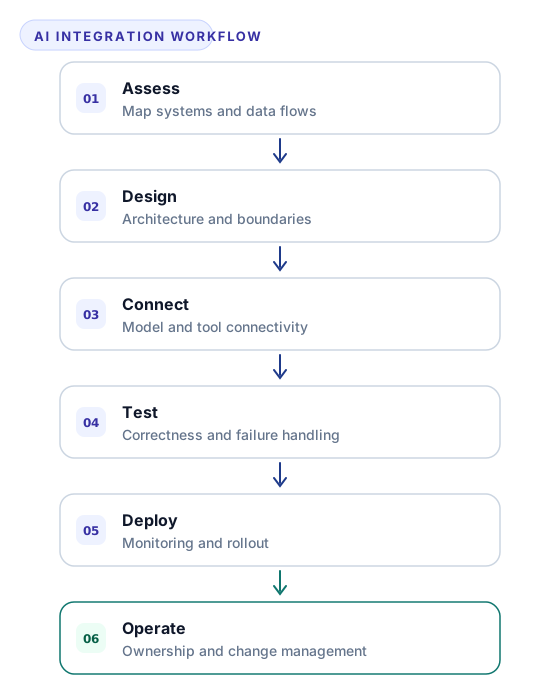
Applications, APIs, Data Flows, and Dependencies
The mapping phase catalogues every system the integration will touch or depend on: internal applications, third party services, databases, message queues, and storage layers. For each, it records the interface type, rate limits, data schemas, and any known instability.
Dependency mapping reveals compounding risk. An integration that touches five systems inherits the failure modes of all five. Identifying that an upstream CRM API has a 429 rate limit behavior or that a data warehouse query takes 40 seconds under load is far cheaper to discover during mapping than during a production incident.
Authentication, Permissions, and Ownership
Authentication and permissions are among the most common sources of integration delay. Every system the AI must access has its own auth model — OAuth, API keys, service accounts, internal SSO, or a combination — and each requires a decision about what the AI is allowed to read, write, or trigger.
The mapping phase also surfaces ownership questions: who controls the credentials, who approves permission changes, and who is responsible when the integration needs to access a system that sits in a different team's domain. These are organizational decisions that require resolution before technical work begins.
Section 03 · Architecture
Architecture and Model Connectivity
Integration pattern selection and context design determine whether an AI capability survives production conditions — not just sandbox tests.
Encrypted InfoWeb defines AI integration consulting as embedding AI into existing systems and workflows through strategy, model selection, API connectivity, custom implementation, and change management. Model selection and API connectivity are the components most organizations focus on. Strategy and change management are the components that determine whether the integration survives contact with production.
Architecture decisions include which integration pattern to use, how data flows between the model and the systems it touches, and how context is managed across a workflow with multiple steps.
Selecting Integration Patterns
The three most common integration patterns are synchronous API calls, asynchronous event driven flows, and embedded model calls inside an application's own processing pipeline. Each carries different latency profiles, failure modes, and monitoring requirements.
Synchronous integrations are appropriate when a response is needed immediately and latency is acceptable. Event driven integrations are appropriate when the AI task is long running, when inputs arrive in batches, or when results feed downstream processes that do not need to wait. Embedded calls work well when the model is one step in a larger computation that the application already owns.
Choosing the wrong pattern creates friction that compounds over time. A synchronous integration for a task that regularly exceeds timeout thresholds will require workarounds that accumulate technical debt. Getting the pattern right at design time is cheaper than refactoring after deployment.
Handling Context, Tools, and Structured Outputs
Models connected to production systems often need to call tools — internal APIs, search functions, database queries — and return structured outputs that downstream systems can parse reliably. Both require explicit design.
Tool definitions specify what the model can call, with what arguments, and under what conditions. For the constraints that determine whether tool use stays reliable under production conditions, see LLM Function Calling: A Production Engineering Guide. Output schemas define the shape of the model response. Without them, downstream systems parse free text, which breaks whenever the model changes phrasing.
Section 04 · Testing and Security
Testing, Security, and Production Controls
AI integration testing requires the same discipline as testing any distributed system, plus additional coverage for probabilistic model behavior.
Leanware describes AI integration as a system level problem involving architecture, data flows, model evaluation, compliance, performance, and long term maintenance. That framing captures the scope correctly: testing an AI integration requires the same discipline as testing any distributed system, plus additional coverage for model behavior that is probabilistic rather than deterministic.
Testing must cover the happy path and the failure modes. A system that works on valid inputs and collapses on malformed ones, rate limit errors, or upstream timeouts is not production ready.
Failure Handling and Fallback
Every AI integration needs a fallback for the cases when the model cannot respond: a timeout, an upstream service outage, an input that violates a validation check, or a response that fails the output schema. Fallback behavior is an explicit design decision — either a graceful degradation path, a queued retry, or a human escalation route.
Teams that skip fallback design discover it during their first production incident. The failure mode is predictable: the AI path fails, the application has no fallback, and the workflow stops. Designing fallbacks before deployment costs a fraction of what debugging a live failure costs.
Performance, Compliance, and Access Control
Performance testing for AI integrations must mirror real workflow volumes, not just a representative happy path against a sandbox environment. Models under load behave differently than models in development. Latency distributions widen, rate limits surface, and error rates rise in ways that a sequential test will not reveal.
Compliance requirements — data residency, logging, retention, and access control — are most expensive to add after the integration is deployed. Requirements that touch which data the model can see, what gets logged, and who can audit those logs need to be addressed during design. The AI Systems Architecture service covers compliance and governance design for production AI systems.
Access control defines not just what the model can reach but what it can change. Integrations that give a model write access to production systems without explicit scope constraints create risk that is difficult to audit after the fact.
Section 05 · Operations
Operate the Integration After Launch
Deployment is not the finish line. An AI integration that is not monitored will drift as models update, data schemas change, and usage patterns shift.
Operational readiness means having monitoring in place before the integration goes live, not after the first incident surfaces a gap. The three areas that require explicit operational design are monitoring, change management, and vendor flexibility.
Monitoring and Change Management
The monitoring surface for an AI integration includes model response quality, latency, error rates, tool call success rates, and output schema conformance. A detailed reference for what to measure and how to wire it in is available in LLM Observability: What to Measure and How to Wire It In. These signals serve different audiences: engineers need error rates and latency; product owners need output quality and task success rates.
Change management covers what happens when any component changes — the model version, an upstream API, a data schema, or a business rule. Integrations that are not designed for change become brittle quickly. A model update that changes output format, or an upstream API deprecation that removes a field the integration depends on, should trigger a documented process, not an emergency.
Maintaining Vendor and Model Flexibility
Integrations built around a single model provider or a single vendor's tooling accumulate switching costs over time. Abstracting the model call behind an interface the application owns, and keeping tool definitions and output schemas in version control independent of any vendor's format, preserves the option to swap components without rewriting the integration.
This is not theoretical. Model providers update, deprecate, and reprice their offerings regularly. Teams that built direct integrations against a specific model's API in a prior generation are now paying the cost of tight coupling.
Section 06 · Selection
How to Choose an AI Integration Consultant
The differentiator is not API familiarity — it is evidence of moving integrations from prototype to production and speaking precisely about what that required.
The primary differentiator among AI integration consultants is not familiarity with AI APIs — most consultants who claim integration experience can call a model. The differentiator is whether they have moved integrations from prototype to production and can speak precisely about what the prototype skipped, what production required, and how failures were caught and resolved.
Evidence of System Level Engineering
Ask for specifics: what systems did they connect, what was the auth model, how did they handle rate limits and failures, what monitoring did they put in place, and what broke during production that did not break in development. These questions separate consultants who have shipped integrations from those who have built demos.
System level engineering also shows in how they approach mapping. A consultant who wants to understand your existing systems before proposing an architecture is more likely to design an integration that survives production than one who leads with model recommendations before understanding the environment.
Questions about Ownership, Maintainability, and Risk
Ask who owns the integration after the engagement ends. Ask what happens when a model provider changes a behavior or deprecates an API. Ask how the integration will be tested against future changes without reengaging the consultant.
Maintainability is a design decision that must be made during the engagement, not after. Integrations that are difficult to test, that embed business logic in prompt strings without version control, or that depend on undocumented vendor behavior will require expensive intervention when they break. The right consultant will surface these risks during design and propose specific mitigations — not because you asked, but because they already know what integration debt costs.
If you are evaluating how AI integration fits into a broader architecture strategy, the right next step is to map what your organization already has before selecting a model or a vendor. That is where I start every engagement — and it is where the decisions that determine production outcomes get made.