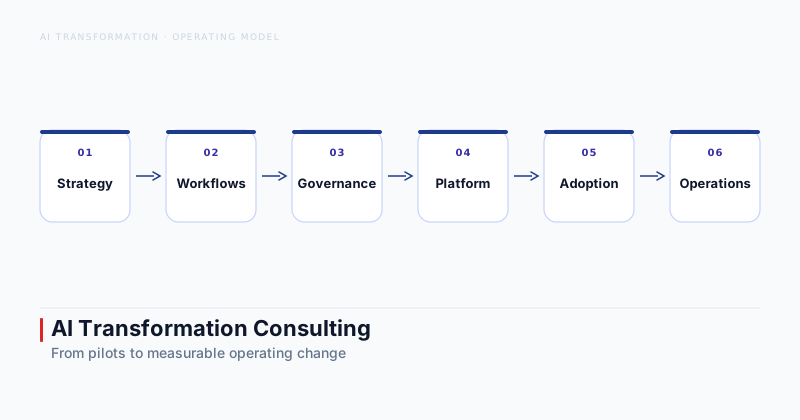
Section 01 · Definition
What AI transformation consulting really means
Most organizations do not fail at AI because they chose the wrong model. They fail because they treated AI as a tool rollout rather than an operating change.
Beyond tool rollout
Deploying an AI tool is a procurement decision. Transformation is something different. It means changing how work is structured, who owns which decisions, what data flows where, and how results are measured — with AI embedded into those processes rather than sitting alongside them.
AI Transformation Consulting describes the discipline as combining strategy and governance, readiness, business case work, workshops, and pilot delivery. That range matters because organizations that treat transformation as a single implementation project often end up with successful proofs of concept that never reach production, or production systems that cannot be maintained or expanded without returning to the original vendor.
A transformation engagement typically produces a redesigned operating model, not just a working system. That means new decision rights, new measurement baselines, a governance framework, and an architecture that teams can extend without starting from scratch each time.
Transformation as operating model change
Quick answer
What does AI transformation consulting do? AI transformation consulting helps organizations redesign workflows, operating models, governance, and technical foundations so AI becomes part of how the business runs. Strong engagements connect strategy with implementation, change management, data readiness, measurable baselines, and ownership so pilots scale into durable operating capability.
The operating model question is the one most engagements underestimate. You can have a sound AI strategy, a reasonable use case list, and a capable implementation partner — and still produce nothing lasting if the organization has not decided who owns AI decisions, how those decisions are escalated, and what standards apply across projects. Those are operating model questions, and they require the same rigor as the technical architecture.
Section 02 · Workflows
From experiments to redesigned workflows
Pilots are useful for validating assumptions. They are not a reliable path to transformation unless the organization explicitly designs what happens after a pilot succeeds.
Why pilots do not equal transformation
Revenue Institute defines AI transformation as moving firms from isolated experiments toward workflow level automation, production AI systems, and organizational change. The gap between those two states is where most AI programs stall.
A pilot proves that a use case is technically viable. Transformation requires proving it is operationally sustainable — that the data pipeline can be maintained, the model outputs can be monitored, the team can handle edge cases, and the workflow improvement holds at production volume.
Where human judgment and automation change
Redesigning a workflow for AI is not simply inserting a model where a human used to act. It means mapping where human judgment remains essential, where AI augments that judgment, and where full automation is safe and appropriate. Each of those zones requires different handoffs, different monitoring, and different accountability structures.
The most durable transformations treat this mapping as a core deliverable — not an afterthought. When you can articulate which steps are automated, which require a human in the loop, and why, you have a workflow design that survives staff changes, model updates, and evolving compliance requirements.
Section 03 · Foundations
Readiness, data, and architecture foundations
Before recommending investment in any AI initiative, a credible transformation partner will assess what the organization can actually support.
Assessing technical constraints
CHI Software lists readiness assessment, strategy, data and architecture readiness, governance, implementation planning, and adoption among its AI transformation consulting services. The order is deliberate — architecture constraints shape which use cases are feasible within a realistic timeframe.
That assessment surfaces the gaps that would otherwise show up as project failures: data that is not available at the right latency, systems that cannot expose the APIs an AI layer needs, infrastructure that cannot handle inference at scale, and teams that lack the skills to maintain what gets built.
A thorough AI readiness assessment examines data quality and access, existing tooling, integration points, security and compliance constraints, and the team's current capability to operate AI in production. The output is a constraint map that either validates the proposed roadmap or forces a more realistic one.
Preparing systems for integration
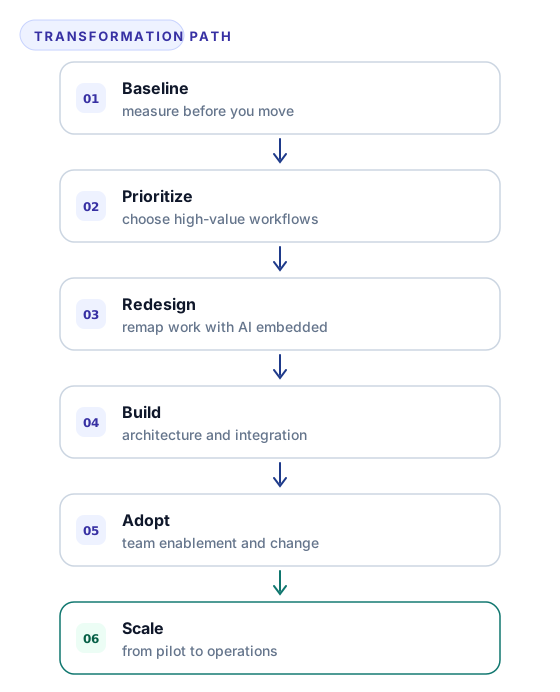
System preparation is unglamorous and consistently underestimated. Making a production AI integration work reliably requires clean data contracts between systems, observable pipelines that surface failures before they reach end users, and deployment patterns that allow model updates without requiring downtime across dependent workflows.
Skipping this phase saves time upfront and costs multiples of that time when the first model update breaks a downstream process that no one documented. Good transformation consulting surfaces these dependencies early and produces an architecture that accounts for them rather than deferring the problem to the implementation team.
Section 04 · Governance
Governance and operating model design
Governance in this context means defining who can authorize a new AI use case, who reviews model outputs in production, and what the escalation path is when an output falls outside acceptable bounds.
Decision rights and accountability
IMHIO frames AI transformation as workflow and operating model redesign supported by governance, platform foundations, monitoring, and baseline metrics established before deployment. The governance piece is where many organizations resist the work — it feels bureaucratic until an AI output causes a real business problem and no one knows who owns the resolution.
It does not require a large standing committee. It requires clear ownership and a process that runs without constant executive involvement. The build vs buy decision is one of the first governance questions a transformation engagement should answer — because the answer shapes the architecture, the vendor relationships, the staffing model, and the maintenance obligations for the next several years.
Policies, escalation, and measurable baselines
Governance without measurement is a policy document that no one reads. Baselines need to be established before a workflow is changed so there is a real reference point for evaluating whether the AI version is performing better, worse, or about the same.
Those baselines should cover the metrics that matter to the business owner — cycle time, error rate, cost per unit, customer outcome — not just the technical metrics the model team cares about. When both sets of metrics are tracked from deployment, you have the evidence needed to fund the next phase of scaling. Governance frameworks for production AI cover the monitoring, logging, and escalation structures that make this visible in practice.
Section 05 · Adoption
Change management and adoption
Workflow redesign changes what people do every day. That change does not manage itself.
Role redesign and team enablement
Teams that are not involved in designing new workflows and not given the skills to operate them will find ways to work around the AI system, making the investment invisible and unmeasurable.
Effective adoption programs start before the build phase. They involve the people closest to the work in use case selection and workflow mapping, so the design reflects real operational knowledge rather than a consultant's model of how the work should go. That involvement also creates a group of people who understand the system and can support their colleagues when it is deployed.
Making new workflows stick
Adoption is not a launch event. It is the period after launch where teams develop fluency, where edge cases surface, and where the gap between designed workflow and actual practice gets closed. Engagements that treat adoption as a training program at the end of implementation consistently underperform those that embed it into the delivery cadence from the start.
Role redesign is part of this. When AI handles what was previously manual work, the time and attention freed up needs a destination — a redefined scope, a new responsibility, a higher value task. Without that redefinition, the efficiency gain diffuses into informal coordination and workarounds rather than compounding into measurable output.
Section 06 · Evaluation
How to evaluate a transformation partner
The market for AI transformation services includes firms at every level of depth. The boundaries need to be explicit before you engage.
Evidence of execution depth
Ask for evidence that the partner has moved from strategy through pilot to production with a client in a comparable operating context. Strategy slides are easy to produce. Production systems with measurable outcomes, maintained over time, are not. The gap between those two artifacts tells you whether the engagement will produce a working operating change or a well designed plan that stalls at implementation.
Neither a pure strategy model nor a full delivery model is wrong — but the boundaries need to be explicit before you engage. Know what the partner owns and where their responsibility ends.
Questions about ownership, metrics, and scale
Before signing, ask the partner to describe the handoff model. What do they own, and when does ownership transfer to your team? What artifacts will your internal team be able to maintain? How will success be measured, and by whom? What happens when a model drifts or a pipeline breaks six months after the engagement ends?
These questions surface the difference between a partner who builds capability in your organization and one who builds dependency on their team. A transformation engagement that leaves your organization unable to operate the systems it paid to build is not transformation — it is managed services by another name.
If your organization is weighing whether to bring in a transformation partner or build internal capacity, the decision usually turns on the maturity of your existing AI team and the urgency of the business outcomes you need. That is the conversation I have with founders and CTOs at the start of every scoping call — reach out if you want to think through it.