Section 01 · What This Is
What it means for an AI agent to run on-chain
An on-chain AI agent is not a chatbot that discusses blockchain. It is an autonomous software system that holds real assets, executes real transactions, and operates under on-chain governance rules — without continuous human involvement.
Quick answer
In one sentence: An on-chain AI agent holds a blockchain wallet, reasons about on-chain state, executes smart contract transactions autonomously, and operates under governance rules encoded in the protocol — making it accountable to the chain, not just to its operator.
The convergence of agentic AI and blockchain is not theoretical in 2026. Autonomous agents hold Ethereum wallets via ERC-4337 account abstraction, execute DeFi transactions without human sign-off, and participate in on-chain governance votes. Chainlink, Aave, and MakerDAO all have agentic components operating in their production protocols.
For an AI architect with a background in both blockchain systems and agentic AI, this intersection is the most technically defensible territory available. The combination of production agentic AI experience and smart contract development knowledge is rare, and the SERP for practitioner-level content on the intersection is essentially empty.
Section 02 · Architecture
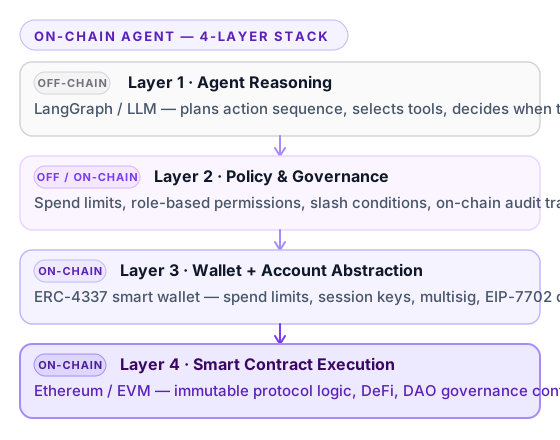
The four-layer architecture for on-chain agents
Agent reasoning layer
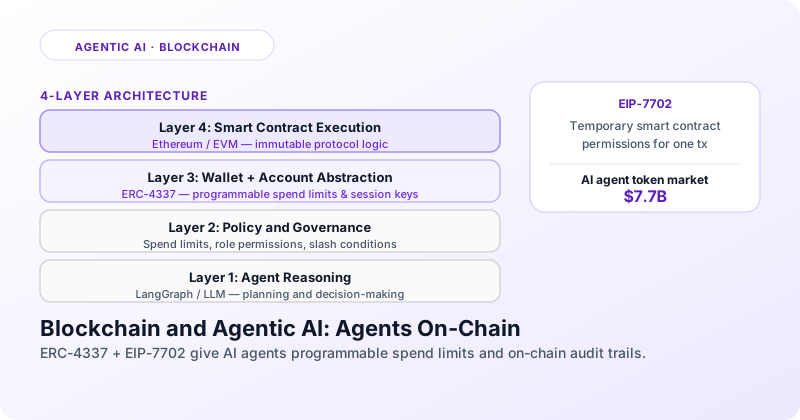
The LLM-based reasoning core that analyzes on-chain state, formulates a plan, and decides which actions to take. Claude Sonnet 4.6 and GPT-5.4 are both used in production on-chain agents. The reasoning layer reads chain state from RPC endpoints, indexes from The Graph, and oracle price feeds. It does not touch the chain directly — all actions flow through the policy layer.
Policy and governance layer
Deterministic rules that constrain what the agent is allowed to do. Spend limits per transaction and per time period. Allowlists of contract addresses the agent can interact with. Forbidden action types. The policy layer runs before every transaction and blocks any action that violates the rules. This is not an LLM call — it is hard logic that cannot be overridden by the reasoning layer.
Wallet and account abstraction layer
ERC-4337 account abstraction turns the agent's wallet into a smart contract with programmable rules. Session keys allow temporary, scoped permissions — the agent can spend up to X ETH on Y contract for Z hours. EIP-7702 extends this: a human-controlled account can temporarily delegate specific permissions to an AI agent for a single transaction, then revoke them.
Smart contract execution layer
The on-chain contracts the agent interacts with. Immutable governance contracts on Ethereum or Cosmos. DeFi protocols like Aave, Uniswap, and Compound. Custom protocol contracts. Every action the agent takes is recorded permanently on-chain, providing an immutable audit trail that no off-chain log can replicate.
Section 03 · Production Use Cases
Where on-chain agents are live in 2026
DeFi protector agents
AI agents embedded in protocols like Aave and MakerDAO that monitor the mempool for adversarial transactions and can autonomously pause specific vaults or front-run attackers to neutralize exploits. These agents operate 24/7 and respond faster than any human monitoring system.
Autonomous treasury management
DAOs using AI agents to rebalance protocol treasuries based on market conditions, governance parameters, and risk models. The agent executes swaps and liquidity provisions within policy-defined bounds, with significant transactions requiring multisig approval from core contributors.
On-chain insurance claims processing
Insurance protocols using AI agents to evaluate claims against on-chain evidence — transaction records, oracle price feeds, and protocol state at the time of the insured event — and process payouts autonomously for claims below a value threshold.
Reputation staking and slashing
Protocols where AI agents provide price feeds or execute governance votes must stake tokens. If an agent provides a faulty price feed or fails to execute a committed governance action, its staked tokens are slashed. This creates a direct economic incentive for the agent's operators to maintain model quality.
Section 04 · Governance
The governance controls that make on-chain agents trustworthy
An autonomous agent with a wallet and smart contract access is powerful. Without governance controls, it is dangerous. The governance layer is not a compliance checkbox — it is the technical foundation that makes on-chain agents acceptable to protocols, regulators, and users.
Spend limits
Hard caps on the value of transactions the agent can execute per call, per hour, and per day. Encoded in the account abstraction contract, not in the agent's prompt. Cannot be overridden by the reasoning layer or by a prompt injection attack.
Role-based permissions
The agent holds different session keys for different permission scopes. A monitoring agent has read-only access. An execution agent has limited write access within defined contract addresses. A governance agent has voting rights but no treasury access. Keys are scoped, short-lived, and revocable.
Slash conditions
Protocols that rely on agent services require the agent's operators to stake tokens. Conditions that trigger slashing are defined on-chain: providing an oracle value outside an acceptable range, failing to execute a committed governance vote, or taking a prohibited action. Slashing is automatic, deterministic, and public.
Immutable audit trail
Every action the agent takes is a transaction on-chain. It is permanent, public, and attributable. This is a governance property that off-chain agents cannot replicate. When something goes wrong, the investigation starts with the on-chain record, not a log file that can be modified or lost.
Section 05 · Common Questions
Does AI use blockchain? Does blockchain use AI? How do they work together?
These are the most searched curiosity-driven questions on the intersection of AI and blockchain. Each has a distinct and non-obvious answer.
Does AI use blockchain?
In 2026, yes — but selectively. AI agents use blockchain primarily for three things: as a source of verifiable, tamper-proof data to inform decisions (on-chain price feeds, transaction history, governance votes), as an execution environment for autonomous actions (smart contract calls, DeFi positions, token transfers), and as a governance layer for accountability (immutable audit trails of agent actions, staking and slashing conditions). AI systems that are not operating in a blockchain context — most production LLMs — do not use blockchain and have no need to.
Does blockchain use AI?
Increasingly yes. DeFi protocols use AI agents for anomaly detection, oracle verification, and autonomous treasury management. Layer 2 sequencers are exploring AI-assisted transaction ordering optimization. On-chain governance systems use AI to summarize proposals and predict voter sentiment. Smart contract auditing pipelines use LLMs as a first-pass vulnerability scanner. Blockchain itself is a deterministic system that does not inherently require AI — but AI is being layered on top of it at every level of the stack.
How do AI and blockchain work together?
The integration runs in two directions. AI reads from blockchain: agents query on-chain state via RPC endpoints, read oracle price feeds, and interpret smart contract events to inform their reasoning. AI writes to blockchain: agents execute transactions via smart contract wallets (ERC-4337), submit governance votes, and trigger protocol actions. The blockchain provides what AI systems lack: immutable records, trustless execution, and economic accountability. AI provides what blockchain lacks: natural language interfaces, complex reasoning over unstructured data, and autonomous decision making.
Is blockchain AI?
No. Blockchain is a distributed ledger technology — a protocol for maintaining a shared, immutable record of transactions across a network of independent nodes. It does not involve machine learning, inference, or any form of AI reasoning. The confusion arises because both blockchain and AI are hyped technology categories that often appear in the same breath. They are complementary technologies with different purposes: blockchain provides trustless data integrity and execution; AI provides reasoning and decision making.