Section 01 · The Right Question
Why model selection for agents is different
Choosing an LLM for a chatbot and choosing one for a production agent are different decisions. Agents need properties that general benchmarks do not measure.
Quick answer
The short answer: For production agentic AI, prioritize tool-call reliability, instruction following across long traces, and safety behavior in automated contexts. Benchmark scores on general reasoning tell you less than you think.
A production AI agent runs dozens or hundreds of LLM calls in sequence. Each call has context from prior calls. The agent follows a schema for tool calls and expects the model to return structured output it can parse. Over a long run, small deviations compound — a model that occasionally ignores a field in a tool schema or adds an unprompted conversational aside breaks downstream logic in ways that are hard to debug.
The six dimensions that matter for agent selection are different from the ones that matter for a chatbot. General reasoning scores and writing quality are less important than tool-call schema adherence, context retention over long traces, and refusal behavior in automated pipelines where there is no human to re-prompt.
Section 02 · Evaluation Framework
Six dimensions that matter for agentic AI
Tool-call schema adherence
Does the model return exactly the JSON structure the tool schema specifies, every time, across a long run? Models that occasionally hallucinate field names or return extra fields break automated pipelines. This is the single most important dimension for production reliability.
Instruction following across long traces
Can the model follow a system prompt instruction introduced in the first call, 40 tool calls and 30,000 tokens later? Models that drift — gradually deprioritizing earlier instructions as context grows — produce inconsistent agent behavior that is extremely difficult to reproduce and debug.
Refusal behavior in automated contexts
How does the model handle ambiguous or borderline requests in a fully automated pipeline where there is no human to provide clarification? Over-refusal blocks legitimate agent workflows. Under-refusal creates safety incidents. The right behavior is predictable, configurable, and documented.
Context window and pricing at agent scale
A single agent run can consume 100,000 to 500,000 tokens when you include system prompts, tool schemas, retrieved documents, and the history of prior calls. At scale, the difference between $3 per million input tokens and $0.30 per million is the difference between a viable unit economics and an unprofitable product.
API reliability and SLA
An automated agent pipeline that calls the LLM API 200 times per task run is far more sensitive to API availability than a chatbot that makes one call per user message. Uptime SLAs, rate limit policies, and fallback behavior on errors all matter significantly more for agentic workloads.
Ecosystem and tooling maturity
Most production agentic AI systems are built on LangGraph, LangChain, LlamaIndex, or a combination. The quality of the SDK, the depth of the documentation, and the number of production examples available for your chosen model directly affects development speed and debugging velocity.
Section 03 · Head-to-Head
OpenAI vs Anthropic vs Google: the six dimensions compared
| Dimension | OpenAI (GPT-5.4) | Anthropic (Sonnet 4.6) | Google (Gemini 2.5 Flash) |
|---|---|---|---|
| Tool-call schema adherence | Excellent | Excellent | Good |
| Long-trace instruction following | Very good | Excellent | Good |
| Safety behavior (automated) | Good | Best-in-class | Good |
| Context window | 1M tokens | 1M tokens | 1M tokens |
| Input cost per 1M tokens | $2.50 | $3.00 | $0.30 |
| Ecosystem maturity | Best — primary target for most frameworks | Very good | Improving |
| Published uptime SLA | 99.9%, Scale Tier only | None published | 99.9% platform, 99.5% generative AI |
Menlo Ventures' enterprise survey put Anthropic at 40% of enterprise LLM API market share, ahead of OpenAI at 27% and Google at 21%. The enterprise preference reflects Claude's lead on safety behavior and the 1M token context window, which meaningfully changes the economics of long agent traces: you can pass full conversation history and retrieved documents without aggressive pruning.
Section 04 · Decision Guide
Which model to use when
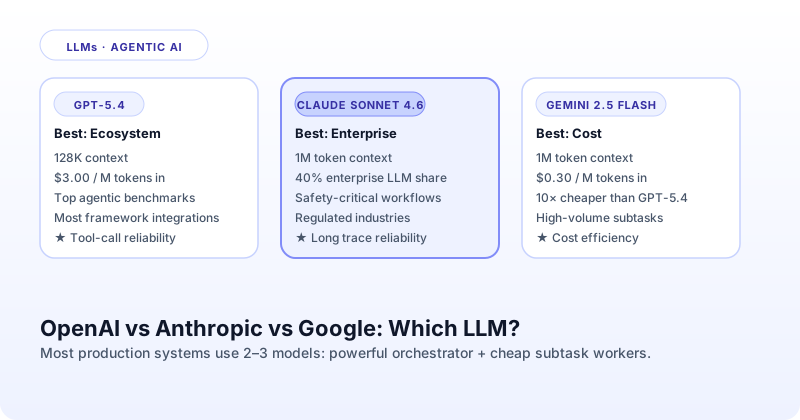
Use GPT-5.4 when ecosystem maturity is the priority
If you are using LangGraph, LangChain, or any major open-source framework, OpenAI is the primary target and the documentation, examples, and community support are deepest. GPT-5.4 leads on agentic execution benchmarks and the Agents SDK is the most feature-complete.
Use Claude Sonnet 4.6 or Opus 4.6 for enterprise and sensitive workflows
For regulated industries, compliance-sensitive applications, and any workflow where agent mistakes have significant business or legal consequences, Anthropic's safety-first design is the right default. The 1M context window is a genuine advantage for long running research and analysis workflows.
Use Gemini 2.5 Flash for high-volume cost-sensitive workloads
At roughly 8x cheaper on input than GPT-5.4 and 10x cheaper than Sonnet 4.6, Gemini 2.5 Flash is the right choice for classification steps, routing decisions, and any subtask that runs at high volume but does not require the model's peak reasoning capability. Pair it with a more capable model for orchestration.
Most teams building production agentic AI systems in 2026 use two or three models: a powerful model (GPT-5.4 or Claude Sonnet 4.6) for orchestration and complex reasoning, Gemini 2.5 Flash for high-volume classification and routing steps, and sometimes a specialized code model for code generation subtasks. Single-model architectures leave significant cost and quality on the table.
Section 05 · Anthropic vs OpenAI
Anthropic vs OpenAI: government, enterprise, and revenue context
Beyond the benchmark comparison, Anthropic vs OpenAI plays out differently in government and enterprise contexts — and the revenue and funding picture helps explain why enterprise buyers choose differently.
The government AI market is where the Anthropic vs OpenAI distinction is sharpest. Anthropic has pursued FedRAMP authorization and maintains a Constitutional AI approach that federal agencies find easier to justify to oversight bodies. OpenAI's GPT-5.4 is more widely used in commercial enterprise but faces more scrutiny in government contexts where explainability and safety documentation are procurement requirements.
Anthropic vs OpenAI: government AI
For government AI applications — defense contractors, federal agencies, intelligence community adjacent work — Anthropic's safety and interpretability focus gives it a differentiated position. Constitutional AI provides a documented, auditable approach to model alignment that government procurement teams can reference. OpenAI's government offering (via Azure OpenAI) is also mature, but Anthropic has made government AI a more explicit strategic focus in 2025 and 2026.
Anthropic vs OpenAI: why published revenue is a bad input
Both companies are growing revenue faster than any public figure stays accurate, and neither publishes revenue on a standardised basis, so treat any single number you read as a dated snapshot rather than a comparison. What is stable enough to plan against is the shape: OpenAI's larger consumer footprint (ChatGPT) drives much of its top line, while enterprise API surveys consistently show Anthropic with strong and growing share. Both have raised multi-billion dollar rounds, with Anthropic backed by Amazon and Google and OpenAI backed by Microsoft.
What is Anthropic vs OpenAI: the core architectural difference
The fundamental philosophical difference: OpenAI pursues capability maximization and scales toward AGI as a primary goal. Anthropic was founded on the thesis that AI safety research should run in parallel with — and constrain — capability scaling. Constitutional AI and RLHF from AI feedback are Anthropic's technical approaches to embedding values directly into the model training process. For production enterprise AI, this philosophical difference translates to measurable behavioral differences in how the models respond to edge cases, borderline requests, and ambiguous instructions.