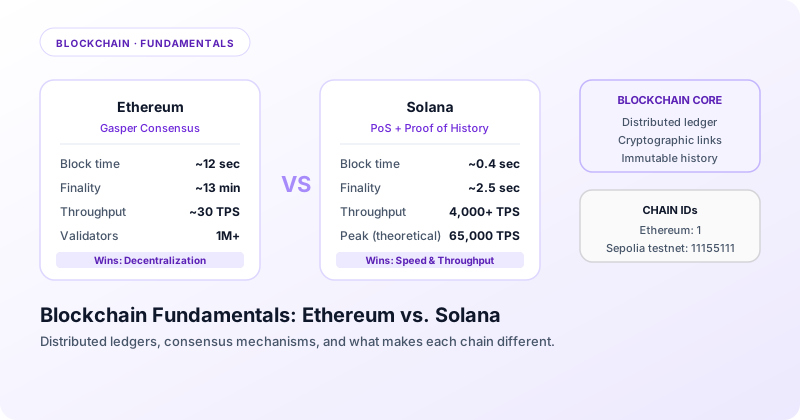
Section 01 · What Blockchain Is
The distributed ledger, explained without the noise
Most explanations of blockchain start with Bitcoin and end with jargon. This one starts with the problem blockchain solves and works forward from there.
Quick answer
What is a blockchain, in plain terms? A blockchain is a ledger — a record of transactions — that is replicated across a large number of independent computers (nodes) worldwide. New entries are grouped into blocks, cryptographically linked to every prior block in order, and broadcast to all nodes simultaneously. No single party owns or controls the record. Changing a past entry requires rewriting every subsequent block and outcompeting the entire rest of the network simultaneously, which is computationally infeasible at scale.
A traditional database is controlled by whoever owns the server. The bank holds your balance. The social network holds your posts. The payment processor holds your transaction history. Trust is delegated to a central institution, and that institution can modify records, freeze accounts, or disappear.
Blockchain removes that central point of control. The ledger is distributed across thousands of nodes run by independent participants around the world. Each node holds a full copy of every transaction ever recorded. When a new block of transactions is proposed, nodes run a consensus algorithm to agree on whether to accept it. Once accepted, the block is appended and its cryptographic hash is embedded in the next block — locking the chain together.
Changing a historical record means recomputing the hash of the altered block and every block after it, then convincing the majority of the network to adopt the altered chain instead of the legitimate one. On a network with tens of thousands of nodes and billions of dollars worth of economic stake, this is not practical.
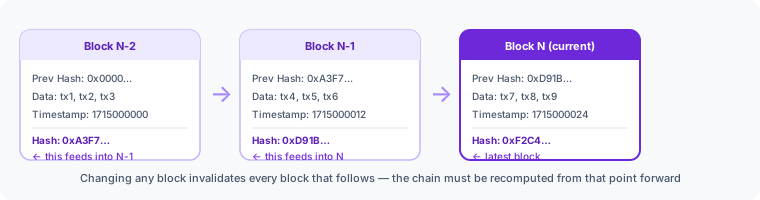
Three properties define a blockchain that is worth building on:
Decentralization
The ledger is maintained by many independent nodes, not a single authority. No one entity can unilaterally alter history, freeze funds, or shut the network down. The degree of decentralization varies — Ethereum has over one million active validators in 2026, giving it among the strongest decentralization guarantees of any public blockchain.
Immutability
Once a transaction is confirmed and buried under several subsequent blocks, altering it requires rewriting the chain from that point forward and achieving majority network consensus on the rewritten chain. In practice this is economically infeasible on large networks. Immutability is what makes blockchains useful as audit trails.
Transparency
All transaction data on a public blockchain is visible to anyone with an internet connection. Anyone can run a block explorer and look up any wallet address, contract interaction, or transaction hash. This transparency enables on-chain verification without trusting any intermediary.
Section 02 · How Networks Work
Nodes, mainnet, testnet, and chain IDs
A blockchain network is the set of computers — called nodes — that collectively maintain the ledger. Running a node means downloading a full copy of the blockchain, validating new blocks as they arrive, and relaying valid transactions to other peers. Anyone can run a node. You do not need permission.
Each chain operates in distinct environments. The two that matter for developers are mainnet and testnet.
Mainnet
The live production network. Every transaction costs real money in the network's native token (ETH on Ethereum, SOL on Solana). Smart contracts deployed here hold real value and face real adversaries. Mistakes cost money and sometimes cannot be undone. You do not experiment here.
Testnet
A developer sandbox that mirrors the mainnet protocol but uses tokens with no real value. Ethereum's primary testnet in 2026 is Sepolia. Solana's is Devnet. You can request free test tokens from a faucet, deploy contracts, send transactions, and break things without financial consequence. Always build and test on testnet first.
Chain IDs exist to prevent confusion between networks. Every EVM compatible chain has a unique numeric identifier. Ethereum mainnet is Chain ID 1. Sepolia testnet is Chain ID 11155111. BNB Chain is 56. Polygon is 137. When you configure a wallet or RPC connection, the Chain ID tells the software which network you are on, and signed transactions embed the Chain ID to prevent replay attacks — a signature made for a transaction on Ethereum mainnet cannot be replayed on Polygon or any other chain.
Why chain IDs prevent replay attacks
Without a Chain ID in the signature, a valid transaction on Ethereum mainnet would also be valid on every other EVM chain. An attacker could take a transaction you signed on a testnet (where tokens are worthless) and replay it on mainnet where the same wallet holds real ETH. Chain IDs close this attack vector. Always verify the Chain ID before signing any transaction.
Section 03 · Ethereum
Gasper consensus: how Ethereum confirms transactions
Ethereum moved from Proof of Work to Proof of Stake in September 2022 — a transition called The Merge. The current consensus mechanism is called Gasper.
Gasper is a combination of two protocols that work together. Casper the Friendly Finality Gadget (Casper FFG) provides finality: once a checkpoint block is finalized, it can never be reverted without destroying at least one third of all staked ETH. LMD GHOST (Latest Message Driven Greediest Heaviest Observed SubTree) is the fork choice rule that determines which chain tip validators build on during normal operation.
Here is how the mechanics work in practice. Validators — participants who have staked a minimum of 32 ETH — are randomly assigned to committees that propose and attest blocks in 12 second slots. Every epoch consists of 32 slots. At the end of each epoch, if two thirds of active validators have attested to a checkpoint, that checkpoint becomes justified. Once two consecutive checkpoints are justified, the earlier one is finalized.
Block time: ~12 seconds
A new block is proposed every 12 seconds on average. This is the time between the creation of one block and the next. It is slow compared to Solana but fast enough for most financial applications and smart contract interactions.
Finality: ~12–15 minutes
Economic finality — the point at which reversing a block would require destroying a third of all staked ETH — arrives after roughly two epochs, or 12 to 15 minutes. Single slot finality is an active research direction that would bring this down to 12 seconds.
Throughput: ~30 TPS on base layer
Ethereum's base layer processes around 15 to 30 transactions per second. This is intentionally limited to keep node hardware requirements low and preserve decentralization. The roadmap offloads most transaction volume to Layer 2 rollups, which can sustain thousands of TPS while posting compressed proofs back to Ethereum.
Validator count: 1 million+
Ethereum had over one million active validators in 2026. Each validator represents 32 ETH staked. This number is why Ethereum's decentralization guarantee is among the strongest in the industry: attacking the network requires controlling an extraordinary economic stake.
The gas fee model on Ethereum deserves a mention. Each operation in a smart contract has a defined gas cost, and users set a maximum gas price they are willing to pay per unit. EIP-1559, introduced in August 2021, added a base fee that is burned each block and a priority tip that goes to the validator. Fees fluctuate with demand. During high activity periods, fees can become prohibitive for small transactions — one of the main reasons Layer 2 networks and Solana have attracted significant developer activity.
Section 04 · Solana
Proof of History: Solana's cryptographic clock
Solana's performance numbers look like marketing until you understand the mechanism behind them. Proof of History is not a consensus algorithm in isolation — it is a way of encoding time into the chain itself.
Traditional blockchains have to agree on the order of transactions by communicating. Validators broadcast a proposed block, wait for other validators to receive and validate it, exchange attestations, and then finalize. All that message passing takes time, and that time creates a ceiling on throughput.
Solana's Proof of History eliminates most of this coordination. Before a block is even proposed, the network has already agreed on a global timestamp — not a wall clock time, but a cryptographic sequence produced by a verifiable delay function (VDF). Each validator maintains a SHA-256 hash chain where each output feeds as input to the next computation. The sequence number of that hash chain serves as proof that time has passed. Because the hash function is sequential and cannot be parallelized, a validator cannot fake a position in the sequence without doing all the work up to that point.
When validators receive a transaction, they can stamp it with its position in the hash chain. Other validators do not need to exchange messages to agree on transaction ordering — the Proof of History sequence already establishes it. This is why Solana can achieve consensus with dramatically less communication overhead.
Block time: ~0.4 seconds
Solana produces a new block roughly every 400 milliseconds. Compare this to Ethereum's 12 seconds or Bitcoin's 10 minutes. The PoH mechanism allows the network to agree on block ordering without the back and forth messaging that slows other chains.
Finality: ~2.5 seconds
Solana achieves optimistic confirmation in one block and full Tower BFT finality in about 2.5 seconds. For most applications, the optimistic confirmation is sufficient. This is orders of magnitude faster than Ethereum's 12 to 15 minute finality.
Throughput: 4,000+ TPS sustained, 65,000+ theoretical
The network sustains around 4,000 to 6,000 real transactions per second in 2026. The theoretical maximum — assuming parallel processing via Sealevel is fully utilized — exceeds 65,000 TPS. The practical sustained figure is lower because validator hardware and network conditions vary.
Sealevel: parallel smart contract execution
Solana's Sealevel runtime can execute multiple smart contracts simultaneously because each transaction declares upfront which accounts it will read and write. The runtime identifies non-overlapping transactions and runs them in parallel across GPU cores. This is only possible because Rust, Solana's smart contract language, provides memory safety guarantees that make the data race free parallelism feasible.
Solana's tradeoff is validator hardware requirements. Running a high performance Solana validator requires a server class machine with significant RAM, fast NVMe storage, and a high bandwidth internet connection. This raises the barrier to entry for validators compared to Ethereum, where a standard consumer machine can run a validator node. The higher hardware requirement means fewer validators and somewhat greater centralization pressure.
Proof of History is not the consensus mechanism
A common misconception is that Proof of History is Solana's consensus algorithm. It is not. PoH is a mechanism for creating a shared clock and ordering events without message passing. The actual consensus — who gets to propose blocks, how finality is achieved — is handled by Tower BFT, Solana's implementation of Practical Byzantine Fault Tolerance adapted to work with the PoH timeline.
Section 05 · Comparison
Solana vs Ethereum differences: which chain should you build on?
This is not a simple question with a universal answer. The right chain depends on what your application needs.
Quick answer
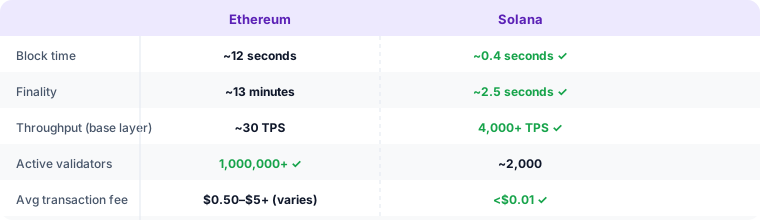
What are the key differences between Solana and Ethereum? Solana leads on speed (0.4s blocks, 2.5s finality, 4K+ TPS) and cost (fractions of a cent per transaction). Ethereum leads on decentralization (1M+ validators), security, and ecosystem depth. Solana is optimized for high throughput consumer applications. Ethereum is optimized for censorship resistance and financial infrastructure where trust is the core value.
Here is the honest breakdown of how the two chains compare across the dimensions that actually matter for developers and builders.
Speed and throughput
Solana wins decisively. A 0.4 second block time and 2.5 second finality compared to Ethereum's 12 second blocks and 12 to 15 minute finality is not a marginal difference — it is a different category of user experience. Applications where latency matters (payments, gaming, high frequency trading) favor Solana strongly.
Decentralization and security
Ethereum wins decisively. One million plus validators with 32 ETH minimum stake creates an economic security model that would require tens of billions of dollars to attack. Solana's validator set is smaller and hardware requirements mean the barrier to becoming a validator is higher. For applications where censorship resistance is the primary requirement, Ethereum's decentralization provides stronger guarantees.
Fees
Solana wins on average cost. Transactions on Solana typically cost fractions of a cent. Ethereum base layer fees during periods of high demand can reach several dollars for a simple transfer and tens of dollars for a complex smart contract interaction. Ethereum Layer 2 networks (Arbitrum, Optimism, Base) close this gap significantly, bringing costs to a few cents.
Developer ecosystem
Ethereum wins on ecosystem depth. Ethereum has years more of tooling, audited libraries, DeFi infrastructure, and developer documentation. The Solidity developer community is larger and most security patterns are better understood. Solana's Rust based ecosystem is growing rapidly but remains smaller.
Uptime and reliability
Ethereum has a stronger uptime record. Solana experienced several notable outages in its earlier years, though the network has become more stable with each major upgrade. For applications where guaranteed availability is critical, Ethereum's track record is longer.
For applications building consumer grade products where user experience is paramount — games, consumer payments, social applications — Solana's speed and low cost make it compelling. For applications where trust and censorship resistance are the core value proposition — financial infrastructure, governance systems, any application where the security model needs to withstand nation state level adversaries — Ethereum's decentralization is worth the tradeoffs in speed and cost.
Many serious projects in 2026 build on both. They use Ethereum for governance, asset issuance, and long term settlement, while using Solana or an Ethereum Layer 2 for the high throughput user facing operations.
Section 06 · VC Perspective
Why build on Ethereum vs Avalanche vs Solana: the investor perspective
The chain selection question looks different from a venture capital perspective. VCs evaluating blockchain projects in 2026 have watched multiple cycles of chain preference shift — and the reasoning has matured significantly.
The question "why build on Ethereum vs Avalanche vs Solana" (vol 70, KD 14) comes up in every early stage blockchain startup conversation. Here is how sophisticated investors frame the answer in 2026.
Consumer and high frequency applications: Solana is the default
For consumer products where user experience is the differentiator — payments, gaming, social media, high frequency trading — Solana is the VC consensus default in 2026. The 0.4 second block time and sub cent fees are not marginal improvements; they enable product categories that are unusable on Ethereum base layer. Consumer retention in crypto products is highly sensitive to confirmation latency. A 12 minute wait for Ethereum finality is a user experience failure for any application where speed is part of the value proposition.
Financial infrastructure and governance: Ethereum remains the institutional standard
For DeFi protocols, tokenized real world assets, DAO governance systems, and any application where censorship resistance is the core value proposition, Ethereum's decentralization justifies its tradeoffs. Institutional participants — banks, funds, regulatory bodies — are more comfortable with Ethereum's security model and its 1M+ validator count. The ecosystem depth — audited lending protocols, battle tested AMMs, established oracle networks — means Ethereum financial infrastructure is more likely to survive adversarial conditions.
Avalanche's position: enterprise and subnet customization
Avalanche occupies a different position than either Solana or Ethereum in the VC framework. Its subnet architecture allows enterprises to launch app specific chains with custom validators, custom token economics, and the option to keep data off the public chain. This makes Avalanche the preferred choice for regulated financial institutions and enterprise applications that need blockchain properties but cannot operate on a fully public network. It is not competing directly with Solana for consumer DeFi or with Ethereum for decentralized governance — it targets a different buyer.
The multi-chain reality: serious projects build on both
The most common VC position on chain selection in 2026 is not Solana OR Ethereum — it is both where justified by the application architecture. A DeFi protocol might issue governance tokens and manage the treasury on Ethereum while routing high volume trades through Solana. A gaming project might use Ethereum for NFT asset provenance and Solana for in game transaction throughput. The infrastructure cost of being multi-chain has dropped significantly, and the user experience benefit of matching chain to use case is increasingly the differentiator between funded and unfunded projects.
Section 07 · Getting Started
What to do before writing a single line of code
If you are new to blockchain development, resist the urge to deploy anything to mainnet immediately. The path that saves the most time and money is: understand the concepts, set up a wallet, use the testnet, then move to mainnet only when your application is thoroughly tested.
Set up a wallet
MetaMask is the standard for Ethereum and all EVM compatible chains. Phantom is the standard for Solana. Both are browser extensions and mobile apps. Your wallet stores the private key that controls your blockchain addresses. Treat it with the same care you would a bank password — there is no customer support to recover a lost private key.
Get testnet tokens
For Ethereum, visit the Sepolia faucet (sepoliafaucet.com or the Alchemy faucet for Sepolia) and request test ETH to the address from your MetaMask wallet on the Sepolia network. For Solana, switch Phantom to Devnet and run 'solana airdrop 2' in the CLI, or use the Solana Devnet faucet. These tokens have no real value.
Explore a block explorer
Etherscan (etherscan.io) is the standard explorer for Ethereum. Solscan (solscan.io) and the official Solana Explorer cover Solana. Look up any wallet address or transaction hash to see the full on-chain record. This is an essential debugging tool for every blockchain developer.
Read the documentation
Ethereum's documentation at ethereum.org/developers is comprehensive and well maintained. Solana's documentation at docs.solana.com has improved significantly. Both have developer quickstart guides that walk through deploying your first contract or program in under an hour.