Section 01 · Overview
What enterprise AI consulting covers
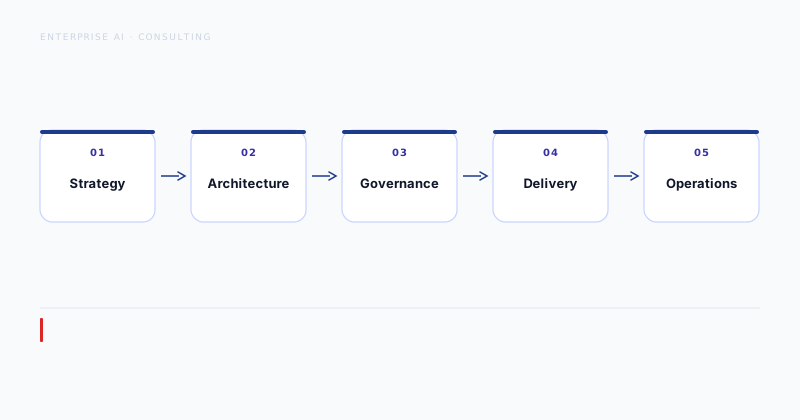
Enterprise AI consulting is advisory and implementation support for organizations that need to move AI initiatives across multiple teams, systems, and business functions. One framing from the advisory community is that it involves partnering with experienced advisors to identify, prioritize, govern, and scale AI initiatives across a large organization. What that means in practice is establishing a shared view of what to build, in what order, under what architecture, and under what governance conditions.
Quick answer
What does enterprise AI consulting involve? Enterprise AI consulting turns scattered AI experiments into a coordinated operating model by combining use case prioritization, architecture, governance, implementation planning, and change management. Strong engagements connect executive goals with data readiness, production constraints, and measurable outcomes so programs move beyond isolated pilots and scale responsibly.
From isolated pilots to an operating model
At the pilot stage, most organizations have a clear problem and a working prototype. At enterprise scale, the problem set is plural: twenty candidate use cases across five business units, three legacy data systems with inconsistent schemas, a dozen stakeholders with competing priorities, and compliance requirements that affect what the model can and cannot see.
Enterprise AI consulting addresses that coordination layer. The engagement does not just advise on models. It establishes a shared view of what to build, in what order, with what architecture, under what governance conditions, and with what organizational support. Without that coordination layer, AI programs at enterprise scale produce competing point solutions that share infrastructure costs but deliver no compounding benefit.
Why enterprise scope changes the problem
Enterprise scope introduces two problems that smaller deployments rarely face. The first is organizational gravity: large organizations have procurement cycles, security review boards, change advisory processes, and integration standards that slow AI deployment by weeks or months if they are not engaged early and correctly. The second is model governance at scale. A probabilistic system that performs well on a curated evaluation set can behave unpredictably in production when the query distribution shifts or upstream data changes without warning.
A credible enterprise AI consulting engagement addresses both. It maps the organizational path before committing to a technical path, and it builds monitoring and governance into the architecture from the start rather than treating them as work to be done after a failure surfaces. The firms that skip this discipline tend to produce architecturally sound systems that fail for organizational and governance reasons.
Section 02 · Strategy
Strategy, readiness, and use case prioritization
Linking AI investments to business outcomes
The strategy phase of an enterprise AI engagement answers two questions: which AI use cases are worth building, and in what order. Answering those questions well requires connecting proposed AI investments to specific business outcomes rather than capability checklists or technology demonstrations.
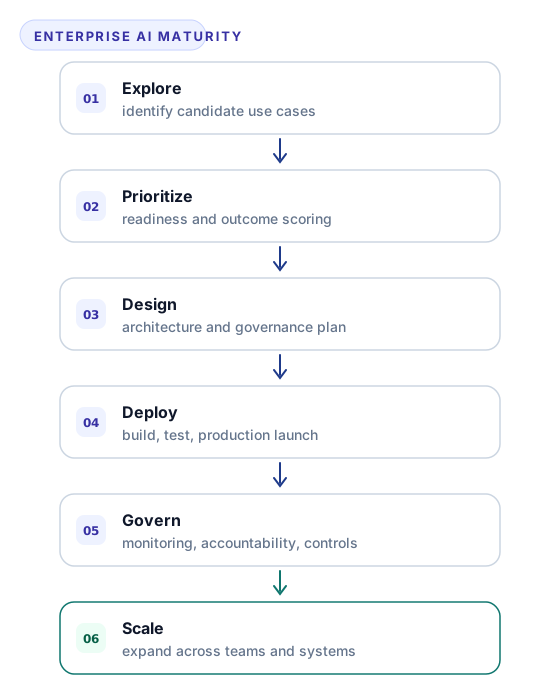
One framing from the advisory space describes enterprise AI consulting as helping organizations design, build, deploy, and govern AI as a core business capability rather than a portfolio of separate experiments. That distinction matters. A company that has run an AI pilot is not the same as one that has embedded AI into how it operates. The strategy phase exists to chart the path from one to the other, starting with the use cases that have the clearest outcome definition, the strongest data foundation, and the lowest organizational friction.
A strong strategy engagement produces a prioritized use case backlog with business outcome targets, success criteria, and the data and integration prerequisites for each item. The backlog is not a wish list. It is a sequenced program tied to specific business levers, with a realistic view of what can be delivered in the near term and what requires capability building first.
Assessing data, systems, and team readiness
Use case prioritization cannot happen in isolation from a readiness assessment. A model that performs well in a sandbox environment can fail in production because the upstream data pipeline is inconsistent, the integration point does not exist, or the team responsible for operating the system has no exposure to AI workflows.
A readiness assessment covers data quality and accessibility, infrastructure and platform compatibility, team capability gaps, and organizational readiness for adoption. If you are building that assessment yourself, the AI readiness assessment framework covers the key dimensions for CTOs and founders evaluating where their organization actually stands. Consulting engagements typically combine this work into a discovery phase that precedes any architecture or delivery commitments.
Section 03 · Architecture
Architecture and platform decisions
Scalability, security, and integration
Architecture decisions made during an enterprise AI engagement have consequences that outlast the initial deployment by years. A system designed to handle ten thousand inference requests per day behaves differently at ten million. A system built on a single vendor's embedding and retrieval stack requires significant rework if that vendor changes its pricing model, deprecates a capability, or exits the market.
Enterprise AI services typically address architecture across several connected dimensions: custom model development, private or on premises deployments for regulated environments, security and data governance, and managed operations after deployment. The goal is an architecture that is not just technically sound for the initial use case but maintainable, auditable, and capable of absorbing change as the AI market evolves.
Integration with systems of record is a recurring challenge that pilots consistently underestimate. AI systems that cannot read from or write to the platforms the business actually uses produce outputs that generate manual work rather than reducing it. Architecture planning should map every system the AI program touches, including authentication, data access, output routing, and the human workflows that depend on what the system produces.
Avoiding lock-in and fragmented tooling
The AI infrastructure market moves quickly. Vendors that offered the leading embedding models or retrieval systems at one point may be outpaced within months by new entrants or by established cloud providers consolidating the stack. An architecture that hard codes dependencies on a single vendor at every layer creates lock in that is expensive and disruptive to unwind when the market moves.
When engaging an enterprise AI consulting partner, ask explicitly about vendor neutral design. The build versus buy decision for AI touches the same tradeoffs: when to use a managed service, when to build on open source components, and how to preserve optionality as the market evolves. A credible consulting partner can defend their architectural choices across those tradeoffs and explain what assumptions would need to change for a different recommendation.
Section 04 · Governance
Governance and operating model
Decision rights and accountability
Governance is among the most underspecified components of enterprise AI programs. Organizations that invest heavily in model development and architecture often discover only after a visible failure that they never defined who has authority to pause a deployed model, who is accountable when a model produces a harmful or incorrect output, and what process governs updates to a production system.
A governance framework for enterprise AI addresses those questions before deployment. It defines the roles responsible for each AI system, the escalation path when something goes wrong, and the criteria that trigger a review or a shutdown. It also specifies how new AI deployments get reviewed before reaching production, and what audit evidence the organization needs to satisfy internal and external stakeholders.
The framework does not need to be elaborate. It needs to exist and be known before the system reaches production. Organizations that define governance after a failure has occurred are responding to pressure rather than managing risk.
Policies, monitoring, and risk controls
Governance also covers the ongoing monitoring and risk controls that keep production AI systems within acceptable operating parameters. Drift detection, output sampling, alert thresholds, and incident response procedures are governance artifacts, not engineering afterthoughts. Systems that are not actively monitored degrade in ways that are invisible until they affect users, customers, or regulators.
Organizations that build monitoring into the operating model from the start are better positioned to detect degradation early, respond to distribution shift, and satisfy auditors when they ask how the system is controlled and who is accountable for its behavior. Consulting engagements that leave monitoring design to a later phase or a different team typically produce systems that are technically deployed but not actually governed once the initial engagement ends.
Section 05 · Delivery
Delivery from discovery to operations
Design and implementation stages
Most enterprise AI consulting engagements follow a recognizable delivery structure. The discovery phase maps business context, data availability, integration constraints, and organizational readiness. The design phase translates the strategy into an architecture and a delivery plan with clear milestones. The delivery phase builds, tests, and deploys the system in an environment ready for production. The optimization phase tunes the system based on real production feedback after launch.
One advisory framework describes this as progressing through discovery, design, delivery, and ongoing optimization. The specific phases vary by firm and engagement scope, but the pattern is consistent: establish the context, design the solution, build and deploy it, then improve it under real conditions where assumptions can be tested against actual behavior.
What distinguishes stronger engagements is what happens at the handoffs between phases. A discovery that does not produce clear constraints on the design is not useful. A design that does not account for integration reality will stall in delivery. Good enterprise AI consulting keeps those handoffs explicit and grounded in the actual business and technical environment rather than in a document that gets archived when the next phase starts.
Ongoing optimization after launch
Deployment is not the end of the engagement. AI systems do not stabilize the way conventional software does after a release. Query distributions shift, upstream data changes, model providers update their APIs, and user behavior evolves as adoption grows. A production AI system that is not actively monitored and periodically reevaluated will degrade over time in ways that are often invisible until a failure reaches users.
Enterprise AI consulting engagements should specify, in the initial scope, what happens after launch. Who is responsible for monitoring? What metrics define acceptable performance? Under what conditions does the consulting team stay involved versus handing off to the internal team? What does a successful handoff look like, and what capability does the client organization need to have in place before the handoff completes? The answers to those questions determine whether the organization ends up with a maintained production system or an unsupported deployment that becomes a liability.
Section 06 · Partner Selection
How to choose an enterprise AI consulting partner
Evidence of production delivery
The single most reliable signal of consulting quality is evidence that the partner has delivered AI systems to production at scale, not just completed strategy engagements or produced reference architectures that were never built. Ask for specific examples: the problem, the architecture, the delivery timeline, the production outcomes, and what the system's state was six months after launch.
Firms that have delivered to production have opinions about what fails in practice. They have seen evaluation sets that did not predict production behavior. They have hit the integration complications that pilots skipped over. They have run incident response on AI systems behaving unexpectedly in production. They have handed off systems to client teams and watched what happened next. Those experiences are not available from firms that operate primarily at the strategy and advisory layer.
Buyer questions for scope, ownership, and outcomes
Beyond delivery evidence, the conversations that matter most are about ownership and accountability. When does the engagement end, and in what condition is the system at that point? Who on the client side needs to be capable of operating and maintaining what gets built, and does the consulting engagement include the knowledge transfer that makes that possible? How are success criteria defined before work begins, and how are they verified at each delivery milestone?
Before shortlisting any partner, run a structured vendor due diligence process that covers technical depth, governance capability, and the specifics of how the firm handles accountability after launch. The questions in that framework surface the gaps that a reference call or a capabilities presentation will not reveal under normal circumstances.
If you are evaluating whether an enterprise AI consulting engagement is the right next step for your program, I work with senior engineering and executive teams on exactly this kind of architecture and strategy work. The Agentic AI Consulting page explains the engagement model and typical scope.