Section 01 · How pay works
How fractional CTOs actually get paid
The default unit is a monthly cash retainer. Equity is a supplement that enters the deal only when both sides want the engagement to behave like a longer partnership.
Quick answer
How much equity should a fractional CTO get? Most engagements pay a cash retainer of $6,000 to $18,000 per month, with equity of 0.25 to 1 percent added only when the engagement runs six months or longer. Anything above 1 percent for a part time role is a structuring mistake, not a generous offer.
The default unit of fractional CTO compensation is a monthly cash retainer, usually $6,000 to $18,000 depending on scope and days per week. Equity is a supplement, not a substitute. That ordering matters because it sets the negotiation frame: you are buying senior architecture ownership by the month, and equity enters the deal only when both sides want the engagement to behave like a longer partnership.
Founders tend to arrive at this conversation with the wrong reference points. They know what a full time CTO gets at seed stage, somewhere between 1 and 4 percent, and they know what an advisor gets for a monthly call, somewhere between 0.1 and 0.5 percent. A fractional CTO sits between those poles but is priced like neither. The role carries real delivery responsibility, which an advisor does not, on a fraction of the time commitment a cofounder makes. If you are still deciding whether the role fits your stage at all, start with what a fractional CTO actually does and come back to the pay structure once the scope is clear.
The rest of this post gives you the numbers: the three structures that show up in real deals, the equity bands by engagement length, vesting mechanics that fit a part time role, and a worked dilution example you can rerun with your own valuation.
Section 02 · The structures
The three ways founders structure the deal
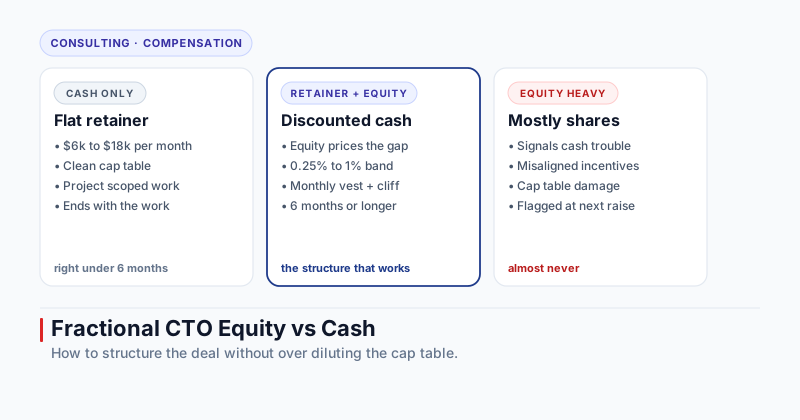
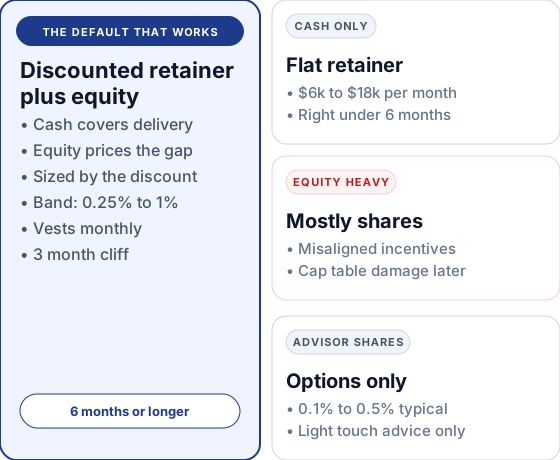
Almost every fractional CTO deal lands in one of three shapes. Two of them are reasonable. One of them is a warning sign for both sides.
Cash only
A flat monthly retainer at market rate, no equity. This is the right default for engagements under six months, project scoped work like an architecture review or a hiring sprint, and any situation where the startup has the runway to pay for what it uses. It keeps the cap table clean and the relationship simple: the work ends, the cost ends.
Discounted retainer plus equity
The startup pays below the market retainer and grants equity sized on the gap. This is the structure that works for engagements of six months or longer, because it gives the fractional CTO real skin in the outcomes they are shaping while keeping enough cash in the deal to signal that the startup values the time. Most of this post is about getting this structure right.
Equity heavy or equity only
Mostly shares, little or no cash. Founders propose it when runway is tight; a few operators accept it when they believe in the company. It usually serves neither side. For the startup it signals cash desperation to the next investor who reads the cap table. For the operator it converts a services engagement into an angel investment without the diligence. It also misaligns incentives: a person paid almost entirely in equity has a rational reason to favor optics over architecture.
The asymmetry is worth stating plainly. Cash only is never embarrassing. Equity heavy almost always is. The interesting design space is the middle structure, and the two questions that define it: how much equity, and on what schedule.
Section 03 · Equity bands
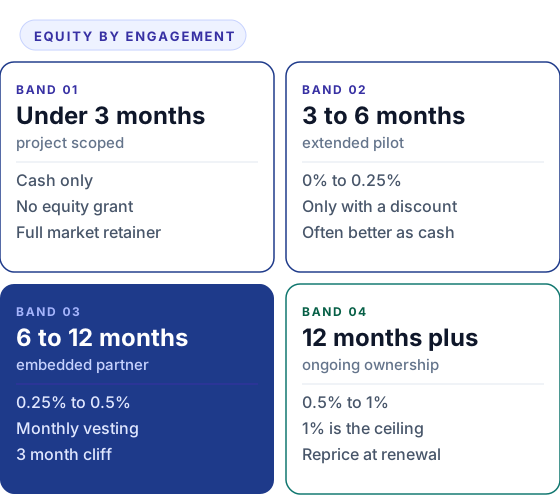
How much fractional CTO equity is fair for the time?
The honest answer is a band, set by engagement length and scope rather than by negotiation stamina.
| Engagement length | Equity band | Notes |
|---|---|---|
| Under 3 months | None | Cash only at full market retainer |
| 3 to 6 months | 0 to 0.25% | Only alongside a real cash discount |
| 6 to 12 months | 0.25 to 0.5% | The most common band in practice |
| 12 months or longer | 0.5 to 1% | 1 percent is the ceiling, not the midpoint |
Two rules sit on top of the table. First, equity below six months of engagement is usually noise: too small to motivate anyone, just large enough to clutter the cap table. Pay cash and keep it clean. Second, 1 percent is a hard ceiling for a part time role. The comparison that makes the ceiling obvious is the full time CTO benchmark of 1 to 4 percent: a person working two days a week, able to leave on thirty days notice, should not earn what a person betting their whole career earns.
Sizing inside the band is where the discount logic earns its keep. Price the equity against the cash the startup is not paying. If the market retainer for the scope is $14,000 a month and the startup pays $10,000, the deferred value is $4,000 a month, or $48,000 over a twelve month engagement. Divide by the current valuation to get the grant: at an $8 million post money valuation, $48,000 is 0.6 percent. That number lands inside the 12 month band, and more importantly it is defensible, because every input came from an observable figure rather than a feeling.
Section 04 · Vesting
How should fractional CTO equity vest?
Vesting for a part time executive should match the engagement, not the template in the option plan.
The standard four year schedule with a one year cliff was designed for permanent employees; copied onto a twelve month fractional engagement it means the person earns nothing until the engagement is nearly over, which defeats the purpose of granting equity at all.
The structure that fits: monthly vesting across the engagement length, with a three month cliff. On a twelve month engagement with a 0.6 percent grant, that vests 0.05 percent a month, with the first three months accruing and releasing together once the cliff passes. The cliff protects the startup from a bad fit walking away with equity after six weeks. The monthly schedule after the cliff protects the operator from doing eleven months of work and losing the grant in month twelve.
Three mechanics round out the structure. Use options or restricted stock from the existing plan rather than inventing a new instrument, because your lawyers and your next lead investor have seen those before. Renewals get a fresh decision, not an automatic top up: when the engagement extends past the original term, reprice a new grant against the valuation at renewal. And put the consulting agreement, not a side letter, in charge of what happens to unvested shares on termination from either side. None of this is exotic; all of it gets skipped in deals done on a handshake, and the skipped parts are what end up in dispute.
Section 05 · The math
What half a percent actually costs: a worked example
Founders consistently underprice equity grants because the number looks small on the day of the grant. Run the math forward and the real cost shows up.
Take a seed stage startup at an $8 million post money valuation granting 0.5 percent to a fractional CTO on a twelve month engagement. On grant day that stake is worth $40,000 on paper, which feels cheap next to writing another $4,000 monthly check. Now run it forward through a normal path: the company raises a Series A and takes 25 percent dilution, cutting the stake to 0.375 percent. The company later reaches a $50 million valuation. The stake is now worth $187,500.
That outcome is not a problem if the grant bought what it was supposed to buy: a year of senior architecture ownership that materially improved the odds of reaching that valuation. It is a problem if the grant was sized casually, because the same engagement could have been compensated with $48,000 of deferred cash value, and the difference between $48,000 and $187,500 came out of the founders and every other shareholder. Equity is the most expensive money a startup spends. Spend it like that is true.
Over granting is borrowing against the next round
A founder with three months of runway grants 2.5 percent to a fractional CTO in place of cash. At the Series A, the lead investor reads the cap table, asks who owns 2.5 percent, and hears that it was a part time engagement that ended a year ago. That conversation now costs either a repricing negotiation with someone who has no reason to cooperate, or a flagged term sheet. Over granting is not generosity.
Section 06 · The decision
When cash heavy beats equity heavy
The structures are tools, and the choice between them follows from runway, engagement length, and what the equity is actually supposed to do.
Cash heavy is the right call when the engagement is under six months, when the work is project scoped with a defined end state, or when the startup has 12 months or more of runway. In those cases equity adds administrative cost and cap table noise without buying alignment, because the engagement ends before the alignment matters. It is also the right call when the founder is unsure about fit: parting ways with a cash only contractor is a conversation, while parting ways with a shareholder is a process.
The equity component earns its place when the engagement runs six months or longer, when the fractional CTO owns decisions whose consequences arrive after the engagement ends, and when both sides genuinely want renewal to be the default. If you are earlier in the process and still scoping what the engagement should look like, the guide on when and how to hire a fractional CTO covers the hiring sequence that comes before any of this pricing logic.
A useful final check before you sign either structure: ask what behavior the equity is paying for. If the honest answer is retention and ownership of outcomes, the discounted retainer plus a banded grant does exactly that. If the honest answer is that the startup cannot afford the retainer, the equity is a loan dressed as alignment, and both sides should price it that way. If you want a structured second opinion on scoping and pricing an engagement like this, that is part of what the fractional CTO service covers in the first conversation.