Section 01 · Definition
What each model actually is
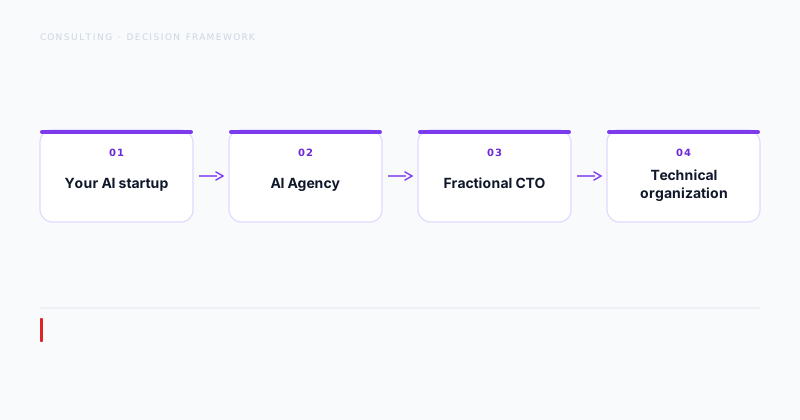
Two engagement types that look similar from the outside — both bring senior AI expertise — but solve very different founder problems.
Quick answer
In one sentence: An AI agency delivers a defined product for a fixed fee; a fractional CTO is embedded technical leadership — the right choice depends on whether you need a build delivered or a technical function grown.
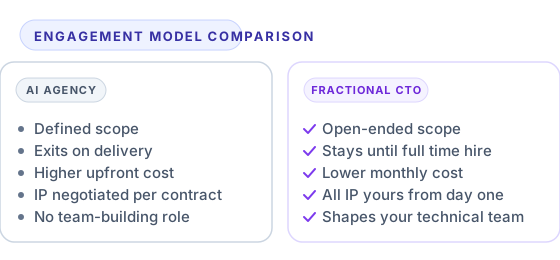
An AI agency is a team, typically 4 to 10 people, hired under a statement of work to deliver a defined scope. You specify the product; they build and hand it off. The relationship has a natural endpoint — a deliverable — after which the agency exits. The internal team that runs what they built has to be yours, or you are back for another contract in six months.
A fractional CTO is a single senior technical leader who joins your company part time, usually 20 to 40 percent of their work week. They make architectural decisions, evaluate engineers, choose vendors, and set technical direction — not for a fixed scope but for however long it takes to build the technical function you need. Most engagements end when the company hires a full time CTO, and the best fractional leaders help find and onboard that person.
The confusion comes from the fact that both models bill monthly and both claim senior AI expertise. The difference is accountability. An agency is accountable for a deliverable. A fractional CTO is accountable for all technical decisions — including the ones the previous agency already made.
Section 02 · Comparison
The eight axes that decide it
Neither model is obviously better. Each wins on four of the eight axes that matter to an early stage AI startup.
| Decision axis | AI agency | Fractional CTO |
|---|---|---|
| Accountability | Accountable for a specific deliverable within scope | Accountable for all technical decisions, including scope that changes |
| IP ownership | Code transfers on final payment; model tuning artifacts and prompt libraries often excluded | All IP is yours from day one — no vendor to negotiate with |
| Hiring downstream | No involvement in your engineering team | Directly evaluates, hires, and onboards your first engineers |
| Cost structure | Higher upfront; project fees typically $40k to $200k | Lower monthly ($4k to $15k); open-ended, typically 12 to 24 months |
| Risk transfer | Agency absorbs delivery risk for in-scope work; scope ambiguity stays with you | You retain all execution risk; the fractional CTO advises on managing it |
| Architecture decisions | Makes decisions within project scope; handoff quality varies | Owns architecture across vendors, models, and future hires |
| Speed to first build | Faster — typically 6 to 12 weeks for a scoped AI product | Slower to first build — 3 to 6 months before the team ships independently |
| Post-launch operations | Agency exits; your team inherits operations or you re-engage | Fractional CTO stays through launch and transitions into scale mode |
Section 03 · Agency model
When the agency model wins
Four signals that point to an agency engagement over embedded leadership.
Your scope is stable enough to write a statement of work
If you can describe the first build in a single document — what it does, what it does not do, and what done looks like — an agency will execute it faster than embedded leadership. Agencies are delivery machines. They need a clear target to be worth the rate.
You need a working product in under 12 weeks
Agencies have full teams available immediately. A fractional CTO is one person and needs weeks to understand your context before they can make decisions that stick. If speed is the constraint, the agency wins on raw timeline for a first build with defined requirements.
Your internal team will own it after delivery
If you have engineers who can inherit the codebase and understand the decisions behind it, the agency handoff model works. If nobody on your team can operate what the agency builds, you will call them again in six months at a higher rate. The handoff plan is as important as the build plan.
You do not yet have budget for ongoing technical leadership
Agency projects have a defined end. A fractional CTO is a monthly retainer with no guaranteed endpoint. If your budget is a one-time allocation rather than an ongoing line item, the agency model fits the cash flow better — you pay for the deliverable, not the relationship.
Section 04 · Fractional CTO model
When a fractional CTO wins
Four signals that point toward embedded technical leadership over a delivery contract.
You are building a technical team, not just a product
If hiring engineers is on your 12-month roadmap, you need someone who can evaluate them. An agency has no stake in your hiring decisions. A fractional CTO often becomes the deciding voice on your first 3 to 5 technical hires — and bad early hires cost you more than the engagement itself.
Architectural decisions keep changing
Statement of work engagements struggle when scope evolves. If your product direction is still shifting — which is common at seed and Series A — you need leadership that can change the plan without renegotiating a contract. A fractional CTO's value compounds precisely when uncertainty is high.
Investors or enterprise customers require named technical leadership
Many Series A investors want a named CTO in cap table conversations. Enterprise customers often require a technical point of contact with real decision authority. A fractional CTO satisfies both requirements while you search for or grow a full time hire.
You expect to hire a full time CTO within 12 to 18 months
The fractional CTO model is designed as a bridge. The best engagements end with the fractional leader helping hire their full time replacement. That transition — documenting architecture, building the hiring process, warming up candidates — starts from the first week, not the last.
Section 05 · Economics
How the total cost compares across a full engagement
The agency model is cheaper in month three. The fractional model often delivers more value per dollar by month twelve.
A typical agency engagement for a production AI product — not a prototype, but a system with testing, documentation, and a handoff package — runs $15k to $60k per month for a team of 4 to 8 people. A focused three to five month build totals $45k to $300k all in.
A fractional CTO engagement at two days per week runs $4k to $15k per month depending on experience and market. An 18-month engagement totals roughly $72k to $270k.
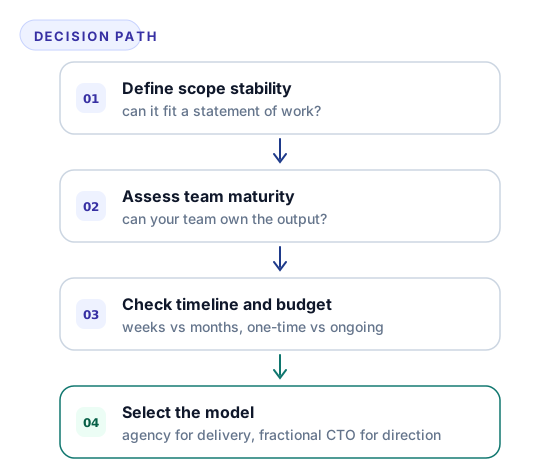
The crossover in raw spend happens around month 9 to 12. But the comparison breaks down at that point because what you receive is different. The agency left a codebase. The fractional CTO left a technical team, a hiring process, documented architecture decisions, and vendor relationships that the next CTO can actually inherit.
The right framing is not which is cheaper but which cost produces the asset you need in 18 months. If the asset is a shipped product, the agency wins. If the asset is a technical organization that can ship independently, the fractional CTO wins.
For a practical look at what the fractional CTO engagement model looks like in practice — scope, milestones, and how the first 90 days are structured — the fractional CTO hiring guide covers the evaluation criteria and typical engagement structure.
Section 06 · Contract due diligence
The model and agent wrinkles standard contracts overlook
AI engagements carry liability surface area that most agency contracts were not written to cover. Four clauses to add before signing.
Prompt engineering IP
Most software IP clauses cover code. Prompts are not code — they are intellectual property with no settled legal category. If the agency builds the prompt library that makes your product work and the contract does not specifically include it, you may not own it when the project ends. Ask for a specific IP rider covering prompts, chain definitions, and evaluation rubrics.
Model tuning artifacts
If the agency fine-tunes a model on your data, the resulting weights need to be assigned to you explicitly. Standard agency contracts often miss this entirely. The underlying base model belongs to the model provider; the tuned delta is negotiable. Get it in writing before the training run starts, not after the project closes.
Vendor dependency
If the agency builds exclusively on a single model provider, you inherit their pricing risk, rate limit risk, and deprecation risk after they exit. Negotiate a vendor-neutral architecture clause: the system should be able to swap the underlying model provider with reasonable engineering effort. This is a one-paragraph addition to the statement of work.
Agent decision accountability
If you deploy an AI agent that takes actions with business consequences — sending emails, making purchases, updating records — and the agent makes a wrong decision, the liability question is not resolved in standard software delivery contracts. Define it explicitly: who is responsible for testing agent behavior, under what conditions the agent can act autonomously, what the human review trigger is, and what the rollback procedure looks like.
For a broader view of accountability structures in production agent systems — including the observability and safety layers that go around systems that take real-world actions — the agentic AI consulting guide covers what responsible production deployments require.
If you are weighing a fractional CTO against a technical cofounder rather than an agency, the comparison with a technical cofounder covers the equity, authority, and commitment differences between those two models.
If you are evaluating a fractional CTO engagement for your company specifically, the Fractional CTO service covers the engagement structures, typical milestones, and how the model adapts to different company stages.