
Section 01 · The decision
The one question that settles this
Most founders ask which option is better. The question that actually matters is whether your competitive advantage lives in the code.
Quick answer
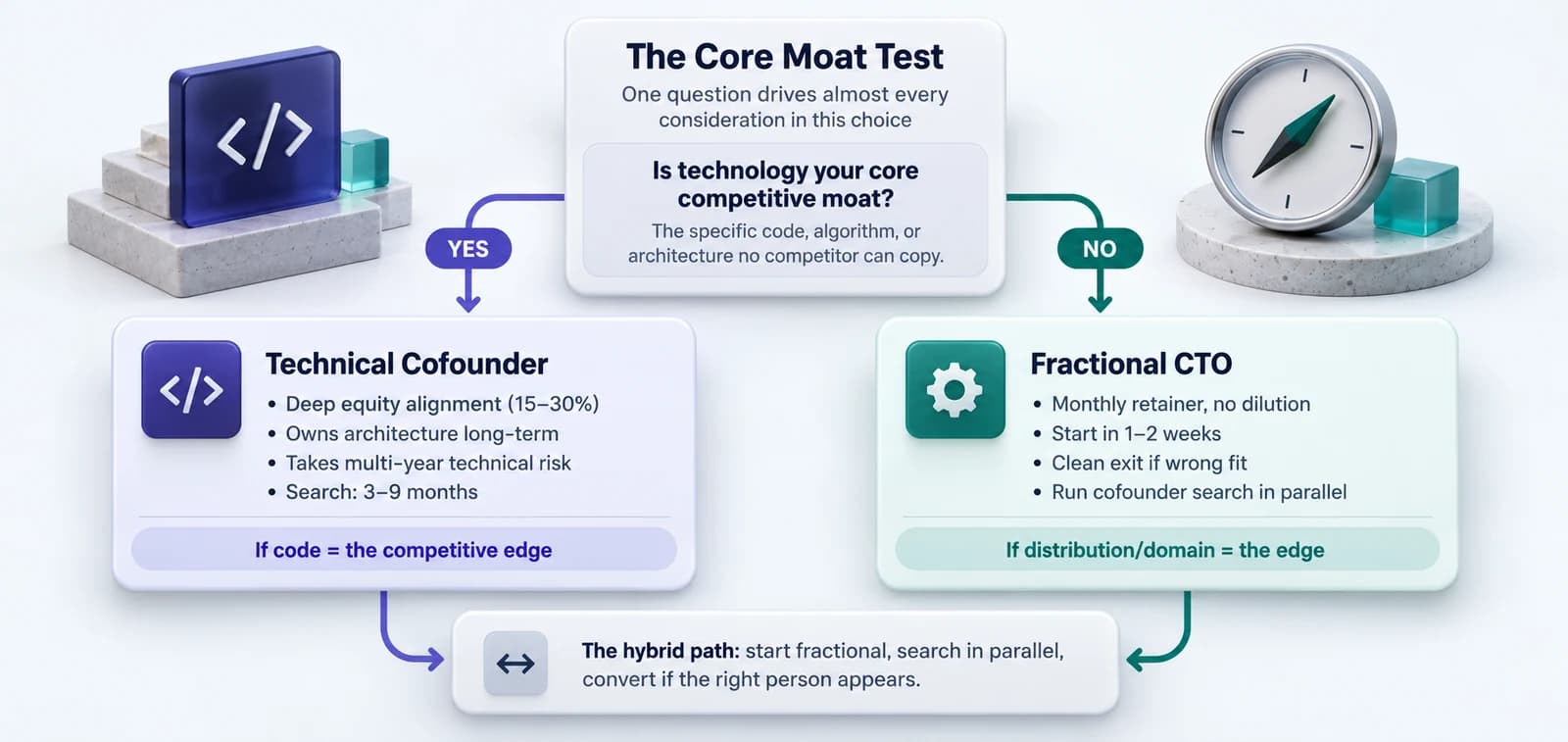
The short answer: Choose a technical cofounder when your competitive moat IS the technology. Choose a fractional CTO when your edge is in distribution, brand, domain expertise, or sales motion, and technology is the execution layer, not the source of defensibility.
Think about what you are building. If the defensibility of the product depends on a novel algorithm, a proprietary model trained on data you spent years accumulating, or a breakthrough technical approach no hired team executing a spec could replicate, you are in cofounder territory. The person who builds that needs skin in the outcome measured in years, not a monthly retainer.
If your competitive advantage is in supplier relationships you spent a decade building, regulatory knowledge your team holds from working inside the industry, or a go to market motion no competitor has figured out yet, technology is the execution layer. You need it to work reliably, but no specific line of code is the reason you win. That is fractional CTO territory.
This is the core moat test. Run it before any other analysis. If you cannot answer “our technology is the moat” with a specific technical claim, not a general feeling, a fractional CTO almost certainly makes more sense for your current stage.
Section 02 · Cofounder signals
When a technical cofounder is the right call
Four conditions consistently make the cofounder path the right choice. If none of them apply, you are almost certainly better served by a fractional arrangement.
The product's core defensibility is a technical breakthrough
A healthcare diagnostics model trained on proprietary clinical data. An infrastructure primitive that took three years to get right. A hardware plus software stack where the firmware is the product. If no competitor can replicate what you are building by hiring good engineers and executing a spec, you need someone whose compensation aligns with the multi-year effort required. Equity is not just incentive here. It is accountability.
Top-tier investors will ask about your technical cofounder as diligence
Not a curiosity. A question. Many institutional investors at pre-seed stage will not fund a nontechnical solo founder in a deep technical domain. If you plan to raise from these firms, a technical cofounder is sometimes a table stakes requirement that no fractional arrangement satisfies. Know your investor targets before assuming the question is optional.
You cannot hire the expertise you need
The best infrastructure engineers and ML researchers often only join as founders, not employees, especially when the problem is genuinely unsolved. If every recruiting conversation ends with the candidate asking to be involved from the beginning, the market is telling you something about what it takes to attract this caliber of person.
You need someone who owns ten-year consequences
A fractional CTO will give you excellent judgment for the duration of the engagement. A cofounder lives with the architecture decisions when the company has 200 engineers, when technical debt accumulates at scale, when the system breaks at the moment that matters most. The equity is not just financial. It is a stake in the outcomes of every decision they make.
Section 03 · Fractional CTO signals
When a fractional CTO is the right call
If none of the cofounder signals apply, a fractional CTO is almost certainly the faster, cheaper, lower-risk path. Four signals make this clear.
Your competitive edge is not in the code
You are building a marketplace where the network effect comes from the supply side. You are entering a regulated industry where the advantage is in compliance knowledge your team built from the inside. You are selling an enterprise product where the go to market is the differentiator. The technology must work, but none of the specific technical choices create durable competitive advantage. Good execution wins, not a technical breakthrough.
You need to move now
Finding the right technical cofounder is a 3 to 9 month search if you do it well. A fractional CTO can start next week. If your market window is open and you need to ship, the search timeline alone is a reason to start with a fractional engagement. You can run a cofounder search in parallel without blocking product progress.
You need senior technical credibility without the cofounder conversation
A fractional CTO can write the architecture document, present to engineers and investors, build the hiring plan, and manage the engineering team. They deliver the credibility signal a nontechnical founder needs without the 20 percent of the company that a cofounder conversation typically requires.
You have a functioning team but no technical director
This is the most common fractional CTO engagement: an early team of 3 to 5 engineers who are shipping but need senior architecture ownership, hiring judgment, and investor facing representation. A fractional CTO fills that gap while you decide whether a full-time CTO hire makes sense, and on what timeline.
To understand what a fractional CTO engagement covers day to day, the what a fractional CTO actually does post walks through the scope, responsibilities, and how the role changes across company stages.
Section 04 · Cost
The real cost of each path
The equity math looks obvious until you think it through carefully. The calculation depends entirely on a question most founders skip.
A technical cofounder at founding typically gets 15 to 30 percent of the company. At a $3 million post-money pre-seed valuation, that is $450,000 to $900,000 in equity at current value. After a seed round, a Series A, and an option pool refresh, the founding team stake is already heavily diluted. Adding another 20 to 30 percent for a technical cofounder changes the exit math for everyone remaining.
A fractional CTO at $6,000 per month for 12 months is $72,000. At $8,000 per month, it is $96,000. No equity, no dilution, no shareholder conversation when the engagement ends.
| Technical Cofounder | Fractional CTO | |
|---|---|---|
| Cost structure | 15 to 30% equity at founding | $4K to $18K per month, no equity |
| Time to start | 3 to 9 months to find | 1 to 2 weeks |
| Exit impact | Shares in the outcome | None — fixed cost |
| Removal cost | Legal, financial, relational | End the retainer |
| Incentive horizon | Years — full company lifecycle | Months — engagement scope |
The math only favors the cofounder path under two conditions: the company reaches a large exit, and the company value was materially driven by what that specific cofounder built. At sub-$10 million outcomes, the cash path almost always wins on pure economics. At $100 million-plus exits built on proprietary technology, the cofounder path wins, but only if the first premise was true from the start.
For a deeper look at what equity looks like when you bring on a fractional CTO with an equity component, the fractional CTO equity and cash structure guide covers the deal mechanics, vesting schedules, and dilution math in detail.
Section 05 · Risk
The cofounder conflict problem
Approximately 65 percent of startups cite cofounder conflict as a significant challenge. It is the most common single reason early-stage companies stall.
The mechanism is almost always the same. The working relationship that felt natural at two people and zero revenue becomes strained at ten people and $1 million in annual recurring revenue. Disagreements about pace, priorities, hiring, or equity splits that felt abstract at founding become urgent when there is real value at stake and real decisions to make under pressure.
The legal reality of removing a cofounder who holds 20 percent of the company is not an employment termination. It is a shareholder event. You need board approval. You need a buyback agreement. You often need investor consent. The emotional cost is real, the financial cost is real, and the distraction to the business during the process is often the most damaging part.
A fractional CTO who is not working out ends cleanly. You stop the retainer. There is no equity to unwind, no shareholder vote, no lawyers negotiating buyback terms. The downside of the wrong fractional CTO choice is a few months of retainer and some lost time. The downside of the wrong cofounder choice can be severe enough to end the company.
This is not an argument against cofounders. The right cofounder, someone whose judgment you would trust for ten years and whose technical instincts match the problem, is the most valuable relationship in your company. The argument is about what you are taking on if the relationship turns out to be wrong, and whether you have stress-tested the relationship before locking in that level of exposure.
Section 06 · The hybrid
The hybrid path most founders miss
Most nontechnical founders treat this as a binary choice. The evidence says it rarely needs to be.
Hire a fractional CTO now. Get moving in days, not months. Use the first 6 to 12 months to build the product, evaluate what the technical challenges actually are, and run a cofounder search in parallel from a position of strength rather than urgency.
If you find someone extraordinary during that period, someone who passes the cofounder test because the technology genuinely is the moat and this person is uniquely positioned to build it, convert. Negotiate an arrangement that reflects the reduced risk of later-stage entry. The conversation is cleaner and the deal terms are fairer when you both know what you are building.
If you do not find that person in 12 months, you have a working product, a technical team that is shipping, and a clean cap table. That is a significantly stronger position than one where you gave away 25 percent of the company on a vision pitch before you understood the technical requirements.
The hybrid path is especially useful for nontechnical founders who need to de-risk the question of who builds this before committing to a permanent answer. Start the engagement, learn what senior technical leadership actually looks like in practice for your problem, and let that inform the decision.
If you want to understand what a fractional CTO engagement looks like before committing, the fractional CTO service describes the scope, day-to-day structure, and engagement models in detail.