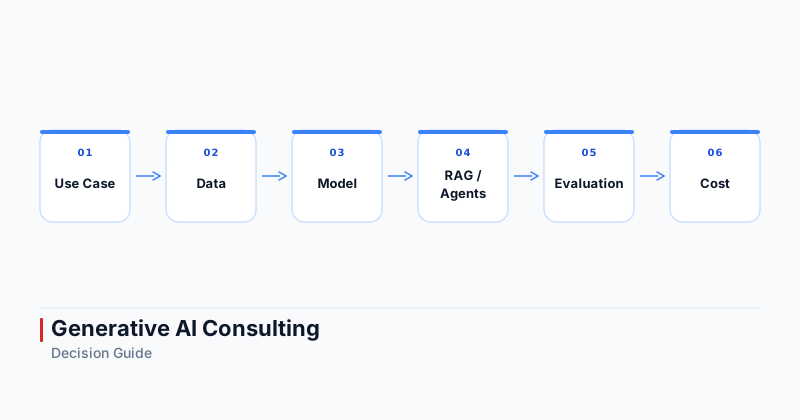
Section 01 · Scope
What generative AI consulting actually covers
The work is pre-build decision support: use case validation, architecture selection, governance design, and cost modeling before the engineering team writes production code.
Quick answer
What is generative AI consulting? Generative AI consulting helps organizations decide where and how to use technologies such as LLMs, retrieval systems, and AI agents. The work commonly includes use-case validation, data readiness, model and vendor selection, architecture, RAG or agent design, governance, cost estimation, evaluation criteria, and proof-of-concept planning before a larger production investment.
Uvik defines generative AI consulting as helping companies decide how, where, and whether to use LLMs, RAG systems, AI agents, and generative AI workflows before implementation. The critical word is before. A generative AI consultant does not own the engineering outcome — the consultant owns the decisions that shape whether an engineering investment is worth making and how it should be structured.
General AI consulting covers predictive machine learning, analytics, computer vision, forecasting, and broad data strategy. Generative AI consulting has a narrower focus: LLM-specific systems with their particular architecture choices (RAG, agents, fine-tuning, prompt design), their rapidly changing model landscape, their token economics, and their failure modes around hallucination, latency, and cost drift. A consultant who conflates the two disciplines will apply machine learning intuitions to problems that need language model intuitions and vice versa.
At its most useful, a generative AI engagement answers three questions before the first sprint: is there a use case with a defensible business case, is the organization technically capable of delivering and operating it, and what does success look like in terms the team can measure? Without clear answers, the prototype phase accumulates debt and the production decision gets made by inertia rather than evidence.
Section 02 · Use Cases
Choose use cases with a go or no-go discipline
Most organizations identify more generative AI opportunities than they can execute well. The filter is not creativity but a structured go or no-go that separates high-return investments from costly experiments.
The Hackett Group describes generative AI consulting as spanning strategy through enterprise implementation with emphasis on ROI, implementation risk, and measurable business outcomes. That framing is useful because it anchors use-case selection to outcomes, not to the novelty of the technology. A use case that sounds technically interesting but cannot be connected to a specific business outcome is not ready for a production investment.
A disciplined use-case filter evaluates candidates across two dimensions before any architecture discussion. The first is business value and workflow fit: does the use case have a measurable outcome (cost reduction, revenue, time-to-answer, risk reduction), does it address a workflow step that is genuinely amenable to language model output, and is the value hypothesis specific enough to be falsifiable? The second is feasibility, data, and risk: is the relevant data accessible and governed, what is the failure mode if the system is wrong, and what regulatory or compliance constraints apply?
| Dimension | Go signal | No-go signal |
|---|---|---|
| Business value | Specific measurable outcome with an owner | Value claim is directional with no numbers |
| Workflow fit | Task involves language understanding or generation as the core operation | Task is primarily calculation, routing, or classification that a simpler model handles better |
| Data readiness | Relevant data is accessible, governed, and representative | Data is fragmented, unverified, or requires significant preparation before any model can use it |
| Risk profile | Failure mode is visible, recoverable, and low-stakes | Failure in production causes financial, legal, or safety harm without a human review layer |
Use cases that fail the filter are not abandoned permanently. They are staged: data readiness gaps become a data infrastructure project, and high-stakes failure modes get a human-in-the-loop design that requalifies the use case with an acceptable risk profile. Staging is more productive than simply moving to the next idea because it builds toward the conditions that make the original opportunity viable.
Section 03 · Architecture
Select the model and architecture
LLM, RAG, fine-tuning, and agent architectures solve different problems. Matching the pattern to the use case before writing code is the single highest-leverage technical decision in a generative AI engagement.
HSO emphasizes clean governed data, production architecture, structured governance, and change management as foundations for realizing generative AI value. The architecture decision shapes all of those downstream requirements. A RAG system has different data governance needs than a fine-tuned model, and an agent orchestration layer has different production monitoring requirements than a direct LLM call.
Base LLM (prompt engineering)
Best for tasks where the model already has the necessary knowledge and the problem is formulation: summarization, classification, rewriting, translation, code generation. Lowest implementation cost and fastest iteration. Fails when the task requires proprietary or recent information the model was not trained on.
Retrieval-augmented generation (RAG)
Best for grounding LLM responses in a specific document corpus, knowledge base, or data source. Keeps knowledge current without retraining. The core engineering challenges are retrieval quality, chunk design, and context window management. For a detailed comparison of when RAG outperforms fine-tuning, see the fine-tuning vs RAG guide.
Fine-tuning
Best for adapting a model to a consistent style, domain vocabulary, or structured output format that prompt engineering cannot reliably achieve. Requires a labeled training dataset and adds an ongoing retraining cost. Appropriate when the base model consistently fails at a specific pattern despite well-constructed prompts.
Agent orchestration
Best for multi-step workflows where the system must decide which tools to call, in what order, and how to handle partial failures. Agents introduce new failure modes: tool call errors, reasoning loops, and cost unpredictability. An agent architecture is justified when the task requires dynamic planning that a static prompt chain cannot handle reliably.
Model and vendor selection follows architecture selection. The relevant criteria are context window size relative to the retrieval or task design, inference latency against the user experience requirement, output quality on the specific task type (not benchmark aggregates), per-token cost at projected volume, and data residency constraints for regulated industries. Vendor lock-in risk is material at the architecture level: an agent system built against one provider's function-calling conventions is harder to migrate than a RAG system using a provider-agnostic embedding and retrieval layer.
Section 04 · Controls
Define evaluation, guardrails, and cost
Evaluation criteria and cost estimates must be defined before the prototype — not discovered after. Organizations that defer this work until after a demo decision fund systems they cannot measure or afford.
Quality and safety criteria translate the business case into measurable evidence. For a document QA system, the metric might be answer accuracy on a labeled evaluation set with a retrieval recall floor. For a code generation copilot, it might be a pass rate on a language-specific test suite plus a human review acceptance rate. The metric needs to be specific enough that the team can run the evaluation on the prototype output and produce a number that either justifies scaling or surfaces a gap that needs to be closed first. For a structured approach to building and running these evaluations, the RAG evaluation metrics guide covers the measurement framework in detail.
Guardrails cover two separate concerns. The first is output safety: hallucination detection, content filtering, and structural validation for use cases that require formatted output. The second is behavioral scope: preventing the system from taking actions, accessing data, or generating responses outside the intended domain. Agent systems need explicit tool permission scopes, not broad access granted at build time and narrowed later.
Running cost estimation is the most commonly skipped step in generative AI advisory. Token costs at prototype scale bear no relationship to token costs at production scale, and retrieval infrastructure adds a separate cost curve. A realistic cost model covers input and output token volume at projected usage, embedding generation and reembedding frequency, retrieval infrastructure (vector database, search index), monitoring and observability tooling, and model version upgrade costs when providers change pricing. For a structured approach to cost projection and optimization, the LLM inference cost optimization guide covers the model in detail.
Section 05 · Production Path
Move from prototype to production
A working demo is not a production-ready system. The gap between prototype success and a maintainable, monitored, cost-controlled production deployment is where most generative AI investments stall.
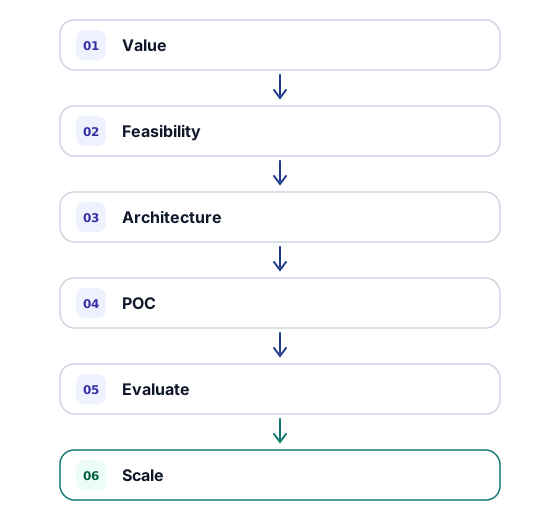
GenAI Consulting Services describes typical engagements as moving from discovery and a fast prototype to a production build and handoff for LLM, RAG, agent, or automation systems. The prototype phase has a specific, bounded purpose: to generate evidence against the evaluation criteria defined in the controls step. A prototype that succeeds against those criteria justifies the production build. A prototype that fails surfaces the gap, and the decision is whether to address the gap or close the project before larger investment.
Production readiness for a generative AI system requires artifacts that most prototype deliverables do not include. A stable retrieval pipeline with tested chunk quality and a monitored recall rate. An inference cost dashboard with alerting for volume or price changes. A versioned prompt management system so that prompt changes are reviewed, tested, and rolled back if they degrade output quality. A documented failure mode response plan that names who is responsible for each category of failure and what the escalation path looks like.
Capability transfer is the final production gate. The internal team must be able to evaluate the system, update retrieval sources, iterate on prompts, monitor costs, and respond to failures without requiring the consulting team to return for each change. A generative AI engagement that does not end with a capable internal team has delivered a dependency, not a system.
Section 06 · Selection
How to choose a generative AI consultant
The right generative AI consultant has both architecture depth and evaluation discipline. Without architecture depth, the system design is too thin to act on. Without evaluation discipline, the organization cannot tell whether the system is working.
Verify architecture and evaluation depth
Ask which specific LLM patterns the consultant has built in production: RAG with hybrid retrieval, agent orchestration, fine-tuning pipelines, structured generation. Ask what evaluation frameworks they have used on past projects and what the measurement looked like. Generalist strategy firms that added a GenAI practice rarely have the depth to advise on retrieval architecture, context window optimization, or production failure modes.
Probe cost and ownership transparency
Ask for a running cost model from a recent engagement: what the projected volume was, what the actual cost was at 90 days, and how the model accounted for retrieval infrastructure. Consultants who have not built and operated these systems at scale cannot provide this. Ask who owns prompt versioning and cost monitoring after handoff.
Require production readiness artifacts
Ask for sanitized examples of the handoff deliverables from a past engagement: the evaluation framework, the monitoring setup, the prompt management system, the failure mode response plan. A consultant who cannot show concrete production artifacts produces recommendations that do not survive contact with engineering.
Check for vendor independence
Ask whether the firm has reseller agreements, implementation revenue, or referral arrangements with any of the model providers or infrastructure vendors they might recommend. Structural incentives shape recommendations regardless of how the scoring is presented. Independence must be verified, not assumed.
Define the prototype-to-production boundary
Get explicit clarity on where advisory responsibility ends and implementation begins, and what the handoff deliverable is. The most expensive ambiguity in generative AI engagements is the gap between a successful demo and a maintained production system. Define what constitutes production readiness before the engagement starts, not after the prototype is built.
If you are evaluating whether a structured generative AI advisory engagement fits your current situation, or whether a more integrated technical engagement covering both architecture decisions and implementation ownership would serve better, the Agentic AI Consulting service covers both advisory scope and production engineering depending on where the organization is in its AI maturity.