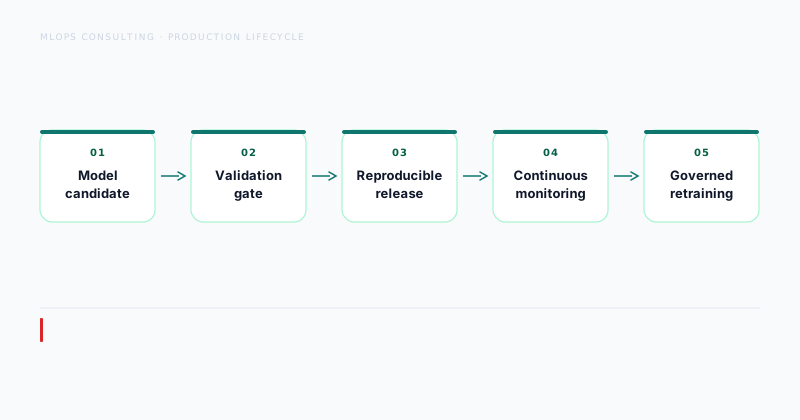
Section 01 · Foundations
What MLOps consulting should actually solve
MLOps consulting helps teams operationalize machine learning by making training, validation, deployment, monitoring, retraining, rollback, and governance repeatable. The real goal is not a larger platform but a production lifecycle that matches model risk, release frequency, infrastructure, and ownership while giving engineers traceability, observability, and controlled change.
Quick answer
What is MLOps consulting? MLOps consulting designs the operating system around production machine learning — covering reproducible pipelines, deployment controls, monitoring for software and model signals, retraining rules, rollback procedures, governance, and team ownership. The output is a production lifecycle that matches model risk, release frequency, and infrastructure, not a platform selection or tool recommendation.
Most organizations encounter the same inflection point: a model that performed well in a notebook or staging environment becomes a liability the moment it enters production. Releases depend on a single engineer who knows the exact sequence. Monitoring covers the API layer but misses model behavior. Retraining is ad hoc. When something breaks, no runbook exists and ownership is contested.
MLOps consulting addresses the operating system around machine learning, not just the models themselves. A strong engagement covers reproducible pipelines, deployment controls, monitoring for both software and model signals, retraining rules, rollback procedures, governance, and team ownership from the first delivery.
From validated model to reliable operation
The gap between a validated model and a reliable production system is larger than most engineering teams expect. Validation confirms that the model performs on held-out data. Reliable operation requires that the model continues performing under production data distributions, that it can be updated without regression, that failures surface quickly and route to the right team, and that the system behaves predictably under load.
HSO describes MLOps consulting scope as spanning the full machine learning lifecycle, including platform design, pipeline automation, deployment, monitoring, governance, and enablement — precisely because each layer compounds the ones beneath it.
Why the lifecycle matters more than the tool list
Tools do not make decisions — lifecycles do
An organization can adopt every popular MLOps tool and still have an unreliable production ML system if the lifecycle decisions are missing. Tools do not decide who owns a model incident. They do not define when a candidate model should replace a production model. They do not specify what happens when drift is detected. Those decisions — ownership, promotion criteria, response rules — are what consulting should produce. The platform follows from those decisions, not the other way around.
Section 02 · Architecture
Start with the minimum production architecture
The right MLOps architecture depends on the model portfolio, team structure, release frequency, serving requirements, existing infrastructure, and production risk. The objective is the minimum architecture needed for reliable operation, not the most comprehensive platform the team can justify.
A team running two batch scoring models with weekly releases needs version control, a basic promotion gate, and monitoring tied to accuracy and latency. A team running fifteen models with continuous retraining, real-time serving, and regulatory audit requirements needs a substantially more involved stack. Building the second system for the first team is how MLOps projects fail: the operational overhead exceeds the value.
Match architecture to model portfolio and risk
The right starting question is not “what should our MLOps platform do?” It is “what is the minimum control surface required for reliable operation at our current model count and risk level?”
High-risk models — those with direct financial impact, regulatory exposure, or safety implications — require stricter promotion gates, more granular monitoring, rollback windows, and audit logging. Lower-risk models tolerate simpler approaches. Treating every model in the portfolio identically leads to either undercontrolled high-risk deployments or overengineered infrastructure for routine work.
Avoid platform complexity before it is justified
The pattern seen across failing MLOps adoptions is consistent: a team selects a comprehensive platform, spends months on setup, and eventually finds that day-to-day engineering effort is dominated by maintaining the platform rather than improving the models. Platform complexity should follow model complexity, not precede it.
Define expansion triggers before signing the platform contract
Start with the controls required for reliable operation at the current scale, define the signals that would justify adding a layer, and expand the infrastructure only when those signals are triggered. This requires explicit decision criteria, which is exactly what a consulting engagement should produce.
Section 03 · Reproducibility
Make training and release paths reproducible
Reproducibility is the foundation of a trustworthy ML production system. Without it, debugging a production regression means archaeology rather than diagnosis, and controlled rollback is theoretically possible but practically unreliable.
Reproducibility requires versioning datasets, models, features, code, configurations, and other machine learning artifacts so teams can recreate model states, compare changes, and support controlled releases. This is not simply storing model weights. It means capturing the full context: the data snapshot the model was trained on, the preprocessing transformations, the evaluation results, and the configuration that produced the training run.
Automated validation and promotion
Define promotion criteria before writing pipelines
A promotion gate is the checkpoint between a trained candidate and the production system. Define automation criteria — accuracy above threshold, latency within bounds, no regression on the golden evaluation set — and human approval cases before the first pipeline is implemented.
Automate where criteria are well defined
Manual promotion gates that rely on an engineer remembering to run specific checks are not reliable at scale. They create the conditions for regressions to reach production on a busy deployment day. Automate the checks, surface the results, and require explicit approval only where judgment is needed.
Flag first deployments and regulated environments explicitly
A first deployment of a new model type, or any release into a regulated environment, warrants human sign-off regardless of automated gate results. Build that exception into the promotion policy before it is needed.
Registries, lineage, and controlled rollback
A model registry provides a single source of truth for which model version is in production, which versions are staged for evaluation, and what the lineage of each version is. Lineage — the record of what training data, code version, and configuration produced a given model — is what makes controlled rollback possible.
Rollback without lineage is a gamble: the team reverts to a previous artifact but cannot be certain the conditions that produced it are faithfully reproduced. Rollback with lineage is a deliberate reversion to a known state, verifiable against the same evaluation criteria used for the original promotion.
Section 04 · Monitoring
Monitor both software health and model behavior
Production ML systems require monitoring on two surfaces simultaneously: software health and model behavior. Most teams start with software health alone — latency, error rates, throughput — because it maps directly onto familiar SRE practices. Model behavior monitoring is the layer that typically lags.
Software health monitoring catches infrastructure failures. Model behavior monitoring catches what software health cannot: statistical drift in the input distribution, degradation in output quality that does not trigger an error code, and early signals of a business metric problem that has not yet produced a visible failure.
For production LLM systems, effective observability covers both dimensions. The post LLM Observability in Production covers the instrumentation patterns in detail for language model deployments, which share the same dual-surface structure.
Latency, drift, data quality, and operational health
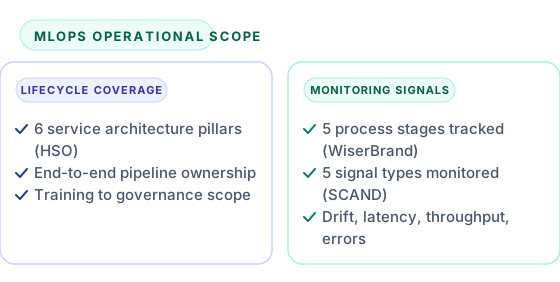
SCAND describes continuous monitoring across accuracy, latency, drift, data quality, and operational health, with alerts and dashboards used to investigate production changes. WiserBrand describes predeployment testing alongside postdeployment monitoring for performance, drift, bias, and cost, with dashboards tied to service objectives and rollback or retraining decisions.
The signal types that matter in production: output accuracy on labeled subsets, input feature distribution shifts, prediction confidence distribution changes, latency percentiles across model versions, and error rates by input category.
Alerts that lead to an explicit action
Design monitoring backward from the decision it supports
An alert that does not specify an action is operational noise. The design of a monitoring system should work backward from the decision it needs to support: when this signal crosses this threshold, the response is to investigate, retrain, degrade gracefully, or page the on-call owner. Dashboards that display dozens of metrics without threshold logic or routing rules produce teams that check dashboards manually rather than teams that respond to signals automatically.
Section 05 · Retraining
Treat retraining as a governed release
Retraining is not a separate operational concern from release management — it is a release. A newly trained candidate should be evaluated against the current production model before it replaces production, using the same evaluation criteria and promotion gates applied to any other release.
The failure mode is treating retraining as a maintenance operation rather than a deployment decision. Automated retraining pipelines that promote directly to production without a validation gate create the conditions for a model trained on corrupted or shifted data to replace a stable production system without anyone noticing until business metrics degrade.
Retrain, validate, compare, approve, deploy
The retraining lifecycle should follow the same stages as any controlled release: train the candidate on the new data, validate against the evaluation set, compare to the current production model on the metrics that matter, require approval where the criteria do not unambiguously favor the candidate, and deploy through the same gate as any other promoted model.
This requires that the evaluation set remains stable and representative. An evaluation set that is refreshed at the same time as training data cannot serve as an independent quality gate.
Why a new candidate should not replace production automatically
Automatic promotion is a reasonable optimization once the team has confidence in the evaluation criteria and has observed the retraining pipeline through multiple cycles without incidents. It is not the right starting point.
Governance for AI model decisions includes not just who can promote a model but what criteria govern the decision. The post AI Governance for LLMs in Production covers the governance structures that apply to language model releases, but the same principles apply to any model type with business impact.
Section 06 · Ownership
Define ownership before scaling the model portfolio
Ownership is the variable that determines whether monitoring and retraining pipelines produce outcomes or produce dashboards that no one acts on. It answers: who is paged when this model's accuracy degrades? Who decides whether to retrain or rollback? Who is accountable for the business metric impact?
The answer cannot be “the data science team” as a collective. Collective ownership produces collective ambiguity, which produces delayed response and unresolved incidents.
Who owns incidents and model health
Each model in production should have an explicit owner — a named individual or a named team rotation — who receives alerts, owns the first response, and decides whether to escalate. This is not bureaucracy; it is the minimal governance required for a production ML system to be operable without a heroic individual holding it together.
Ownership should be documented in the model registry alongside the version history and lineage. When a model in production causes an incident and the team cannot quickly determine who owns it, the registry is the correct place to find the answer.
Runbooks, handover, and governance
A runbook is an operational script, not documentation
A runbook for a production model describes what to do in the most common failure scenarios: drift detected, accuracy below threshold, serving latency spike, retraining pipeline failure. Runbooks are not documentation in the conventional sense — they are operational scripts that the on-call engineer can execute under pressure without needing to reason about the system from first principles.
Governance determines which decisions require approval and who gives it. Promotion of a new model version, changes to monitoring thresholds, emergency rollback, and changes to the evaluation set are all governance decisions. Defining them before scaling the portfolio means that when the hard call arrives, the organization already has a clear answer.
Section 07 · CTO Checklist
A CTO checklist for selecting an MLOps engagement
An MLOps consulting engagement is justified when models are in production or ready for production and the team lacks reliable lifecycle controls.
The right signals are: releases require manual steps that are not documented, production behavior is not systematically monitored, retraining is ad hoc, rollback is theoretically possible but practically unreliable, or ownership of production model incidents is unclear.
Readiness signals
The organization should have a clear picture of the model portfolio before engaging an MLOps consultant: how many models, their risk levels, release frequencies, and the current state of the deployment and monitoring infrastructure. An engagement that starts with a full infrastructure audit of a portfolio the team cannot describe coherently will consume most of its time on discovery rather than on design.
Deliverables and acceptance criteria
Documented production lifecycle per model tier
Each model tier should have an explicit lifecycle document: what triggers a training run, what the promotion criteria are, who owns the promotion decision, and what the rollback procedure is.
Automated promotion gates with explicit criteria
Gates should be defined in code with clear pass/fail criteria, not described in a design document and left to manual execution. The test suite for the gate is part of the deliverable.
Monitoring stack tied to decision rules
Each monitored signal should map to a decision: investigate, retrain, page the owner, or alert the business. A monitoring dashboard that does not include routing rules is an incomplete deliverable.
Rollback procedures tested against the production environment
A rollback procedure that has not been executed against the actual production environment is a hypothesis. It should be tested — in a staging environment that mirrors production — before the engagement closes.
Ownership definitions and runbooks
Ownership documentation and runbooks for the most common failure scenarios are operational deliverables, not optional appendices. An engagement that closes without them has not transferred the operational knowledge.
Scope described in tools is not scope
Evaluate a proposed engagement against this list. If the scope is described entirely in terms of platform selection and tool configuration, the engagement is likely to produce infrastructure without the operational decisions that give it value. Generic architecture diagrams and tool recommendations are not deliverables — they are inputs to the work.
If your team is moving from validated models to a production ML portfolio and needs architecture that will hold at scale, AI Systems Architecture consulting covers the end-to-end design work from infrastructure to governance.