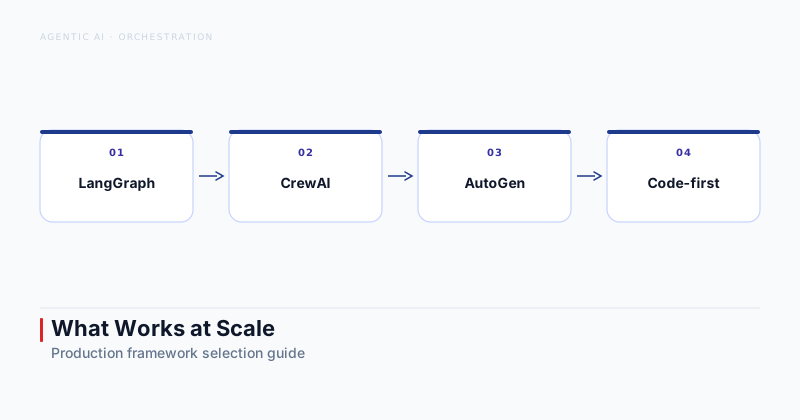
Section 01 · The Problem
What multi agent orchestration frameworks actually do
An orchestration framework is the layer that coordinates when agents run, what state they carry, how they hand off work, and what happens when something fails.
Quick answer
Which multi agent orchestration framework should you use for production? LangGraph is the most production ready option for complex stateful workflows. CrewAI is the fastest path to a working demo but requires hardening before production. AutoGen suits collaborative multi agent patterns. When state control, cost observability, and testability cannot be compromised, a code first orchestration layer sometimes beats all three.
In a single agent system, coordination logic is trivial: the agent runs, returns a result, and the session ends. In a multi agent system, it is the architecture. Most frameworks provide four core capabilities: a graph or workflow model defining the execution topology, a state object representing shared memory available to all agents, a dispatch mechanism for moving work between agents, and a runtime that executes steps and handles errors.
The gap between a demo and production is almost never in the happy path. It is in the failure path: what happens when an agent call times out at step 6 of a 10-step workflow? Where is the state? Can the run resume or does it restart from scratch? How are costs attributed across agents? How is a human review gate triggered without blocking the entire run? These are the questions that reveal whether a framework is production ready or just production adjacent.
Section 02 · Evaluation Framework
Seven axes that separate demo from production
The standard comparison asks about LLM provider support, GitHub star counts, or tool integrations. None of those predict production success. These seven axes do.
State model
How the framework represents and persists shared memory that agents read and write. A weak state model means you manage state yourself, outside the framework. In production, this leads to race conditions, lost context after restarts, and runs that cannot be reproduced. The strongest state model is typed, versioned, checkpointed, and owned by the framework.
Retry semantics
What happens when an agent call fails or returns an invalid response. Naive retry — try again immediately — is rarely acceptable because it burns budget, inflates latency, and masks root causes. Production grade retry semantics include per agent retry budgets, exponential backoff, fallback strategies, and the ability to log failures without silently running them again.
Human in the loop
Whether the framework has a first class mechanism for pausing a workflow, surfacing a decision to a human, and resuming after approval. Building this after the fact on a framework that was not designed for it is painful and unreliable. The interrupt should be a declared checkpoint in the graph, not an external polling mechanism bolted on top.
Cost observability
Whether the framework exposes per agent token spend, tool call cost, and end to end workflow cost in a form that can be attributed, aggregated, and alerted on. Without this, you have no signal until the bill arrives. Cost observability is not a nice to have for production systems — it is how you know when a workflow is misbehaving.
Deploy story
How you run the framework in production: whether it supports containerization, whether it has a managed runtime or requires you to host the execution loop yourself, and whether it integrates with your infrastructure without forking the framework internals.
Testability
Whether you can run the orchestration logic with deterministic, reproducible inputs without hitting real LLM APIs. Frameworks that tightly couple agent logic to live model calls make it expensive and slow to run a test suite, which means the test suite does not get written. Testability is the axis that determines whether your system degrades gracefully over time.
Backpressure
How the framework handles concurrency limits, rate limits from the model provider, and work queues when agent throughput exceeds capacity. A framework that silently drops runs or crashes under load is not production ready regardless of what its documentation claims.
Section 03 · LangGraph
LangGraph: strong where it counts
LangGraph models agents and tools as nodes in a directed graph, with conditional edges controlling execution flow. The graph is the contract — you declare the topology, and the runtime enforces it.
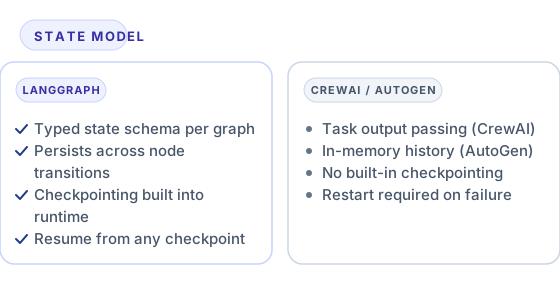
Its state model is the strongest in the category. State is a typed Python dictionary that all nodes can read and write through a declared schema. Combined with the checkpointing system included in the runtime, it persists across node transitions, survives process restarts, and provides a full audit trail of every state change. Resuming a failed workflow from a checkpoint requires no custom code.
Retry semantics are explicit rather than magic. You define how each node responds to failures: through conditional edges that route to a fallback node, a retry decorator, or a human in the loop interrupt that pauses the graph until approval arrives. The interrupt mechanism is first class — the graph suspends at a declared checkpoint, writes its current state, and waits for an external event to resume. This is the right abstraction for regulated workflows where a human must approve before the system continues.
LangGraph's deploy story improved with the LangGraph Platform managed runtime. Self hosted deployments require managing the execution loop, state backend, and checkpoint storage yourself — workable, but not trivial for small teams. Cost observability is strong when paired with LangSmith, which attributes spend at the graph, node, and individual model call level.
The tradeoff is the learning curve. LangGraph asks you to think in terms of graphs, state reducers, and conditional edges. For engineers accustomed to sequential scripts or simple chains, the mental model shift takes time. For detailed production patterns including interrupt configuration and streaming, the LangGraph production patterns guide covers the specifics.
Section 04 · CrewAI
CrewAI: fast start, production gaps
CrewAI is built on a crew and role abstraction. You define agents with roles, goals, and backstories; assign them tools; configure a crew with a process; and let the framework orchestrate execution.
The autonomy model is the source of both its speed and its production gaps. CrewAI asks agents to decide the order of actions, which tools to call, and when the task is complete. This autonomy is exactly what makes the happy path fast to prototype. It is also what makes the failure path hard to control: when an agent decides incorrectly, the crew can spend significant budget on unproductive tool calls before the framework notices something is wrong.
State management in CrewAI is coarser than LangGraph. Agents share context through task outputs passed between them, but there is no checkpointed state graph. A failure mid run typically means restarting the crew from the beginning — expensive for long running workflows and unacceptable for those that trigger side effects along the way.
Human in the loop support exists in CrewAI but requires explicit configuration and is not as deeply integrated as in LangGraph. Cost observability relies on third party instrumentation for attribution at the agent or task level.
CrewAI is the right choice when you need a fast prototype, your workflow is relatively short, your failure tolerance is high, and cost control is not yet a constraint. It is the wrong choice when you need deterministic resumption, granular cost attribution, or auditable human approval gates.
Section 05 · AutoGen
AutoGen: collaborative patterns done well
AutoGen models multi agent interaction as a conversation: agents exchange messages, negotiate, and collectively produce an output.
The conversational model is natural for patterns where agents genuinely need to iterate toward a result — code review loops, consensus building workflows, and critic refinement chains where one agent generates and another evaluates. AutoGen's message passing model is the most direct representation of this pattern.
AutoGen's state model is lighter than LangGraph's by design. Conversation history is the state, and it lives in memory by default. For multi turn workflows that need crash recovery, you add external persistence. This is a deliberate architectural choice that keeps the framework simple, but it means you are writing the production safety layer yourself.
Testability is a relative strength: because agents communicate through message objects, you can inject test messages and inspect outputs without hitting live LLM APIs for the orchestration logic itself. The core loop is easier to test in isolation than LangGraph's graph primitives. Cost observability and retry semantics require instrumentation — the framework does not provide per agent cost attribution out of the box.
AutoGen Core is a Python library you deploy like any other, which keeps the deploy story simple. AutoGen Studio adds complexity if you need the visual interface in production. For a detailed side-by-side of LangGraph and AutoGen on concrete production scenarios, the LangGraph vs AutoGen vs CrewAI comparison covers the tradeoffs in depth.
Section 06 · The Fourth Option
Code first orchestration: when you skip the framework
None of the three frameworks is the right answer for every system. There is a fourth option that practitioners undervalue: write the orchestration layer yourself.
A code first orchestration layer is not an absence of architecture. It is a deliberate choice to own the execution loop, which gives you complete control over every axis: state model, retry semantics, human in the loop, cost attribution, deploy story, testability, and backpressure. The cost is that you write more code upfront. The benefit is that you write exactly the code your system needs, with no framework opinions about the execution model getting in the way.
Code first orchestration tends to be the right call when: the workflow has 3 to 5 agents and a predictable topology where a graph library adds ceremony without value; the team is already strong in Python and hesitant to add a framework dependency; compliance or audit requirements are strict enough that you need to trace exactly why every decision was made; or the workload pattern is unusual enough that no framework maps cleanly to it.
A minimal production grade orchestration layer for a 4-agent system can be built in 300 to 400 lines of Python: a typed state dataclass, a dispatcher with retry budgets and exponential backoff, OpenTelemetry spans on each agent invocation, and a human review trigger that writes to a queue and waits for a response. That layer is testable, deployable, observable, and entirely under your control.
For a broader look at how multi agent systems are structured at the architectural level, the multi-agent design patterns guide complements the framework-specific depth here.
Section 07 · Axis by Axis
The framework comparison
Ratings reflect the capability each option provides without custom code. Most gaps are closeable with engineering investment, which matters when you are choosing between comparable options.
| Production axis | LangGraph | CrewAI | AutoGen | Code first |
|---|---|---|---|---|
| State model | Typed, checkpointed | Task output passing | In memory by default | You define it |
| Retry semantics | Explicit, configurable | Implicit, limited | Manual instrumentation | You define it |
| Human in the loop | First class interrupts | Exists, requires config | Manual message injection | You define it |
| Cost observability | Strong with LangSmith | Third party required | Third party required | You define it |
| Deploy story | Platform or self host | Self host only | Library plus optional Studio | Standard deploy |
| Testability | Moderate | Low | Moderate | High |
| Backpressure | Managed runtime handles it | Minimal support | Minimal support | You define it |
Section 08 · Decision Guide
How to choose the right framework
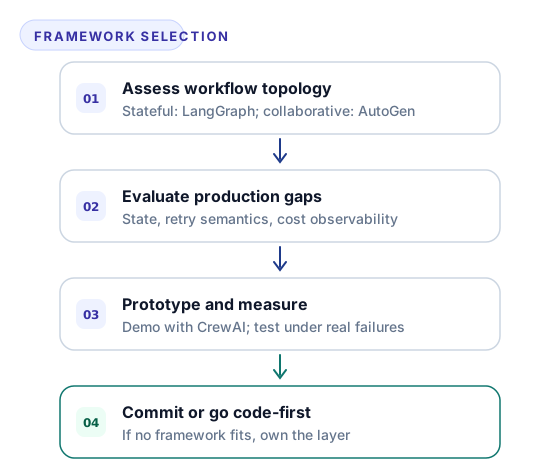
The decision is not about which framework is objectively best. It is about which gaps you are willing to own versus which gaps the framework closes for you.
Choose LangGraph if your workflow is stateful — agents build on earlier results — long running (more than 5 to 8 steps), or operates in a regulated environment where human approval gates and audit trails are required by compliance. LangGraph is also the right choice if you anticipate needing to pause and resume workflows for async approval loops, because this capability is built into the runtime rather than bolted on.
Choose CrewAI if you are building a prototype to validate an idea, your timeline is days rather than weeks, and production deployment is not the current goal. If the prototype works, budget time to evaluate whether CrewAI's state model and retry semantics are strong enough for your production requirements before committing to the framework at scale.
Choose AutoGen if your workflow is fundamentally collaborative — agents that reason together, critique each other's outputs, or iterate toward a consensus. AutoGen's conversational model is the most natural fit for this pattern, and its testability advantage helps if you plan to build a rigorous test suite around the orchestration logic.
Choose code first if your workflow is small and stable, your team is strong in Python, compliance requirements demand full traceability, or you have evaluated the frameworks and none of them maps cleanly to your execution model. Code first is not a compromise — it is an architecture decision that is often the highest leverage option for the right system.
One pattern worth noting: it is common to prototype with CrewAI, learn the problem shape, and then migrate to LangGraph or a code first layer when the production requirements become clear. The migration is not trivial but the learning from the prototype is valuable. If you know from the start that your system is stateful, long running, and headed for production, skip the CrewAI prototype and invest the time in LangGraph or a clean code first design upfront.
If the production complexity of your multi agent system is high enough that you want a senior architecture review before committing to a framework, the Agentic AI Consulting service covers exactly this kind of decision.