
Section 01 · Problem
The ordering problem in distributed systems
Every distributed ledger has to answer one hard question: who decides what order things happened? The answer determines how fast or slow the network can be.
Quick answer
What is Proof of History? Proof of History is a Verifiable Delay Function that acts as Solana's cryptographic clock. A leader runs a sequential SHA-256 hash chain at 400,000 hashes per second. Transactions inserted into the chain get a provable position, which is their timestamp. Validators do not need to vote on time — they read it from the chain.
Traditional blockchains solve the ordering problem through voting rounds. Validators broadcast transactions, collect votes, wait for quorums, and only then agree on which order to commit. Each message round takes real time. Ethereum's 12 second block time exists largely because of this overhead. Bitcoin's 10 minute block time is more conservative still — the protocol needs enough time for the entire network to see the same transactions before a proof of work solution is accepted.
The fundamental cost is time synchronization. Distributed systems have no shared clock. Every node's local clock drifts slightly. Network latency varies by geography. To agree on "when," validators must send messages, wait for replies, and account for the possibility that messages arrive out of order. Those waits compound with the number of validators and the size of the network.
Anatoly Yakovenko spent years at Qualcomm building systems where GPS synchronized clocks let millions of base stations coordinate without talking to each other. He brought that idea to blockchains. The question: could you give validators a shared clock they can each verify independently, without requiring them to negotiate time at all? Proof of History is the answer.
PoH is a clock, not a consensus algorithm
This is the most common misconception about Proof of History. PoH does not decide which transactions are valid or finalize blocks on its own. Those jobs belong to Tower BFT, Solana's actual consensus algorithm. PoH provides the time reference that makes Tower BFT faster. Separating the two layers is what gives Solana its architectural flexibility — you could theoretically swap Tower BFT for a different consensus algorithm while keeping PoH as the clock.
Section 02 · Solution
What Proof of History is
A Verifiable Delay Function produces a result that takes a predictable amount of time to compute and can be verified instantly. SHA-256 run sequentially has exactly this property.
Yakovenko published the Solana whitepaper in November 2017. The design was directly inspired by GPS synchronized clocks used in telecommunications networks. GPS gives every device in range the same atomic time reference. Proof of History creates the equivalent: a time reference that every validator can verify independently from the chain itself.
A Verifiable Delay Function is a computation where the output proves that a specific amount of real time elapsed. SHA-256, run as a sequential hash chain, fits that definition precisely. To produce hash number N, you must have produced hashes 1 through N minus 1 first. There is no shortcut. The time elapsed is encoded in the depth of the chain. Anyone who wants to verify the chain can run any segment in parallel — verification is fast. But production is strictly sequential.
The chain runs at roughly 400,000 hashes per second on the leader's hardware. That means 400,000 ticks per second of cryptographic time. A transaction inserted at tick 1,000,000 provably happened before a transaction inserted at tick 1,100,000. The difference is 100,000 hashes worth of real time. No one can insert a transaction at tick 1,000,000 after the fact without recomputing the entire chain from that point forward — and the validators watching the chain would immediately notice the divergence.
Section 03 · Mechanism
How PoH works step by step
Six steps from genesis hash to finalized block — each one building on the last.
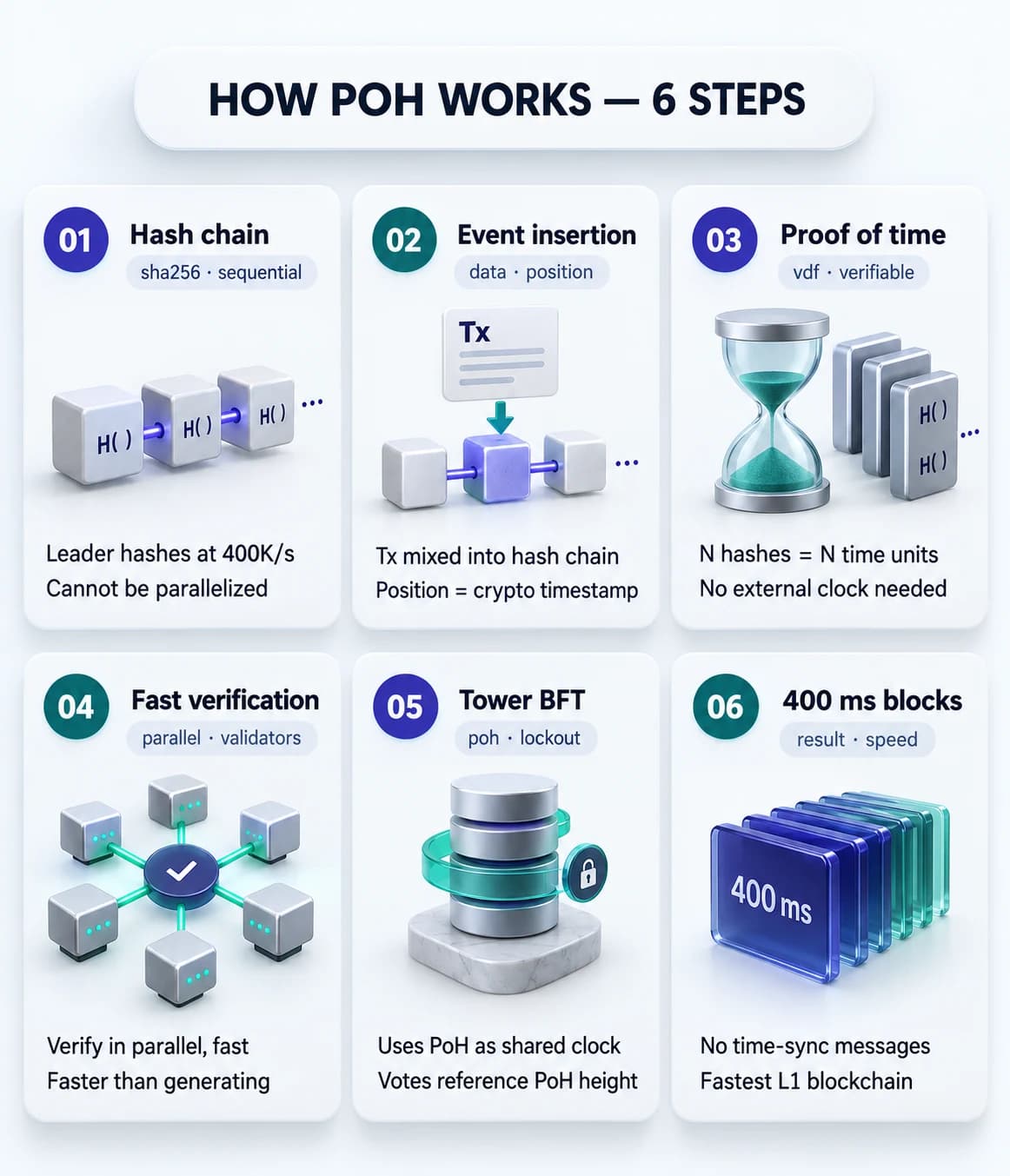
Hash chain starts
The leader takes the previous block's hash as a seed and begins the sequential SHA-256 loop. Each output feeds into the next. The chain cannot be forked at any position without redoing all subsequent hashes — a fact validators can verify instantly by comparing chain tips.
Events are inserted
When a transaction arrives, the leader mixes its data into the current hash: hash(n) = sha256(transaction_data || hash(n-1)). The transaction is now embedded at a specific position in the chain. That position is its cryptographic timestamp. Position cannot be fabricated retroactively.
Position proves time
Because N sequential hashes take a predictable amount of CPU time to produce, position in the chain maps to elapsed time. Transaction A at position 50,000 demonstrably happened before transaction B at position 100,000. No additional messages or votes are needed to establish this ordering.
Validators verify in parallel
Verification is embarrassingly parallelizable. A validator splits the chain into segments and verifies each on a separate CPU core. Verification runs orders of magnitude faster than production. A sequence that took the leader seconds to produce can be verified in milliseconds by any validator.
Tower BFT votes using PoH height
Tower BFT uses the PoH sequence number as a shared clock for its vote lockout mechanism. When a validator votes for block N, it cannot vote against that block for an exponentially increasing timeout — 2 slots, then 4, then 8. This makes reversing a committed block computationally very expensive.
Blocks finalize at 400 ms
The combination of the PoH clock and Tower BFT vote lockouts produces confirmed blocks in about 400 milliseconds and full finality in around 12 seconds. No other layer 1 blockchain achieves this block cadence without sacrificing validator decentralization.
Section 04 · Tower BFT
PoH and Tower BFT: how consensus actually works
PoH is the clock. Tower BFT is the vote counter. The two work together in a way that cuts most of the communication overhead from traditional consensus.
Traditional consensus algorithms like PBFT (Practical Byzantine Fault Tolerance) need two to three rounds of messages before they can agree on anything. Round one establishes what the current state is. Round two establishes what time it is. Round three votes on validity. Proof of History eliminates round two entirely. Validators already know the time — they read it from the chain.
Tower BFT only needs to vote on validity. A validator sees a block, checks that the PoH sequence is correct, checks that the transactions are valid, and votes. That vote is locked in for 2 slots. If the validator votes again on the next block, the lockout extends to 4, then 8, then 16, and so on exponentially. After 32 votes, the lockout is so long that reversing the first block would require waiting roughly the lifetime of the universe. In practice, a block is considered economically final after around 32 confirmed votes — which arrives in about 12 seconds.
The security guarantee comes from the cost of lying. If a validator votes for a fraudulent block, its lockout prevents it from voting on the honest chain for an exponentially growing period. During that period, the validator earns no staking rewards. The economic penalty for attacking the chain through vote manipulation is severe and grows with each additional vote commitment.
Why validators cannot easily skip the clock
A malicious leader could theoretically try to skip ahead in the PoH sequence to claim a fake timestamp. This does not work. Other validators are watching the chain and can verify the sequence independently. A faked sequence either requires redoing all the hash work (which takes just as long as honest production) or produces a chain that diverges from the honest chain at a verifiable point. Any divergence is detected immediately by the rest of the validator set.
Section 05 · Code
Proof of History in code
The core algorithm is simple enough to express in a dozen lines of Python. The implementation inside the Solana validator is Rust for performance, but the logic is identical.
The three functions below show the full lifecycle: producing a PoH sequence, inserting an event, and verifying the result. This is pseudocode — the real Solana validator runs in Rust and processes 400,000 hashes per second rather than the few thousand a Python loop produces. But the logic is byte for byte the same.
import hashlib

# The core PoH loop: sequential hash chain
def generate_poh_sequence(seed: bytes, count: int) -> bytes:
    """
    Run the hash chain forward by `count` steps.
    Cannot be parallelized — each step needs the previous output.
    """
    current = seed
    for _ in range(count):
        current = hashlib.sha256(current).digest()
    return current

# Recording an event into the PoH sequence
def record_event(prev_hash: bytes, event_data: bytes) -> bytes:
    """
    Insert an event at the current position in the chain.
    The event's position in time is now cryptographically proven.
    """
    combined = prev_hash + event_data
    return hashlib.sha256(combined).digest()

# Verification: anyone can verify the chain independently
def verify_sequence(start_hash: bytes, steps: int, claimed_end: bytes) -> bool:
    """
    Verify that claimed_end is exactly `steps` hashes ahead of start_hash.
    Verification can run in parallel on multiple CPU cores.
    """
    computed = generate_poh_sequence(start_hash, steps)
    return computed == claimed_end

# Example usage
seed = b"solana_genesis_hash_00000000"
after_100k = generate_poh_sequence(seed, 100_000)
tx_data = b"transfer:alice->bob:1.5sol"
after_event = record_event(after_100k, tx_data)

# Any validator can verify this independently and fast
assert verify_sequence(seed, 100_000, after_100k)
print("Sequence verified — 100,000 hashes elapsed since genesis")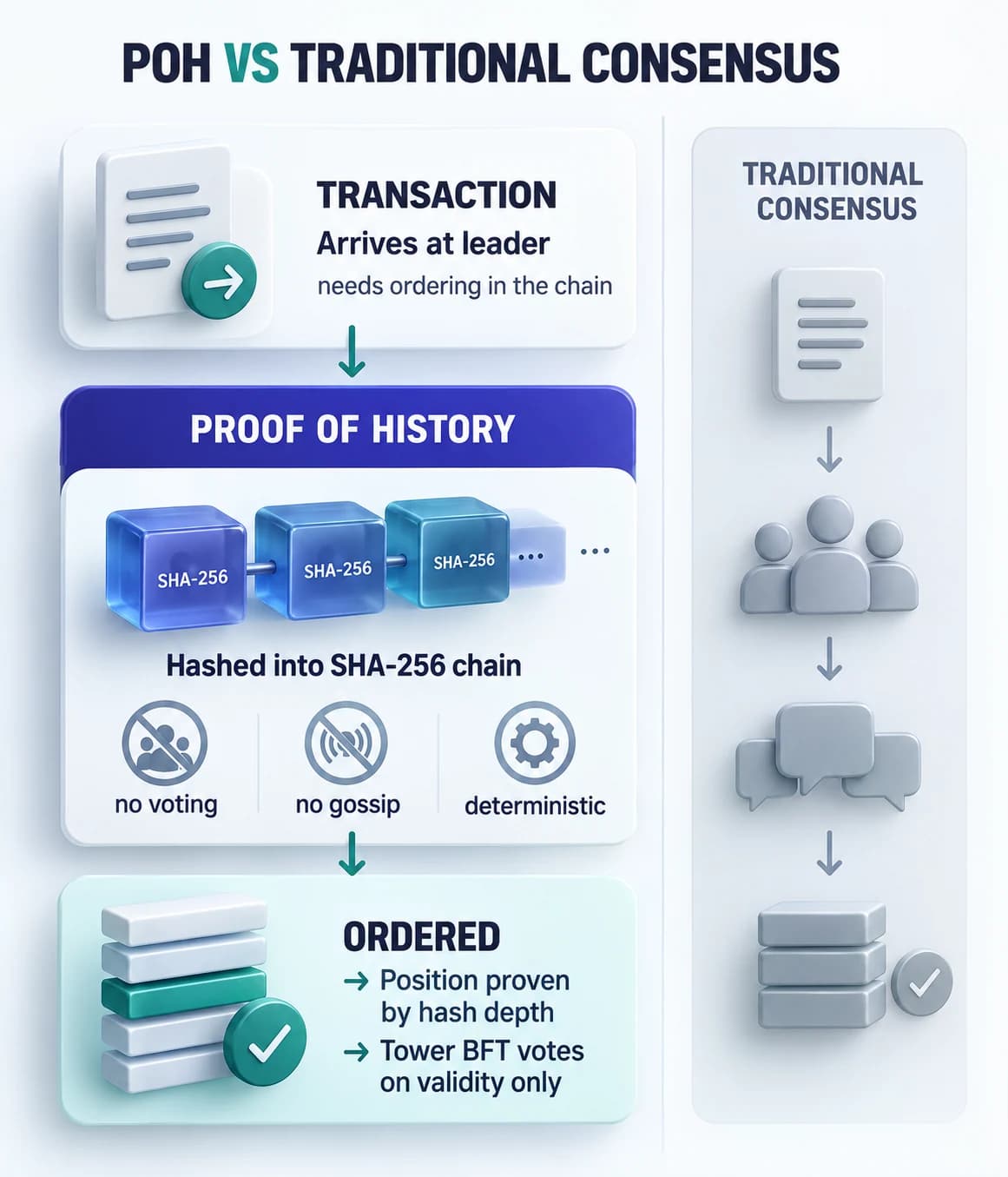
The key insight in the code above is that generate_poh_sequence is fundamentally sequential — the loop cannot be parallelized because each iteration depends on the previous result. But verify_sequence can be split into independent chunks and verified in parallel across multiple CPU cores. This asymmetry is what makes the system work: production is a one person job, verification is a crowd job.
For a broader architectural comparison — how PoH fits into Solana's full stack versus Ethereum's approach to the same problems — read Solana vs. Ethereum: Blockchain Fundamentals Compared.
If you are new to Solana and want to understand the full programming model before going deeper on consensus mechanics, start with What Is Solana? — it covers accounts, programs, lamports, and the development environment setup.
Once you understand how PoH orders transactions, the natural next question is how those transactions modify state. That requires understanding Solana Accounts Explained — the storage model every Solana program reads and writes.
If you are building a Solana application and need help with validator infrastructure, program architecture, or performance tuning, the blockchain development service covers the full stack from consensus layer to client integration.