Section 01 · What RAG Consulting Covers
What production RAG consulting covers
The scope goes well beyond connecting a language model to a document store.
Quick answer
What should RAG consulting deliver beyond a working demo? RAG consulting should be judged by retrieval quality, permissions, grounding, evaluation, and production ownership rather than by a chatbot demo. A strong engagement proves the system on real questions, applies access controls at retrieval time, requires traceable citations, measures regressions, and leaves the client with runbooks and observability.
RAG consulting describes the work of designing, validating, and operationalizing retrieval augmented generation systems for enterprise use. The scope goes well beyond connecting a language model to a document store.
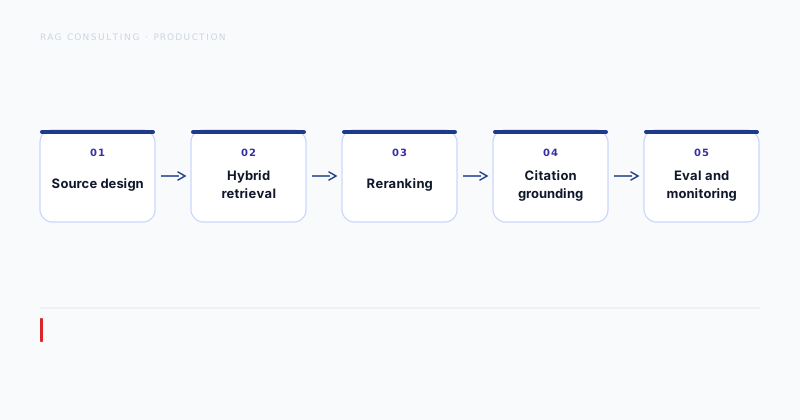
The core of the work is retrieval engineering: deciding which documents enter the index, how they are chunked and embedded, how queries are expanded and matched, how candidates are reranked, and how results are filtered by access policy before reaching the model. Each layer is a design decision with real tradeoffs, and each one can degrade silently as the corpus or the user base changes.
A production engagement should also include a hallucination strategy — structured refusal when retrieval returns nothing useful, citation requirements that trace every claim to a retrieved span, and an evaluation harness that catches regressions before they ship. Without these, the system works in demos but fails in production as soon as it encounters questions the test set built by hand never surfaced.
The guide below works through each dimension in the order you should evaluate them.
Section 02 · Architecture Fit
How do you know if RAG is the right architecture?
A fit assessment reviews real user questions, source documents, update frequency, access complexity, and evaluation cost before recommending a build.
Test the knowledge problem before building
Before building anything, a credible RAG consulting engagement runs a fit assessment. This is not a formality. It is the decision that determines whether the team spends the next several months building the right system or a very expensive mismatch.
A fit assessment reviews real user questions, the source documents that should answer them, how frequently those documents change, the access control complexity, and what evaluation of the final system would actually cost. Each dimension pushes the decision toward or away from RAG.
RAG is the right architecture when answers must come from changing business documents, private knowledge, or permissioned sources that need traceability. The combination of frequent change, access control requirements, and citation needs is the natural fit for a retrieval pipeline.
Compare RAG, fine tuning, and simpler search
Fine tuning is better suited to changing model behavior, style, or specialized skills than to grounding answers in specific documents. A model trained on your product documentation will know the domain but will not reflect documentation updates without retraining. RAG reflects updates immediately because retrieval happens at query time.
Keyword search alone is faster and cheaper but has no tolerance for semantic variation. A user who asks about contract renewal options will get nothing from a keyword index that uses the term subscription extension. Hybrid search bridges this gap, which is why production RAG systems use it rather than either approach alone.
If the knowledge problem is narrow and stable, fine tuning may be sufficient. If it is broad, changing, or requires access controls, RAG is the right direction. A consultant who skips this assessment and starts with implementation is solving the easier problem — not necessarily the right one.
Section 03 · Retrieval Engineering
How should retrieval be engineered for exact business data?
The retrieval layer is where most RAG systems break in production. A single embedding model fails on the exact identifiers that enterprise data is full of.
Hybrid retrieval and reranking
Production retrieval systems combine dense and sparse hybrid search with cross encoder reranking rather than relying on one embedding model. Dense search handles semantic variation well. Sparse search (BM25 or similar keyword methods) handles exact terms well. The combination recovers both.
Reranking with a cross encoder model then scores the merged candidate set against the actual query, rather than using the embedding similarity scores that each retrieval method produced. This extra pass typically improves answer quality substantially because the cross encoder considers the query and the candidate together, not as independent embeddings.
See Hybrid Search for RAG: Combining Keyword and Vector Retrieval for the implementation detail on merging keyword and vector retrieval with reciprocal rank fusion.
Why vector search alone misses exact identifiers
A production RAG pattern combines BM25, embeddings, and reranking because vector search alone can miss exact policy numbers, SKUs, and error codes. A user querying a specific error code will not get a useful result from a dense vector search if the embedding of that error code does not cluster near the embeddings of the document passages that describe it. BM25 finds it immediately.
The chunk size and embedding model also matter. A chunk that includes too much surrounding text dilutes the signal for a specific identifier. A chunk that is too small misses the context needed to generate a useful answer. Chunking strategy, overlap, and metadata enrichment are retrieval engineering decisions that need to be made for your specific corpus, not set once and forgotten.
Section 04 · Permissions
Why do permissions belong inside the retrieval path?
Applying permissions after retrieval is the most commonly deferred and most consequentially misplaced decision in enterprise RAG systems.
Filter with live identity at query time
The correct approach applies per user access control at query time and stores document level permission metadata in the retrieval index. When a query arrives, the retrieval system filters the candidate set to documents the requesting user is authorized to see, then ranks and returns only those.
If permission filtering happens after retrieval — at the application layer, before the model call — there is a window where documents the user should not see have already entered the process. In some implementations, those documents end up in the prompt context even when they are filtered from the final display. That is a data exposure risk regardless of whether the response surfaces the content.
Avoid shared access across the full corpus
Multi tenant systems are particularly exposed when the retrieval index is shared and queries are not isolated by tenant. A well designed single tenant architecture can afford a simpler permission model; a multi tenant system cannot. The retrieval index must carry enough metadata to isolate queries by tenant, role, and document level access policy.
This is not a difficult architectural requirement, but it is one that gets cut in rushed implementations. An engagement that defers the permission design to a later phase is not production consulting — it is a prototype.
Section 05 · Citations and Grounding
What makes a RAG answer defensible?
A production RAG answer must be traceable to specific retrieved content — a correctness requirement, not a UX feature.
Require citations from retrieved spans
Citation grounding combined with hallucination detection and structured output controls lets unsupported answers be caught before reaching users. Requiring citations to retrieved spans and refusing to answer when retrieval is empty is the standard for defensible production output.
The citation requirement has a practical consequence: the model prompt must instruct the model to cite the specific passage it used and to flag when its answer goes beyond what retrieval returned. This requires prompt design, output parsing, and a display layer that renders citations in a way users can verify.
Refuse when retrieval does not support an answer
The failure mode that erodes user trust fastest is a confident answer with no supporting retrieval. The model will generate a fluent, plausible response even when the retrieval step returned nothing useful. Without a refusal policy, the system effectively hallucinates on demand whenever the corpus cannot answer the question.
The refusal policy must be tested explicitly. Golden question sets should include out of scope questions — questions the corpus cannot answer — and the expected behavior is a clear response indicating no available information rather than a fabricated one. This tests both the retrieval layer and the model instruction.
Section 06 · Evaluation Gates
How does evaluation fit into release engineering?
Evaluation is not a project phase that happens before launch. It is an ongoing function wired into the release process.
Golden question sets built from real user queries
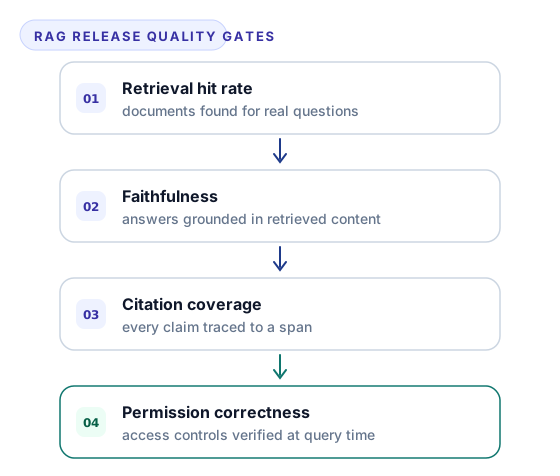
Golden sets with retrieval hit rate, faithfulness, and citation coverage function as continuous integration gates that block untested regressions. The golden set should be built from real user questions — not questions the team invented — because real questions expose the distribution of intent, phrasing variation, and edge cases that production traffic surfaces.
See RAG Evaluation: Metrics That Actually Matter in Production for the full breakdown of retrieval hit rate, faithfulness, and citation coverage metrics, and how to interpret them together rather than in isolation.
Regression gates on retrieval and answer quality
The gate should block a release if retrieval hit rate drops below a defined threshold, if faithfulness drops, or if citation coverage degrades. Each metric addresses a different failure mode: low hit rate means the retrieval layer is not finding the right documents; low faithfulness means the model is not grounding answers in what retrieval returned; low citation coverage means answers are not traceable.
A baseline that is not tracked is a baseline that cannot detect drift. As the corpus grows, as query patterns shift, or as prompt instructions are adjusted, each layer can degrade independently. Evaluation gates make that degradation visible before it reaches users.
Section 07 · Operating Ownership
What operating ownership should a RAG consultant provide?
A consulting engagement that ends with delivery but no operating plan is not production consulting.
Observability, cost tracking, and monitoring
Automated evaluation, retrieval and answer metrics, cost tracking, model routing, tracing, and observability belong in the production RAG scope. These are not optional features — they are the instrumentation that tells the operating team whether the system is working, what it costs, and where it is failing.
Tracing should capture every step of the retrieval and generation path: the query, the retrieved candidates, the reranked results, the prompt sent to the model, the generated answer, and whether the answer was cached or cited. Without this trace, debugging a production failure requires guessing which layer failed.
Runbooks, code ownership, and vendor neutrality
A production handoff should include documented runbooks for common failure modes, clear ownership of each code component, and an architecture that does not require the consulting firm to operate the system in perpetuity. Vendor lock in on the retrieval database or the model provider increases operating cost and reduces the ability to adapt as the landscape evolves.
A consultant who delivers a system that only they can maintain is not building a production RAG system. They are building a managed service dependency.
If you are scoping or evaluating a retrieval augmented generation build, I help engineering teams design and ship production RAG systems — from hybrid retrieval architecture through evaluation harnesses and operating ownership. Reach out via the AI Systems Architecture service page.