Quick answer
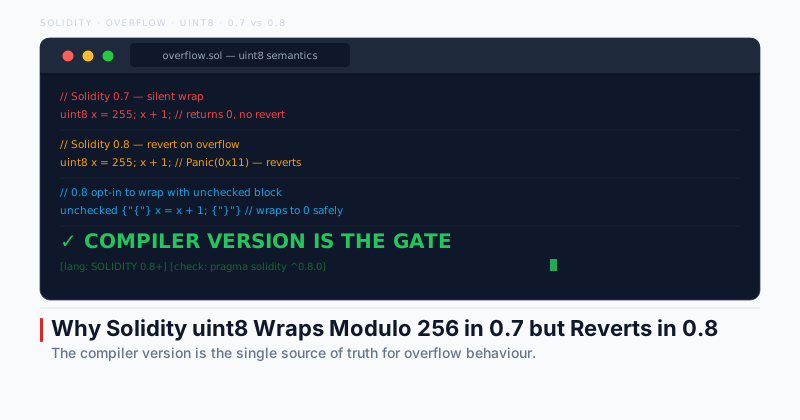
Why does Solidity uint8 wrap to modulo 256 in 0.7 but revert in 0.8? Solidity 0.7 inherited C-style overflow semantics: arithmetic on fixed-width unsigned integers silently wraps around. Solidity 0.8 changed this — every arithmetic operation now has a built-in overflow check that reverts. The 0.8 design treats overflow as a bug by default and requires the developer to opt into wrapping behaviour with an unchecked block.
Section 01 · Semantics
What is actually happening
A uint8 is an 8-bit unsigned integer. Its valid range is 0 through 255. When arithmetic falls outside that range, the compiler version determines what happens next.
A uint8 is an 8-bit unsigned integer. Its valid range is 0 through 255. When the arithmetic result of an operation falls outside that range, something has to give:
- Solidity 0.7: the result is taken modulo 2^8 = 256. So
255 + 1becomes0, and0 - 1becomes255. No error, no revert. - Solidity 0.8: the EVM-level math is the same — the result still wraps — but Solidity 0.8 emits an extra check after every arithmetic operation, and reverts with
Panic(0x11)if the result wrapped.
The change happened because the wrap behaviour caused too many production exploits. Pre-0.8, developers had to import OpenZeppelin's SafeMath library on every contract to get the revert behaviour. Post-0.8, the safe behaviour is the default and the wrap behaviour is the opt-in. See the uint type reference for the full range table across uint8 through int256.
Section 02 · Opt-in Wrap
The unchecked block
When you actually want the wrap — gas-tight loops, ring buffers, certain hashing tricks — wrap the expression in unchecked { }.
// Solidity 0.8+ — explicit opt-in to wrap behaviour
uint8 x = 255;
unchecked {
    x = x + 1; // x is now 0, no revert
}
The unchecked block is the documented escape hatch. Auditors expect to see it whenever wrap behaviour is intended; a bare arithmetic operation in 0.8 that depends on wrapping is a bug almost every time. See loop gas optimization for the most common production use case.
Unchecked propagates through the block
Every arithmetic expression inside unchecked { } skips the overflow check — not just the one you intended to wrap. Keep unchecked blocks as narrow as possible: one expression, one variable, never a whole function body.
Section 03 · Migration
The migration trap
Most code does not depend on wrapping. But two patterns do, and they break silently on compiler upgrade.
When migrating a 0.7 contract to 0.8, every arithmetic operation in the codebase becomes a candidate for the migration trap. Two patterns are the most common offenders:
- Counter loops with deliberate modulo. A loop that walks a ring buffer using
i = (i + 1) % BUFFER_SIZEis fine. A loop that depends onuint8 i; i++;wrapping to 0 after 255 is silent in 0.7 and reverts in 0.8. - Gas-tight increment loops.
for (uint i; i < length; i++)is roughly 80 gas per iteration in 0.8 due to the overflow check. The idiomatic 0.8 fix is to useunchecked { ++i; }inside the loop body.
The safest migration path: compile under 0.8, run the full test suite, fix every failing revert by either accepting the safer semantics or explicitly opting into unchecked.
// Before migration (0.7) — depends on wrap
for (uint8 i = 0; i < 255; i++) {
    // i wraps at 255+1 = 0 — infinite loop risk
}

// After migration (0.8) — safe and cheap
for (uint256 i; i < length;) {
    // loop body here
    unchecked { ++i; }
}
Section 04 · Context
Why this query keeps showing up
The pattern is predictable: unexpected zero counter mid-debug leads straight here.
Developers paste a snippet like solidity 0.7 uint8 overflow wraps modulo 256 into Google when they hit unexpected behaviour mid-debug. The pattern usually goes: “my counter just hit zero out of nowhere” → “what does Solidity actually do on overflow?” → paste.
The answer is the compiler version. Check the pragma solidity line at the top of the contract first. If it says ^0.8.0 or higher, the wrap is a revert. If it says ^0.7.x or lower, the wrap is silent. There is no other configuration.
The Solidity storage layout visualizer can help you see how small integer types are packed in storage, which is the other common reason developers reach for uint8 in the first place.