
Section 01 · Background
Why loops are expensive on the EVM
Each iteration of a loop pays gas for the branch instruction, the condition evaluation, and every opcode inside the body. The cost compounds linearly with iteration count.
Quick answer
The core rule: Every opcode inside a loop body multiplies its individual cost by the number of iterations. A single SLOAD costs 2 100 gas. Inside a 100-iteration loop it costs 210 000 gas — more than many entire transactions. Move expensive opcodes outside the loop whenever possible.
The EVM charges gas per opcode. A JUMPI (branch) costs 10 gas. An ADD costs 3 gas. An SLOAD (storage read) costs 2 100 gas cold or 100 gas warm. An SSTORE (storage write) costs 20 000 gas for a zero-to-nonzero write or 2 900 gas for a nonzero-to-nonzero write. Loop optimization is largely the practice of identifying which of these expensive opcodes can be moved outside the loop body or eliminated entirely.
// ✗ Slow version — three expensive mistakes in one loop
uint256[] storage scores; // storage array

for (uint256 i = 0; i < scores.length; i++) {
    //                  ^^^^^^^^^^^^^ reads storage every iteration (expensive!)
    totalScore += scores[i];
    //           ^^^^^^^^^^ totalScore is also in storage — written every iteration!
    //  i++  creates a temporary copy of i — wastes 3 gas per iteration
}

// ✓ Fast version — all five techniques applied
uint256 len = scores.length; // read storage length ONCE
uint256 sum = 0;             // accumulate in cheap memory variable

for (uint256 i = 0; i < len; ) {
    sum += scores[i];        // only scores[i] reads storage (unavoidable)
    unchecked { ++i; }       // no overflow check needed — saves ~60 gas/iter
}
totalScore = sum;            // write to storage ONCE after the loop
The length-caching SLOAD is warm, not cold
Inside a function, arr.length is accessed via MLOAD (if memory array) or SLOAD (if storage). For a storage dynamic array, reading .length on every iteration is a warm SLOAD (100 gas) after the first cold read (2 100 gas). Caching it saves 100 gas per iteration — small per iteration but significant at scale. For memory arrays, .length is essentially free, so caching has no effect.
Section 02 · Techniques
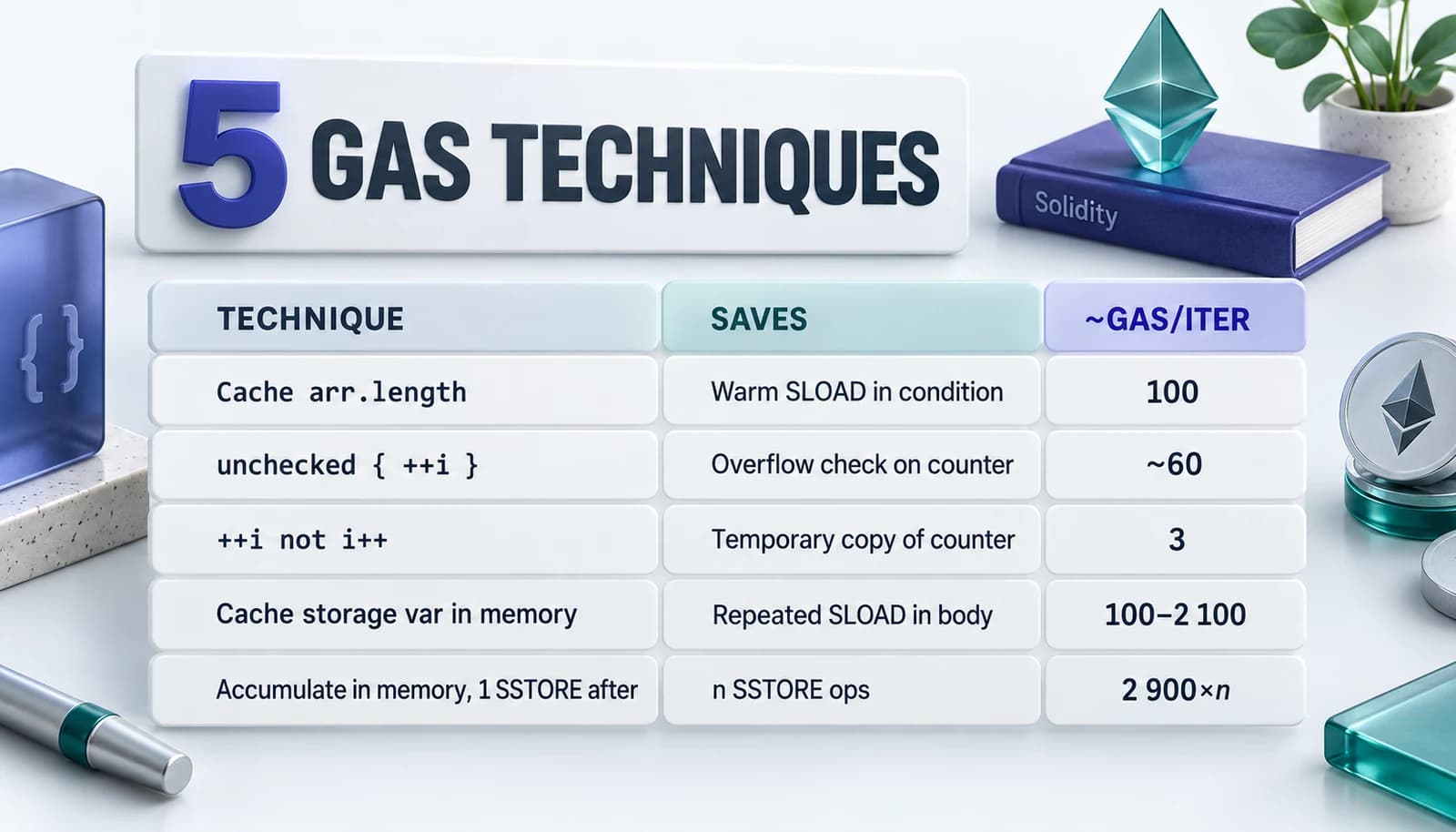
Five loop gas optimization techniques
These five techniques can be applied independently or together. Each targets a specific category of wasted gas.
Cache array length before the loop
Assign arr.length to a local uint256 before the loop header and use that local in the condition. For storage arrays this avoids a warm SLOAD (100 gas) on every iteration. Pattern: uint256 len = arr.length; for (uint256 i = 0; i < len; )
Wrap the counter in unchecked
In Solidity 0.8.x the compiler inserts overflow checks on every arithmetic operation. A loop counter incremented by 1 from 0 to len can never overflow uint256, so the check is provably unnecessary. Wrapping ++i in unchecked { ++i; } removes the check and saves approximately 60 gas per iteration.
Use ++i instead of i++
The postfix form i++ creates a temporary copy of i before incrementing, then returns the copy. In a loop post statement the copy is discarded immediately. The prefix form ++i increments in place and returns the new value, avoiding the temporary. This saves 3 gas per iteration on most compilers.
Cache repeated storage reads in memory
If the loop body reads the same storage variable more than once, or if a storage variable is read on every iteration, assign it to a local variable before the loop. The first SLOAD (2 100 gas cold or 100 gas warm) is paid once. All subsequent accesses use the cheaper local variable.
Accumulate in memory and write to storage once
If the loop accumulates a running total into a storage variable, move the accumulation into a local uint256 and write it to storage once after the loop. Replacing n storage writes with 1 is the single largest gas saving available in most loops.
Section 03 · Deep dive
unchecked increment: how and why it works
The unchecked block is the most impactful single-line optimization for tight loops. Understanding why it is safe is essential before applying it.
// ✗ Default — Solidity 0.8 adds overflow check on every i++
for (uint256 i = 0; i < len; i++) {
    sum += arr[i];
}
// Each i++ compiles to: check overflow, then increment. ~60 extra gas/iter.

// ✓ Optimised — wrap only the counter in unchecked
for (uint256 i = 0; i < len; ) {
    sum += arr[i];
    unchecked { ++i; } // no overflow check on the counter — safe because
                       // i can never reach uint256.max in any real array
}
// Saves ~60 gas per iteration. On 100 iterations = ~6 000 gas saved.
Always wrap only the counter increment in unchecked, not the whole body. The loop condition i < len still runs with full overflow protection outside the block. Keeping the unchecked scope as narrow as possible means you only give up overflow protection where you have proven it is unnecessary — everywhere else Solidity 0.8 still protects you.
When is unchecked unsafe on a loop counter?
If len is type(uint256).max and i starts at 0, incrementing i unchecked will eventually wrap to 0, creating an infinite loop. In practice, storage arrays cannot hold 2^256 elements, and any array you iterate over has a bounded length well below uint256.max. The risk is theoretical, not practical for standard Solidity contracts. If len comes from untrusted input, validate it with a MAX constant before the loop.
Section 04 · Full contract
Complete example: GasOptimizedAirdrop contract
This contract distributes a fixed reward per address from a whitelist. It applies all five optimization techniques. The optimized version costs approximately 40% less gas per call than the naive version.
// SPDX-License-Identifier: MIT
pragma solidity ^0.8.24;

interface IERC20 {
    function transfer(address to, uint256 amount) external returns (bool);
    function balanceOf(address account) external view returns (uint256);
}

/// @title GasOptimizedAirdrop
/// @notice Distributes a fixed reward to a list of recipients.
///         Demonstrates all five loop gas optimization techniques.
///         Capped at MAX_RECIPIENTS to prevent unbounded gas usage.
contract GasOptimizedAirdrop {

    uint256 public constant MAX_RECIPIENTS = 200;

    IERC20  public immutable token;
    address public owner;

    address[] public recipients;
    mapping(address => bool) public claimed;
    uint256 public rewardPerAddress;

    event AirdropExecuted(uint256 recipientCount, uint256 totalDistributed);

    modifier onlyOwner() {
        require(msg.sender == owner, "not owner");
        _;
    }

    constructor(address _token, uint256 _rewardPerAddress) {
        token = IERC20(_token);
        owner = msg.sender;
        rewardPerAddress = _rewardPerAddress;
    }

    // ── Write ────────────────────────────────────────────────────────

    /// @notice Add recipients to the airdrop list (owner only).
    function addRecipients(address[] calldata _recipients) external onlyOwner {
        uint256 newLen = recipients.length + _recipients.length;
        require(newLen <= MAX_RECIPIENTS, "exceeds max");
        uint256 len = _recipients.length;                 // Technique 1: cache length
        for (uint256 i = 0; i < len; ) {
            recipients.push(_recipients[i]);
            unchecked { ++i; }                            // Technique 2+3: unchecked ++i
        }
    }

    /// @notice Execute the airdrop.
    ///         Skips addresses that have already claimed.
    function distribute() external onlyOwner {
        // Technique 1: cache storage array length once
        uint256 len = recipients.length;
        require(len > 0, "no recipients");

        // Technique 4: cache storage variable read in every iteration
        uint256 reward = rewardPerAddress;

        // Technique 5: accumulate total in memory, emit once after loop
        uint256 totalSent = 0;

        for (uint256 i = 0; i < len; ) {
            address recipient = recipients[i]; // 1 SLOAD per iteration (unavoidable)

            if (!claimed[recipient]) {
                claimed[recipient] = true;     // 1 SSTORE (write only when needed)
                require(
                    token.transfer(recipient, reward),
                    "transfer failed"
                );
                unchecked { totalSent += reward; } // safe: totalSent <= MAX_RECIPIENTS * reward
            }

            unchecked { ++i; }                 // Technique 2+3: unchecked ++i
        }

        emit AirdropExecuted(len, totalSent);  // Technique 5: single emit after loop
    }

    // ── Admin ────────────────────────────────────────────────────────

    /// @notice Update reward amount (owner only, before distribution).
    function setReward(uint256 _reward) external onlyOwner {
        require(_reward > 0, "reward must be positive");
        rewardPerAddress = _reward;
    }

    /// @notice Withdraw remaining tokens (owner only).
    function withdraw(uint256 amount) external onlyOwner {
        require(token.transfer(owner, amount), "withdraw failed");
    }

    // ── Read ─────────────────────────────────────────────────────────

    /// @notice Count unclaimed recipients without iterating on-chain.
    ///         Off-chain callers should use this to estimate gas before calling distribute().
    function unclaimedCount() external view returns (uint256 count) {
        uint256 len = recipients.length;
        for (uint256 i = 0; i < len; ) {
            if (!claimed[recipients[i]]) {
                unchecked { ++count; }
            }
            unchecked { ++i; }
        }
    }
}
Section 05 · Anti-patterns
Four loop patterns that waste gas
These patterns appear in production contracts. Each one has a direct, low-effort replacement.
Reading arr.length in every condition check
for (uint256 i = 0; i < arr.length; ++i) reads arr.length on every iteration. For a storage array this is a warm SLOAD (100 gas) per iteration. Fix: uint256 len = arr.length; before the loop, then i < len in the condition.
Writing an accumulator to storage inside the loop
totalScore += scores[i] where totalScore is a storage variable costs a warm SLOAD plus an SSTORE on every iteration. An SSTORE for nonzero-to-nonzero is 2 900 gas. Over 100 iterations that is 290 000 gas in writes alone. Fix: accumulate in a local variable, then do a single SSTORE after the loop.
Emitting an event on every iteration
emit Transfer(from, recipients[i], amount) inside a 100-element loop emits 100 events. Each LOG opcode costs at least 375 gas plus 375 per topic. Fix: if the per-item event is not required by a standard (such as ERC-20 Transfer), emit a single batch event after the loop summarizing the operation.
Deleting array elements inside a forward loop
Deleting elements while iterating forward corrupts the index if elements are shifted. Beyond correctness, delete on a storage slot writes a zero value (SSTORE: up to 2 900 gas per element). If the goal is to clear an entire array, set its length to zero: delete myArray; — this costs a flat fee rather than per-element SSTOREs.