Section 01 · Smart Contracts
What a smart contract actually is
The term 'smart contract' is used loosely. Here is the precise definition and what it means for the code you write.
Quick answer
What is a smart contract? A smart contract is a program deployed to a blockchain that executes automatically when predefined conditions are met. It stores its code and state on-chain, operates without a central operator, and cannot be modified or stopped once deployed. Anyone who interacts with its address triggers its logic, and the outcome is determined entirely by the code — not by any person or organization.
The word "contract" is a metaphor. Smart contracts are not legal contracts in any jurisdiction's definition. They are programs. The "smart" part refers to the self executing nature: when you send ETH to a decentralized exchange contract, the contract automatically calculates the exchange rate, deducts the fee, and sends you back the token. No intermediary needed, no approval required, no business hours.
The critical property of a smart contract is immutability. Once deployed to Ethereum mainnet, the contract code cannot be changed. If there is a bug in the logic, the bug is permanent — unless the contract was explicitly designed with an upgrade mechanism (which introduces its own trust assumptions). This is why auditing smart contracts before deployment is not optional for any application handling real value.
Smart contracts are the foundation of every DeFi protocol, NFT collection, DAO governance system, and tokenized real world asset on public blockchains. The language you write them in determines not just syntax but security properties, execution model, and performance ceiling.
Smart contracts execute deterministically
Every node on the network must execute the same contract code and arrive at the exact same result. This is why smart contracts cannot call external APIs directly, use random number generators, or reference the current time without explicit oracle infrastructure. Any non-determinism would cause different nodes to disagree on the state of the chain.
Section 02 · Solidity
Solidity: the language built for Ethereum
Solidity has been the dominant smart contract language since Ethereum launched in 2015. Understanding its design choices explains both its popularity and its historical vulnerabilities.
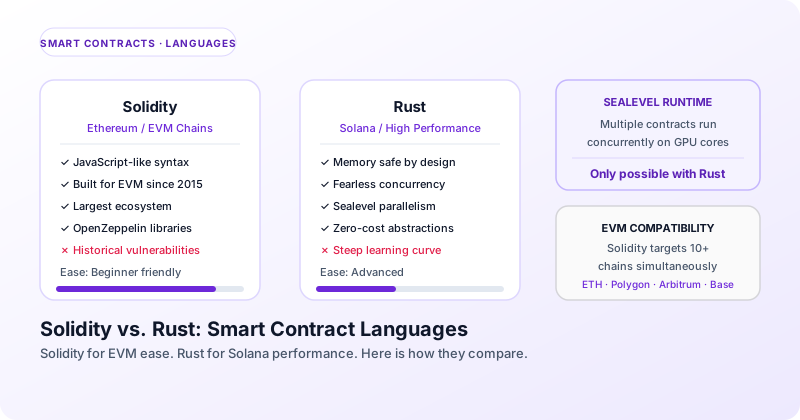
Gavin Wood proposed Solidity in 2014 as a high level language that would compile to EVM bytecode. The design goal was developer accessibility: a syntax familiar to JavaScript and C++ developers, a type system simple enough to learn quickly, and an abstraction layer that hid the low level details of the EVM.
That bet paid off. Solidity is the most widely used smart contract language in 2026. The ecosystem around it — Hardhat, Foundry, OpenZeppelin's audited libraries, Remix IDE, Slither for static analysis — is deep and mature. When you build in Solidity, you can draw on thousands of audited code examples, years of documented vulnerabilities and fixes, and a community of hundreds of thousands of developers.
JavaScript like syntax
Solidity borrows heavily from JavaScript and C++ syntax. Variables, functions, loops, conditionals — if you have written any JavaScript, the basic structure of a Solidity contract feels familiar within hours. This was a deliberate choice to lower onboarding friction and it worked: Solidity lowered the barrier to entry for an entire generation of blockchain developers.
Purpose built for the EVM
Solidity compiles specifically to the Ethereum Virtual Machine bytecode. Every language feature maps to EVM operations. Storage layout, memory management, the distinction between storage and calldata — these are all EVM concepts expressed through Solidity syntax. Understanding the EVM makes you a significantly better Solidity developer because you can predict gas costs and understand the underlying execution model.
Massive library ecosystem
OpenZeppelin's library of audited contracts covers ERC-20 tokens, ERC-721 NFTs, access control, upgradeability patterns, and more. When building a standard token or ownership contract, you import the OpenZeppelin implementation rather than writing from scratch. This dramatically reduces the attack surface: you are using code that has been audited by multiple independent security firms and battle tested across millions of deployments.
Historical security vulnerabilities
Solidity's accessibility comes with a cost. The language has produced some of the most expensive bugs in software history — the DAO hack ($60 million in 2016), Parity wallet vulnerabilities ($150 million in 2017), dozens of smaller reentrancy attacks. The language has improved significantly with each version, and the security community has developed extensive tooling and patterns to prevent known vulnerability classes. But the permissive design means developers can write exploitable code that compiles without warnings.
A simple Solidity contract looks like this conceptually: you define a contract with state variables, constructor logic, and functions. Functions can be public (callable by anyone), private (internal only), or restricted by access control modifiers. The payable keyword marks functions that can receive ETH. Events log data to the blockchain without storing it in contract state.
The reentrancy vulnerability pattern that caused the DAO hack is worth understanding because it illustrates how Solidity's apparent simplicity conceals complexity. If a contract sends ETH to an external address before updating its internal state, and that external address is a contract that immediately calls back into the original contract, the calling contract can drain funds repeatedly before the balance is updated. The Checks-Effects-Interactions pattern — check conditions, update state, then interact with external contracts — prevents this. It is now a mandatory practice but was not always widely understood.
Section 03 · Rust
Rust: performance and memory safety for Solana
Rust was not designed for blockchain development. Solana chose it because its properties — memory safety without a garbage collector, zero cost abstractions, fearless concurrency — were exactly what a high throughput blockchain runtime requires.
Rust was developed at Mozilla Research and first stabilized in 2015. Its core innovation is a borrow checker: a compile time analysis that enforces ownership rules and prevents a class of bugs that plague systems programming in C and C++. You cannot have a dangling pointer. You cannot have data races across threads. The compiler rejects code that could cause these issues — at compile time, not at runtime.
For Solana, these properties are not nice to have. They are architectural requirements. Solana's Sealevel runtime executes transactions in parallel across multiple cores. Two smart contract invocations can run simultaneously as long as they do not touch the same account data. For this to be safe, the runtime must guarantee there are no data races. Rust's ownership model makes that guarantee possible at the language level.
Memory safety without garbage collection
Rust prevents memory errors through ownership rules enforced at compile time rather than a runtime garbage collector. Every value has a single owner. When ownership is transferred, the original owner cannot use the value. When ownership goes out of scope, the memory is freed. This eliminates entire categories of bugs — use after free, double free, null pointer dereferences — without the runtime pauses that garbage collected languages introduce.
Fearless concurrency
Rust's type system prevents data races at compile time. Two threads cannot simultaneously modify the same data without explicit synchronization. This is not enforced by convention or code review — the code will not compile if it violates these rules. For Sealevel's parallel execution model, this is the foundation that makes safe multi-contract execution possible.
Zero cost abstractions
Rust's high level language features — iterators, closures, generics — compile to machine code as efficient as hand written C. There is no runtime overhead for using abstractions. This is critical for Solana validators where every microsecond of execution latency compounds across thousands of transactions per second.
Steep learning curve
Rust is consistently rated one of the most challenging languages to learn, and consistently rated one of the most beloved by developers who have mastered it. The borrow checker rejects code that developers from other languages consider normal. Lifetime annotations, trait bounds, and ownership semantics require a different mental model than object oriented or garbage collected languages. Expect several weeks to months before you feel productive writing Solana programs in Rust.
Solana programs written in Rust use the Anchor framework, which provides abstractions over the lower level Solana program library. Anchor handles account serialization, instruction dispatch, and common security checks, reducing the boilerplate required to write safe programs. Most production Solana programs in 2026 are built with Anchor.
Sealevel: why Rust enables parallel execution
Solana programs specify in their transaction instructions which accounts they will read and which they will write. The Sealevel runtime analyzes incoming transactions and schedules non-conflicting ones to run in parallel. A payment transaction that touches Alice and Bob's accounts can run simultaneously with a swap transaction that touches Carol and David's accounts, as long as there is no account overlap. Rust's memory safety guarantees make the runtime confident that parallel execution cannot produce a data race — and that confidence is justified by the compiler, not just good intentions.
Section 04 · Design Philosophy
Why Ethereum chose Solidity and Solana chose Rust
The language choice reflects the architectural priorities of each blockchain.
Ethereum's goal in 2014 and 2015 was to build a programmable blockchain that as many developers as possible could build on. The Ethereum Foundation made a calculated bet that a familiar syntax would accelerate ecosystem growth faster than a safer but harder to learn language. That bet worked. Ethereum attracted hundreds of thousands of developers and became the foundation of DeFi, NFTs, and decentralized governance.
The tradeoff was a language that is easy to write incorrectly. Solidity's implicit type coercions, integer overflow behavior in older versions, and the complexity of EVM memory management have produced some of the most expensive software bugs ever deployed. Each Solidity version has addressed these issues — Solidity 0.8.x introduced default overflow checking — but the language's permissive design philosophy means security requires discipline that the language itself does not enforce.
Solana's architecture made developer accessibility a secondary concern. The network was designed from the ground up for high throughput. Processing 65,000 transactions per second requires parallelism. Parallelism in concurrent systems requires thread safety. Thread safety without a language level guarantee requires either a slow runtime that serializes everything (the opposite of what Solana needed) or a language whose type system prevents data races by construction.
Rust was the only production ready language that met all three requirements: systems level performance, memory safety without garbage collection, and provable thread safety. The learning curve was accepted as an acceptable tradeoff for the performance and safety properties it provides.
Section 05 · Side by Side
Solidity vs Rust: the practical comparison
Learning curve
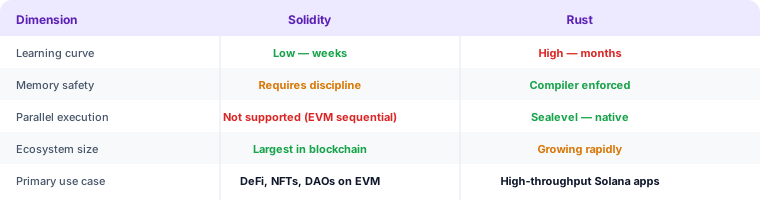
Solidity is accessible to any developer with JavaScript or Python experience. Basic contracts can be written within hours using Remix IDE. Rust requires weeks to months to become productive. The borrow checker rejects valid looking code until the ownership model is internalized. If you need to ship quickly and are not already a systems programmer, Solidity has a lower initial cost.
Security model
Rust is fundamentally safer by design. Memory errors that cause real world exploits in many languages simply cannot be expressed in safe Rust — the compiler rejects them. Solidity requires developers to actively avoid known vulnerability patterns. Both languages can produce secure code, but Rust provides compile time guarantees that Solidity does not.
Tooling and ecosystem
Solidity's tooling is more mature. Hardhat and Foundry for testing and deployment, Slither and Mythril for static analysis, OpenZeppelin for audited libraries — the toolchain is comprehensive and well documented. Rust's blockchain tooling (Anchor, Solana Program Library) is good but newer and covers less ground.
Performance ceiling
Rust on Solana has a higher performance ceiling. Solana programs run with near zero overhead, execute in parallel, and the network processes thousands of TPS. Solidity on Ethereum is limited by the EVM's sequential execution model and 15 to 30 TPS base layer throughput. For applications where performance is the constraint, Rust on Solana wins.
Career and job market
Both skills are valuable in 2026. Solidity developers are in higher absolute demand because Ethereum and EVM chains have more total deployed capital and more active developer teams. Rust developers who specialize in Solana can command significant premiums because the skill set is rarer. Learning Solidity is the faster path to a first blockchain development job. Learning Rust opens doors to higher complexity, higher reward work.
Section 06 · Recommendation
Which one should you learn first?
The honest answer is: it depends on where you want to build.
If your goal is to deploy applications to Ethereum, Polygon, Base, Arbitrum, Optimism, BNB Chain, or any other EVM compatible network — learn Solidity. These chains collectively hold the majority of deployed DeFi value, the largest NFT ecosystems, and the most mature developer infrastructure. Solidity lets you target all of them with a single language.
If your goal is to build on Solana — for its speed, low fees, or the specific applications the Solana ecosystem supports — learn Rust. There is no shortcut here. Solana programs require Rust, and Anchor (the primary framework) requires understanding Rust's ownership model to use effectively.
If you want to work across both ecosystems and have the time to invest in two languages: learn Solidity first to understand smart contract concepts in a more forgiving environment, then learn Rust for the depth it provides. Developers who can work in both are genuinely rare and genuinely valuable.
Start here for Solidity
CryptoZombies is a free interactive tutorial that teaches Solidity through building a game. The official Solidity documentation at docs.soliditylang.org is comprehensive. Foundry's documentation covers modern Solidity development workflow including testing and deployment. OpenZeppelin's contracts repository is the first place to look for audited implementations of standard patterns.
Start here for Rust
The Rust Book (doc.rust-lang.org/book) is the standard learning resource — free, comprehensive, well written. Rustlings is an interactive exercise set for reinforcing the concepts. Once you have Rust basics, the Anchor Framework documentation (anchor-lang.com) covers Solana specific patterns. The Solana Program Library examples show real world Solana programs.