Section 01 · The role
What a Fractional CTO Actually Does
Most founders arrive at this question already in pain. The better approach is knowing the triggers in advance — before the damage sets in.
Quick answer
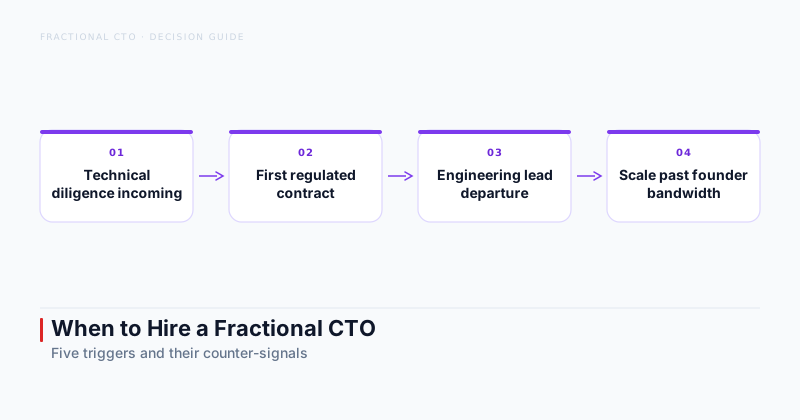
When should a startup hire a fractional CTO? Hire when a specific technical decision is gating a business outcome — a fundraise blocked by diligence questions, a regulated contract, a production outage without engineering leadership, or a first engineering hire wave. If none of those conditions are present, you probably need occasional advice, not an ongoing engagement.
A fractional CTO is a senior technical executive who works on a part time or project basis. The role is architecture ownership, engineering leadership, and technical decision making — not code writing. If you are unsure what the role entails day to day, start with what a fractional CTO does day to day and return to the timing question once the scope is clear.
The rest of this post maps the five specific circumstances where the hire pays for itself immediately, the false alarm version of each, and how the right stage changes the scope of the engagement.
Section 02 · The signals
Five Signals Your Startup Genuinely Needs One
These are not soft indicators. Each one describes a concrete circumstance where the absence of senior technical leadership is costing you something real.
Technical diligence is gating your next fundraise
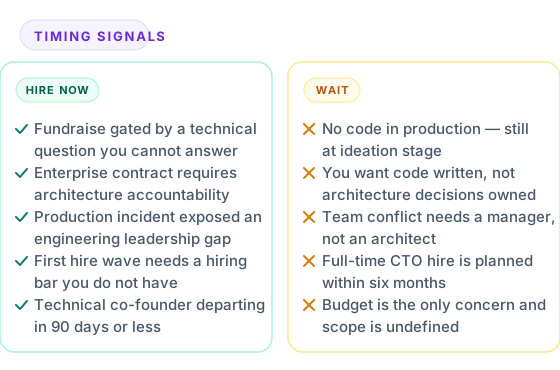
An investor has asked a technical question that no one on your team can answer confidently. Maybe the question concerns scalability, data residency, security architecture, or model liability. The conversation has stalled. A fractional CTO steps in as the technical owner who can run the diligence process, produce the required documentation, and give the investor the confidence to move forward. The trigger is not the diligence question itself but the absence of anyone on your team who owns the answer.
Your first regulated customer contract has arrived
Enterprise customers in finance, healthcare, or legal technology routinely require an architecture review, a vendor security questionnaire, or a documented path toward SOC 2 as a contract condition. A fractional CTO owns that conversation — not as a consultant who files paperwork, but as the person accountable for the technical commitments in the contract. The trigger is the contract; the gap is having no technical leader who can stand behind those commitments.
A production outage revealed a leadership vacuum
When a system goes down and no one on the team is confident enough to run incident response, write the post mortem, or explain to customers what happened and how it will not recur, you have a leadership vacuum. That vacuum predates the outage — the outage just made it visible. A fractional CTO fills it structurally: not by firefighting the immediate incident, but by setting the reliability posture that prevents the next one.
You are about to make your first three engineering hires
The first engineering hires set the technical culture, the architecture instincts, and the hiring bar for every engineer after them. Founders without a technical background often struggle to evaluate candidates rigorously. Technical founders often evaluate for skills they already have rather than the skills the team needs. A fractional CTO writes the hiring rubric, runs the technical interview loop, and pushes back on offers made for the wrong reasons.
Your technical cofounder is departing in the next 90 days
A cofounder departure creates two overlapping problems: a leadership gap and an institutional knowledge gap. The institutional knowledge leaves when the person leaves; the leadership gap persists until it is filled. A fractional CTO cannot replace a cofounder, but they can absorb institutional knowledge through a structured handoff, hold the architecture direction stable, and keep the team productive while you determine whether to hire a full time CTO or extend the engagement.
Section 03 · The false alarms
The False Alarm for Each Trigger
Not every version of these triggers is a genuine signal. Here are the situations that look like the five triggers but are not.
Diligence questions that are not about architecture
If the fundraise is stalling on market size, product market fit, or business model, a fractional CTO will not rescue it. The false alarm is a round struggling for non technical reasons, dressed up as a technical problem.
Compliance paperwork without real technical scrutiny
Some enterprise vendor questionnaires are box checking exercises that a good security framework template can handle without senior architecture involvement. The false alarm is a contract process that is burdensome but not actually a technical ownership question.
Outages caused by process gaps, not leadership gaps
If your team knows exactly what broke and how to fix it, but lacked the process to catch it before it reached users, a fractional CTO is not the fix. A better deployment process or a dedicated reliability practice is. The false alarm is when the team has the leadership capability but lacks the infrastructure and tooling.
Needing code written, not decisions owned
A fractional CTO is an architecture and leadership role. If you need more engineering capacity, a senior contractor or a staff engineer is the right hire. Conflating capacity with leadership is the most common false alarm in this decision.
A full time CTO hire already in progress
If you are three to four weeks from closing a full time CTO hire, starting a fractional engagement rarely makes sense. The exception is when something critical — a fundraise gate or a customer commitment — cannot wait another six weeks.
Section 04 · Stage and scope
How Your Stage Changes the Answer
The trigger tells you whether to hire. The stage tells you how deep the engagement should go.
| Stage | Typical trigger | Engagement scope |
|---|---|---|
| Pre seed | Fundraise diligence or first prototype architecture decision | Four to eight weeks, one specific deliverable |
| Seed | First regulated contract or first engineering hire wave | Three to six months, roadmap ownership and hiring architecture |
| Series A | Scale infrastructure, hiring pipeline, engineering org design | Six to twelve months, sustained leadership until a full time hire |
Preseed founders often need a fractional CTO for a single, high stakes decision — the architecture conversation that unlocks a term sheet, or the first technical hire interview loop. The engagement has a clear end. At seed stage, the scope expands: the fractional CTO is involved in roadmap planning, the hiring process, and the first enterprise conversations simultaneously. To understand what that engagement looks like at the seed stage, the scope and deliverables are different from what preseed companies need.
At Series A, the engagement starts to resemble an interim CTO — broad ownership, multiple workstreams, and a clear mandate to hire a full time successor and hand off. The key distinction from a full time hire is the exit: a well structured fractional engagement includes a handoff plan from day one, so the departure does not create a new leadership vacuum.
Section 05 · AI companies
Three Additional Triggers for AI Startups
AI companies face circumstances that general SaaS startups do not. These are not edge cases — they appear in almost every AI startup past the prototype stage.
The first is model liability in a customer contract. When a contract assigns responsibility for model outputs — wrong recommendations, incorrect classifications, hallucinated responses in a regulated workflow — someone on your team needs to own those technical commitments before a lawyer can structure them. That is an architecture and governance problem first, and a fractional CTO is better positioned to solve it than a counsel who is not close to the system.
The second is the move from prototype to production AI. The gap between a demo that works in a controlled environment and a production system that a customer depends on in a real workflow is substantial. That crossing requires decisions about fallback handling, observability, data provenance, and evaluation infrastructure that most founding teams have not made before — and getting those decisions wrong early is expensive to undo.
The third is data privacy and regulatory compliance for AI systems. Emerging AI regulation introduces compliance obligations that interact directly with how you store, process, and expose model outputs. A fractional CTO who has navigated regulated AI systems before can build the compliance architecture into the design from the start rather than retrofitting it after the first audit.
Section 06 · The engagement arc
What the First 90 Days Should Deliver
A well run engagement has a predictable arc regardless of which trigger prompted it. Here is what each phase produces.
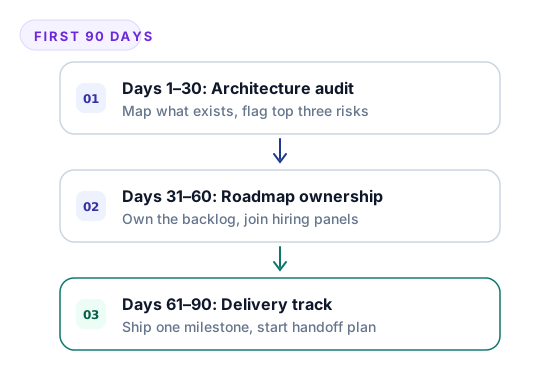
The first 30 days are an architecture audit. The fractional CTO maps what exists, identifies the three highest risk technical decisions on the current trajectory, and produces a written assessment the founding team can act on. No major changes happen in month one — the goal is accurate diagnosis.
Days 31 through 60 shift to roadmap ownership and active unblocking. The fractional CTO joins the hiring pipeline if there are engineering candidates, attends the key customer conversations, and starts moving the highest priority risk items. This is the phase where the engagement starts to feel like having a senior technical leader in the room.
The final 30 days deliver a production milestone and begin the handoff plan. The milestone demonstrates that the engagement produces shipped outcomes, not just reports. The handoff plan is what makes the engagement honest: it defines what a full time successor needs to know and tells you how close you are to being ready to transition. For the full engagement playbook broken down week by week, that post covers the tactical detail each phase requires.
One note on timing: the earlier in a trigger you engage, the more value the fractional CTO can generate. Bringing someone in after the fundraise has already stalled, after the enterprise contract negotiation is already contentious, or after the cofounder has already left means the first 30 days are recovery rather than architecture. If you recognize one of the five triggers above in your current situation, the Fractional CTO service page has a short intake form — a 30-minute conversation is usually enough to scope whether the timing is right.