Section 01 · Definition
What is an AI agent fallback strategy?
The primary path is what you designed. The fallback is what your system does when that design meets reality. Most teams ship the primary path and defer the fallback — that is the gap that becomes an incident.
Quick answer
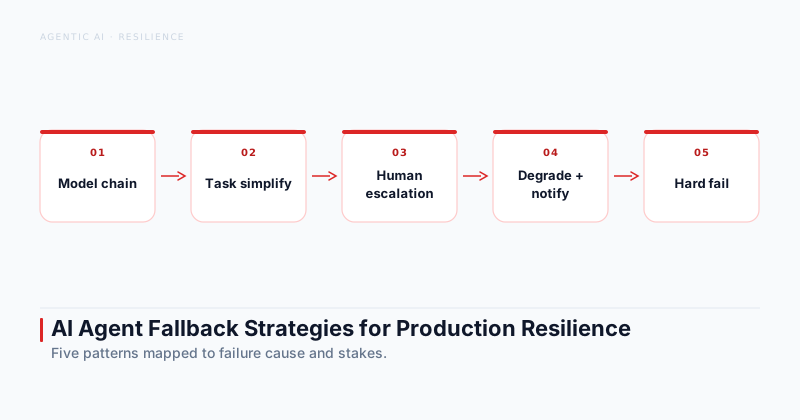
How do you handle an AI agent failure in production? Match the fallback to the failure cause. Transient provider outage: route to a fallback model. Tool timeout: simplify the task scope. Irreversible high stakes action: escalate to a human. Non critical output path: degrade and notify. Wrong answer worse than no answer: hard fail with full observability. Design the fallback path before deploying the agent.
An AI agent fallback strategy is the code path your system executes when the primary path cannot complete. Every production agent has a primary path: the intended sequence of model calls, tool invocations, and state transitions. The fallback is what happens when that sequence breaks.
The distinction matters for one reason: a missing fallback means the exception you did not handle becomes the user experience. An agent that surfaces an unhandled error because its primary provider is down, raises an uncaught exception because a tool timed out, or returns hallucinated output because its context exceeded the window — these are all fallback failures. The gap is not always obvious at design time, which is why fallback paths deserve the same design attention as the primary path.
The framing that clarifies the design space is to separate failure cause from the pattern you apply. A provider outage calls for a different fallback than a quality regression. Mapping failure causes to patterns gives you a rule you can codify rather than a judgment call you make under pressure.
Section 02 · Failure classes
Which failure modes call for a fallback?
Not all failures are equal. Five classes cover most of the space in production agent systems, and each calls for a different response.
Five failure classes cover most of the space in production agent systems.
Provider outage or rate limit
The model provider returns 5xx errors, hits capacity, or applies rate limiting. The agent cannot complete the call at all.
Tool timeout or error
A tool the agent relies on — a database query, an external API, a file system operation — fails to respond within the expected window or returns an error code.
Guardrail rejection
A safety layer, input filter, or output validator blocks the agent's request or response. The primary path completed but the output is unusable.
Budget breach
The task has consumed more tokens, compute spend, or wall clock time than its configured ceiling. Continuing would exceed operational limits.
Quality regression
The model completes the call and passes the safety layer, but an evaluation step determines the output is below the acceptable threshold for the action.
Each failure class calls for a different response. A provider outage is a temporary loss of a resource; the agent may route to another. A quality regression means the primary approach is not working; more attempts with the same model are unlikely to help. Conflating them leads to fallbacks that address the wrong problem.
Section 03 · Pattern 1
When does a model fallback chain apply?
The lowest latency option. The task structure does not change — you send the same or a lightly adapted prompt to a different endpoint.
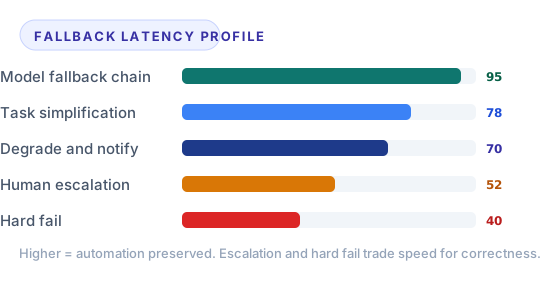
A model fallback chain routes the request to a secondary model when the primary model is unavailable, rate limited, or produces output below a confidence threshold. It is the lowest latency option because the structure of the task does not change — you send the same or a lightly adapted prompt to a different endpoint.
The typical chain has two to three tiers. The primary tier uses the model best suited to the task. The secondary tier uses a model that is cheaper, faster, or backed by a different provider. The tertiary tier, if one exists, is usually a lighter model capable only of a simplified version of the task.
Put the circuit breaker in the tool layer
The fallback trigger needs to live outside the model itself. A circuit breaker in the tool layer tracks consecutive failures and switches tiers automatically; it does not wait for the model to signal distress. This prevents the latency cost of waiting for each attempt to time out before trying the next.
Adapt the prompt per tier
A prompt optimized for a frontier model may produce degraded output on a mid tier model without minor changes to instruction format or output structure. Building the prompt per tier rather than passing the same prompt downstream improves reliability at the cost of more prompt maintenance.
The routing logic — how to assign request classes to model tiers based on cost and capability — is covered in the LLM model routing guide for teams building this as a system rather than a per agent workaround.
Section 04 · Pattern 2
How does task simplification help when an agent fails?
Reduce the scope of what the agent attempts. Complete a narrower version of the task rather than failing entirely.
Task simplification reduces the scope of what the agent attempts when the full task is unachievable. The agent completes a narrower version rather than failing entirely. Three applications cover most cases:
Scope reduction
An agent tasked with producing a full analysis falls back to a summary. An agent tasked with writing a multi part report falls back to the outline. The output is partial but accurate and still useful to the downstream consumer.
Context trimming
When the task fails because the context window is exhausted, simplification trims the least relevant context — conversation history, background documents, verbose tool outputs — and retries the core task with a leaner window.
Step skipping
A multi step agent that hits a bottleneck at step three can skip that step, attempt the remaining steps, and flag the gap in its output rather than blocking on it indefinitely.
The risk is that the user or downstream system cannot tell the output is partial unless the agent explicitly signals it. A task simplification fallback needs a notification component — either a flag in the structured output or a message in the response — that makes the simplification visible. Silent simplification is a form of silent degradation, and it is worse than a clean error because it looks like success.
Section 05 · Pattern 3
When should an AI agent escalate to a human?
Escalation is a design choice, not an emergency measure. An agent designed to escalate at a specific decision point behaves very differently from one that escalates because it ran out of options.
Human escalation is the right fallback when the action is irreversible, the stakes are high, and no automated fallback can maintain acceptable quality. The agent cannot complete the task safely and the correct response is to hand it to a person.
An agent that escalates because it was designed to escalate at a specific decision point gives the human a clean, well scoped decision to make. An agent that escalates because it has exhausted every other option hands the human a half completed task and an implicit request to figure out what went wrong. The former is a feature. The latter is an incident.
Design the escalation trigger at the task classification layer, not in the exception handler. Before the agent takes an action, classify it by reversibility and stakes. High stakes irreversible actions should be gated by human approval before execution — not because the agent is likely to fail, but because the cost of a wrong execution is asymmetric. Low stakes reversible actions should almost never escalate; the agent should attempt another fallback and move on.
The architecture for this pattern, including the decision rule for when to gate versus when to let the agent proceed, is covered in the human in the loop patterns guide for teams building oversight into production agent systems.
Section 06 · Pattern 4
What is degrade and notify for AI agents?
The agent completes what it can and surfaces what it could not. Non critical paths get a partial answer. The gap gets flagged explicitly.
Degrade and notify means the agent produces a partial or reduced output and explicitly surfaces the gap to the user or the monitoring system. The agent does not stop; it completes what it can and signals what it could not.
The pattern applies to non critical output where a partial answer has value and where surfacing the limitation is better than blocking the workflow. A research agent that cannot access one of its sources produces a report with a footnote that one source is unavailable. A support agent that cannot verify a customer record provides general guidance and flags the verification gap for human review.
Two requirements teams consistently underestimate: the partial output needs to be genuinely useful — not the prose equivalent of an error message — and the notification needs to reach someone who can act on it. Degraded output that lands in a log nobody reads is indistinguishable from a silent failure.
Degrade and notify pairs well with an evaluation rig that tracks the degradation rate over time. A spike in degrade and notify events for a specific action class signals that the primary path has a systemic problem, not a transient one. At that point the fallback is buying time, not solving the issue.
Section 07 · Pattern 5
When is a hard fail the right response?
No partial output. No silent degradation. No retry. A well placed hard fail is the system working correctly — not evidence that something is broken.
A hard fail rejects the task entirely, returns an explicit error, and records full observability data. No partial output. No silent degradation. No retry.
Hard fail is the right choice when the cost of a wrong answer exceeds the cost of no answer. For a consequential action — sending a financial transaction, making a legal determination, modifying production infrastructure — an agent that continues under uncertainty and produces a plausible but wrong output is more dangerous than one that stops and says it cannot complete the task.
The observability component is not optional. A hard fail without full context — the task that was requested, the state at failure time, the specific failure mode, the tool outputs available — is debugging noise. A hard fail with complete structured logging is a diagnostic event that tells you exactly what to fix.
The common mistake is treating a hard fail as evidence that something is broken. A well placed hard fail is the system working correctly: the agent reached a decision point it was designed to stop at, and it stopped cleanly. Compare that to an agent that continues through a failure, produces a confident looking wrong answer, and surfaces the problem three steps later when the damage is harder to undo.
For any action class where you are unsure whether to hard fail or degrade, ask: if this output is wrong, can the downstream system detect it? If the answer is no, hard fail.
Section 08 · Decision criteria
How do you choose the right fallback pattern?
Three inputs decide: failure cause first, then reversibility, then latency budget. Apply them in order rather than arguing the whole decision at once.
Three inputs determine the right pattern for a given failure scenario: the failure cause, the action's reversibility, and your latency budget. Apply them in sequence rather than arguing the whole decision at once.
Start with the failure cause
Transient provider errors map to model fallback chain. Context exhaustion or scope overrun map to task simplification. Guardrail rejection or quality regression point toward escalation or hard fail depending on stakes. Budget breach points toward degrade and notify. Unknown internal error points toward hard fail with full observability.
Apply reversibility second
For irreversible actions — sending a message, committing a transaction, deploying code — the fallback pattern must either prevent the action or route to a human before execution. Model fallback chains and task simplification are acceptable for reversible tasks; they are risky for irreversible ones because they may still execute the action with degraded quality.
Use latency budget last
Model fallback chains are fastest, measured in seconds. Task simplification adds a retry pass, measured in seconds to minutes. Escalation is human gated, measured in minutes to hours. If the downstream workflow cannot tolerate human latency and stakes are medium, degrade and notify is the better path.
Teams building production agent systems with firm resilience requirements can work through the agentic AI consulting service for architecture reviews that include fallback design from the start.