
Section 01 · Scope
What an AI development company should own
The scope of a serious AI partner runs from business problem framing through operations — not from sprint one through final delivery.
Quick answer
What does a strong AI development company own? An AI development company should be judged on its ability to move from problem framing to production operations, not on model demos alone. CTOs should verify discovery quality, architecture ownership, integration depth, security, monitoring, post launch support, and adoption measures before selecting a partner or signing a delivery model.
Vendors who hand off at deployment are implicitly telling you that monitoring, incident response, and optimization are your problem — without having designed the system to make that possible. That is the pattern that produces a working demo and a broken production system.
A well scoped engagement starts with business problem analysis: what decision or workflow is the AI system changing, what data exists to support it, whether the ROI is defensible, and what success looks like at 90 days and at 12 months. Partners who skip this step and ask for a spec doc are telling you they will build what you described, not what you need.
Discovery feeds architecture. Model selection, data pipeline design, infrastructure choices, and API specifications should all trace back to the problem definition produced in discovery. If those documents are disconnected, the build will drift from the business goal.
Operational knowledge — how the system behaves under edge cases, what the model does when input quality degrades, which alerts fire for which conditions — must transfer to your team before the contract closes. That transfer is not documentation shipped in a ZIP file. It is structured knowledge sharing during the build, not after it.
Section 02 · Architecture
Evaluate architecture before the first sprint
Architecture decisions set the constraints everything else operates within. Approving a vendor on delivery confidence rather than architectural judgment is the fastest path to a system that cannot scale.
Ask for a written architecture proposal before work begins. It should specify which model or model family they are selecting, why, and what the evaluation criteria were. It should name the data pipeline tools, the infrastructure provider, the API contract, and the monitoring layer. Vague answers at this stage mean vague decisions during the build.
Model selection without documented evaluation criteria is a red flag. The right model for your use case depends on latency requirements, context window needs, cost at your projected request volume, fine tuning feasibility, and provider reliability. A vendor who selects a model without explaining the tradeoffs on each dimension has likely not done that analysis.
AI systems rarely operate in isolation. They read from CRM records, write back to ERP systems, trigger notifications, and expose APIs consumed by your product. A vendor who treats integration as a final step rather than an architectural constraint will produce a system that works in their environment and breaks in yours.
Ask specifically how the vendor has handled integration with systems similar to yours, what the integration test strategy is, and who owns the API contract when both systems need to change. These are not questions about capability — they are questions about process discipline.
Section 03 · Production
Demand production engineering, not demo engineering
The distance between a working demo and a production system is where most AI development company engagements fail.
Production engineering is not glamorous. It involves instrumentation, load testing, security review, and incident playbooks — work that is hard to show on a portfolio page and easy to deprioritize during a compressed build timeline. If these items are not named in the contract, they will be the first to go.
A production AI system needs a deployment pipeline with rollback capability, automated tests that catch regressions, performance monitoring at the model call level, and load testing before first release. Ask which of these the vendor includes by default and which require a change order.
Monitoring deserves specific scrutiny. Model behavior drifts over time as input distributions change. A vendor who deploys without instrumented latency, error rate, and output quality metrics has transferred that problem to you — you will discover the drift from user complaints, not from your monitoring.
Security audits and compliance checks are scope items that disappear under time pressure if they are not named in the contract. If your system handles customer data, financial records, or health information, ask explicitly which security controls the vendor implements, who performs the audit, and what the delivery artifact is. A statement that the system is secure is not a delivery.
Section 04 · Handoff
Check how the vendor handles adoption and handoff
An AI system your team cannot operate, modify, or extend independently has a single point of failure — the vendor.
Adoption and handoff discipline is the difference between a system you own and a system you are renting. The test is simple: if the engagement ended tomorrow, could your team keep the system running and push an update next week?
Code ownership is a legal and a practical question. Legally, work product created by an independent contractor does not automatically transfer to you under most jurisdictions — explicit assignment language is required in the contract. Review the AI vendor due diligence checklist before signing. Practically, code ownership without the knowledge to operate the code provides limited protection.
Documentation should cover architecture decisions and the rationale behind them, model evaluation results, data pipeline design, integration specs, and runbooks for the most likely operational scenarios. Ask to review a documentation artifact from a prior engagement before you sign.
Adoption after deployment is frequently underscoped. The system is live, the engineers have moved on, and the team that will use it daily was not involved in the build. Ask the vendor what they do at launch to measure whether the system is being used as intended, and what the support model is for the first 90 days of operation. If adoption metrics are not in the contract, they will not be tracked.
Section 05 · Checklist
Use a production readiness checklist
A structured checklist before final delivery prevents the pattern where a vendor closes the engagement and the client discovers three months later that monitoring never worked.
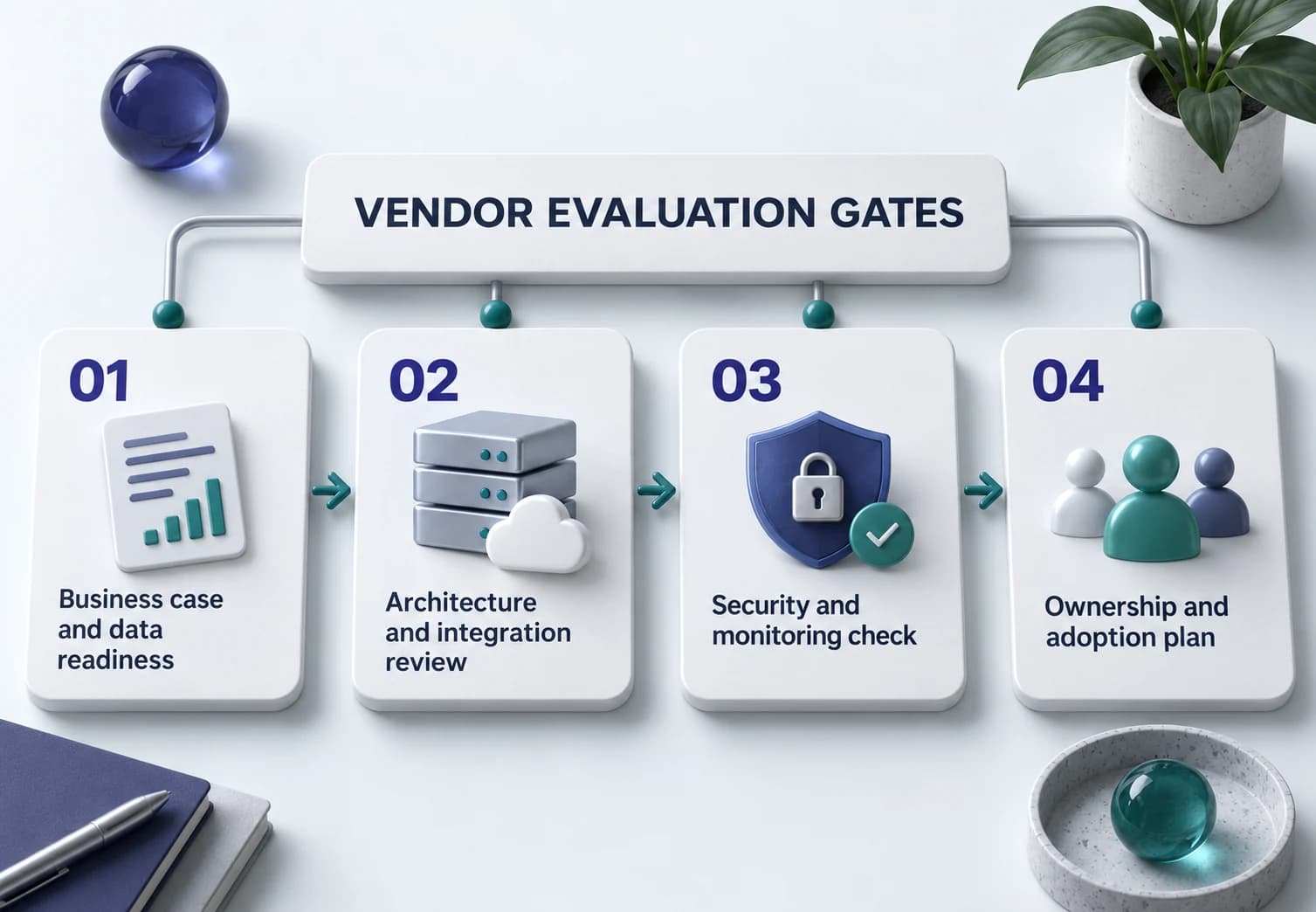
The checklist for AI systems covers more ground than a traditional software delivery. Successful AI adoption requires a clear business case, dependable data, secure infrastructure, integration with existing systems, defined governance, and a monitoring plan after launch.
| Gate | What to verify |
|---|---|
| Business case | ROI model documented; agreed success metric at 90 days |
| Data readiness | Training and inference pipeline instrumented, versioned, reproducible |
| Integration | Integration tests run against production environment, not staging replica |
| Security | Security review completed by named party; findings documented and addressed |
| Monitoring | Latency, error rate, and output quality metrics live and routed to an alert channel your team owns |
| Governance | Defined process for model updates, retraining triggers, and deprecation |
| Documentation | Architecture decisions, runbooks, and model evaluation results delivered and reviewed |
| Adoption | Usage baseline established; first usage review at 30 days on the calendar |
If any item on this list is not in the delivery definition, either add it to the contract or treat it as a known gap you are accepting. The gap will not close itself.
Section 06 · Model
Choose the engagement model that preserves control
Fixed scope, dedicated team, and embedded partner engagements carry different risk and control profiles. The right choice depends on how strategic the system is.
A fixed scope project works when the problem is well defined and unlikely to change. The vendor delivers a specified system, hands it off, and the engagement closes. The risk is that AI problems rarely stay well defined through a build. Scope changes become change orders, which slow delivery and increase cost.
A dedicated team operates under a retainer model with a defined team composition. You have ongoing access to engineering capacity without renegotiating scope for each change. The risk is lower, but the cost is higher and the vendor still controls team allocation decisions.
An embedded partner model integrates the vendor into your existing engineering organization. The vendor works alongside your internal engineers, which accelerates knowledge transfer and produces a team that can operate the system after the engagement ends. This is the model most likely to address the dependency problem. To understand whether an external engagement makes sense at all, the build vs buy AI framework is a useful starting point.
The standard path out of vendor dependency is an embedded model combined with structured knowledge transfer and documentation requirements in the contract. If you are evaluating whether to hire an external engineering team or a consultant to own these architecture decisions, the hire AI engineer vs consultant comparison covers the tradeoffs specific to AI projects.
The selection process for an AI development company is itself an architecture decision. Choose the partner based on how they make decisions under uncertainty, not on how polished their demo is. If you want to stress test a candidate before a long engagement, the AI systems architecture review is the right starting point.