Section 01 · Scope
What AI Engineering Services Include
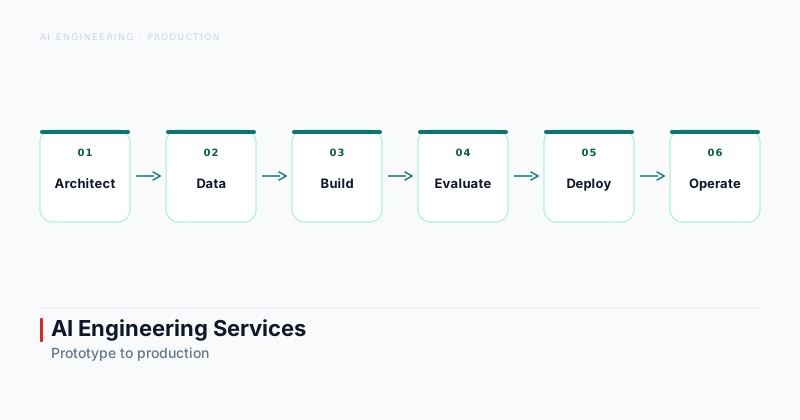
The word “engineering” is doing real work. It distinguishes execution from advice, and working prototypes from production systems.
Quick answer
What are AI engineering services? AI engineering services turn AI concepts and prototypes into production systems by combining software engineering, model integration, data pipelines, deployment, evaluation, monitoring, and operational ownership. Strong providers design for reliability, security, maintainability, and measurable business outcomes rather than stopping at demos or isolated model experiments.
Wipro describes AI engineering as delivering AI powered products, systems, and solutions from concept to production while balancing performance, accuracy, cost, velocity, and responsible AI principles. That framing captures the full scope accurately.
From prototype to production
Most teams have a working prototype within four to six weeks. The gap from prototype to production is where projects fail. A prototype answers “can we make this work in a controlled environment?” Production answers “can this system run reliably inside our business, at volume, without human babysitting, in a way the organization can maintain?” Those are different problems requiring different skills.
Production engineering adds the concerns that prototypes deliberately ignore: latency under load, cost at scale, failure modes outside the happy path, dependency on upstream model providers, data security, access controls, audit trails, and the operational burden of keeping the system healthy after launch.
How engineering differs from advisory
Advisory work produces decisions and plans. Engineering work produces working systems. A strong advisory engagement tells you which AI use case to invest in, whether to build or buy, which vendor to select, and what your governance model should look like. At the end, you have a document and a clearer direction.
An engineering engagement builds the system the advisory work pointed at. At the end, you have running software, deployment automation, monitoring, documentation, and a team that understands how to operate it. Deloitte includes AI and generative application development, data product and platform development, and data security within its AI powered engineering services — the emphasis is on building complete, secure systems rather than generating recommendations.
When you are buying which
Some firms combine advisory and engineering in one engagement. When evaluating a partner, be explicit about which deliverable you are paying for. The output of an advisory engagement looks very different from the output of an engineering engagement, and confusing the two leads to expensive disappointment.
Section 02 · Architecture
Architecture and System Design
The architecture phase sets constraints that are expensive to revisit. Teams that treat it as a formality consistently hit the same class of problems at production scale.
Choosing integration boundaries
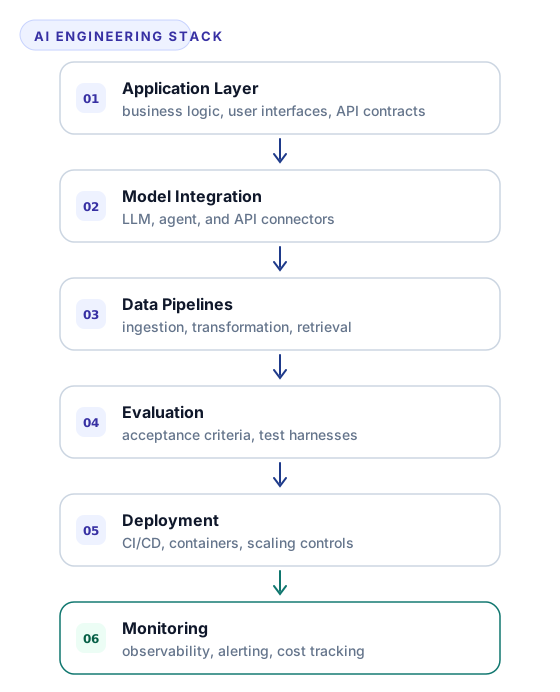
An AI engineering engagement should define where the AI system connects to the existing business architecture. That means answering: which data sources does the system need, and how does it access them? Which downstream systems consume the output? What happens when the AI component is unavailable? What is the fallback behavior?
These boundaries determine whether the system degrades gracefully under failure or produces silent errors that propagate downstream. Getting them right requires understanding both the AI component and the existing business systems — which is why engineering teams that lack business context produce technically correct integrations that fail operationally.
Designing for scale and security
Security is not a compliance checkbox at the end of a project. It is a set of constraints that must be present in the architecture from the beginning. Access control over model inputs and outputs, data isolation between tenants, audit logging for regulated workflows, and protection against prompt injection all require architectural decisions that are difficult to retrofit.
Scale means different things in different contexts. For an inference system, it means latency and throughput targets at peak load. For a data pipeline, it means the volume of documents processed per hour. For an agent workflow, it means the cost and reliability of orchestration at hundreds or thousands of concurrent runs. A credible engineering partner will model these constraints before writing code, not discover them in production.
Section 03 · Build
Build and Integration Work
The build phase is where architecture decisions become software. Delivery does not end at the first deployment.
LLM, agent, and API integration
Most production AI systems are integrations, not training runs. The engineering work is connecting an LLM, an agent framework, or a third party AI API to the business logic that makes it useful. That means writing reliable connector code, handling rate limits and provider outages, managing context windows efficiently, and implementing retry logic that does not amplify costs when things go wrong.
Agent systems add orchestration complexity on top of individual API calls. The engineering team must manage state across steps, define clear tool contracts, handle partial failures without corrupting task state, and ensure the system produces auditable outputs. These are software engineering problems that look different from typical API integration work, and they require specific production experience to solve correctly.
For teams navigating the reliability tradeoffs of LLM based systems, LLM observability wired in from the start is the difference between catching failure modes in staging and discovering them at three in the morning.
Data pipelines and application connectivity
AI systems are only as useful as the data they can access. Data engineering is often underscoped in AI projects: teams focus on the model or the agent and treat data ingestion as solved. In production, data pipelines fail, schemas drift, upstream sources add authentication, and volumes spike unexpectedly.
A production data pipeline for an AI system must handle schema changes without breaking the model integration, support incremental updates rather than full reprocessing on every run, expose data lineage for compliance and debugging, and degrade gracefully when upstream sources are unavailable. These requirements add engineering work that is often invisible until something breaks.
Section 04 · Evaluation
Evaluation, Deployment, and Observability
This is the layer most AI projects underinvest in. Deferring it until after launch requires rebuilding systems that were not built with observability in mind.
Production acceptance criteria
Before the first integration goes into production, you need to define what “good enough to ship” looks like. That means setting measurable thresholds on the behaviors that matter: accuracy on your task distribution, latency at the 95th percentile, cost per unit of work, and failure rate under realistic inputs.
Without defined acceptance criteria, teams ship based on intuition. “It seems to be working” is not an acceptance criterion. Neither is “the demo looks good.” Production acceptance criteria give the engineering team a clear target and give stakeholders a clear signal for when the system is ready. They also establish a baseline for detecting regression after model updates or infrastructure changes.
Strong engineering teams pair acceptance criteria with test harnesses — automated systems that run the acceptance tests continuously, catch regressions before they reach production, and document system behavior over time. Building an evaluation framework before deployment removes a significant class of production incidents that otherwise appear without warning.
Monitoring and operational feedback
Monitoring for AI systems covers more ground than monitoring for traditional software. In addition to standard infrastructure metrics — latency, error rates, resource utilization — AI systems require monitoring for behavioral drift, cost trends, prompt injection attempts, output quality on a sample of real requests, and model provider availability.
Magnitudeminds describes AI engineering services as implementing, managing, and monitoring AI systems from strategy through steady state operations. The monitoring component is not optional: without it, you have no early warning when model behavior changes after a provider update, no cost visibility when an edge case triggers unusually long context windows, and no signal that the system is degrading before users notice.
Section 05 · Operations
Ongoing Ownership and Steady State Operations
A system that launches but cannot be maintained creates technical debt that compounds every time the model changes, a dependency is updated, or a new business requirement arrives.
Who maintains the system
The handoff question should be answered before the build starts, not after launch. Three patterns exist: the engineering partner hands off to an internal team, the partner provides managed support on an ongoing basis, or the work is designed as a short term engagement with the expectation that the internal team will take full ownership. Each has different implications for documentation depth, code maintainability standards, and knowledge transfer.
Internal team ownership is the most demanding handoff. It requires the engineering partner to produce code that nonspecialists can read and modify, documentation that explains the system's behavior rather than just its structure, and enough training that the internal team can diagnose and fix the most common failure modes without calling for help.
Handoff, documentation, and managed support
Documentation for a production AI system covers three layers: operational runbooks (what to do when X happens), architecture documentation (why the system is designed the way it is), and integration documentation (how the system connects to each upstream and downstream dependency). Most engineering engagements produce only the third layer by default.
A managed support arrangement keeps the original engineering team responsible for reliability. This is appropriate when the AI system is critical to the business and the internal team lacks the depth to maintain it independently. It requires a clear SLA, defined escalation paths, and regular reviews to assess whether the internal team is building the capability to eventually take over.
Section 06 · Selection
How to Choose an AI Engineering Partner
Most AI engineering firms present similar capability marketing. The differentiation lies in what you can verify.
Evidence of production delivery
Ask for case studies that describe a system after launch, not at launch. What was the latency at production load? What failure modes did they encounter and how did they resolve them? What did the monitoring surface in the first month? How many model changes did the system survive without manual intervention? These questions cannot be answered by a firm that has only built demos.
References matter more than testimonials. A testimonial from a satisfied client at the delivery stage does not tell you how the system performed six months later. A reference from an engineering leader who can speak to post launch operations is a more reliable signal.
Questions about reliability, ownership, and maintainability
Before signing an engagement, ask: How do you define production acceptance criteria for this type of system? What is your standard monitoring stack, and what does it cover for AI specific behaviors? What documentation do you produce, and what does it look like for a system of this complexity? Who owns the system after launch, and what does the handoff process involve?
The quality of the answers tells you whether you are talking to a production engineering team or a demo shop. A production engineer answers these questions with specifics. A demo shop answers with generalities or deflects to capability claims.
If your organization is evaluating AI engineering partners alongside broader technical decisions, working with an experienced AI systems architect can clarify the integration boundaries, evaluation criteria, and operational model before you commit to a full engineering engagement.