Section 01 · Definition
What AI product development actually includes
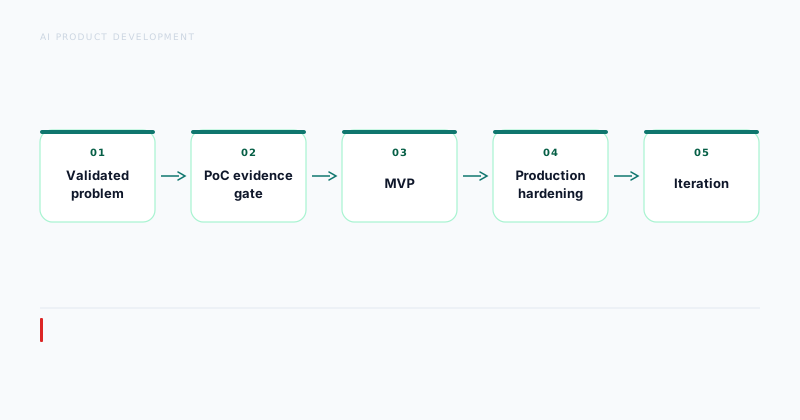
More than calling a model API and shipping a feature. The work covers the full lifecycle from a validated user problem to a production system the team can operate and improve.
Quick answer
What is AI product development? AI product development is the disciplined path from a validated user problem to a production AI product. The work combines product strategy, UX, data and model choices, evaluation, full stack engineering, deployment, and monitoring so teams test value early and avoid funding a technically impressive system that users cannot trust or adopt.
IBM describes AI product development across research, ideation, design and prototyping, test and build, and launch and iteration stages. Each stage produces decisions and artifacts that shape what the next one can do. Skipping stages does not make the product faster; it makes the production system harder to operate and harder to improve.
An isolated AI feature adds model output to an existing workflow. An AI product owns the whole user experience around that output, including what happens when the model is uncertain, slow, or wrong. The product layer includes fallback states, user trust signals, override controls, and feedback loops that the engineering ticket for a feature rarely covers.
The lifecycle IBM outlines is not a waterfall. Research informs ideation; prototyping results revise the research framing; test and build findings send teams back to design. What makes this distinct from pure software delivery is that model behavior is probabilistic. A feature that behaves correctly 98% of the time in development can surface unexpected failure modes at production scale. The product lifecycle has to account for that with monitoring, feedback capture, and a structured path from real behavior back to model or product changes.
Section 02 · Validation
Validate the problem before choosing the model
Model selection is the wrong starting point. The decision that matters first is whether the problem is real, repeated, and valuable enough to justify the cost of solving it with AI.
You cannot validate a model choice before you validate the problem it is meant to solve. Ninestack describes its AI product development process as beginning with problem validation, combining product strategy, UX design, data science, and engineering before full development starts. The order is intentional. Teams that select a model first and then work backward to a use case frequently produce systems that are technically impressive and commercially unused.
The validation question is specific: Is this problem real, repeated, and valuable enough to justify behavioral change from users? A real problem occurs in practice, not in surveys. A repeated problem earns sustained user engagement. A valuable problem produces a business case that justifies the cost of data work, evaluation, engineering, and ongoing operation.
Before you reach model or architecture choices, an AI readiness assessment surfaces whether your data, systems, talent, and governance constraints can support the product you are considering.
Technical feasibility and business viability are separate checks. A problem can be technically solvable and still not worth solving at the cost and latency required. Check whether the required data exists, whether model quality at your constraints meets user expectations, whether integration points into existing systems are accessible, and whether governance and compliance requirements can be satisfied before production. Each of these is a potential stop condition.
Section 03 · Evidence Gate
Use a proof of concept as an evidence gate
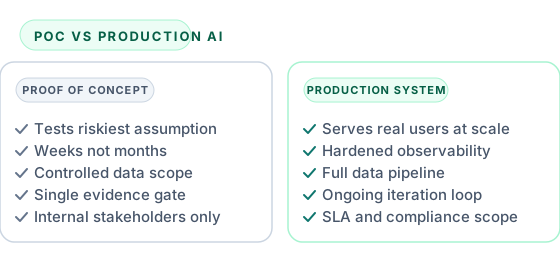
A PoC is not a demo. It is a time boxed test of one falsifiable assumption that produces a go, change, or stop decision before an MVP is funded.
Atomic Loops frames a proof of concept as a time boxed step that answers a falsifiable feasibility question before an MVP is funded. The key phrase is falsifiable. A PoC should test one specific assumption about model behavior, data quality, integration latency, or user response. If the assumption is too broad, the PoC produces a demonstration. If it is falsifiable, the PoC produces a decision.
Set the success threshold before you look at the results. What model quality, latency, or user response rate would tell you the assumption holds? Define that number before the run, not after. Teams that define success after seeing results consistently find that the results are good enough. Teams that define it before find out whether the risk has actually been cleared.
When evaluating whether to build the AI capability yourself or source it externally, the PoC is the right moment to run that analysis. The build vs buy AI decision is easier to make with PoC evidence in hand than with assumptions about what the capability will cost to build and maintain.
The PoC output is a go, change, or stop decision, not a prototype to demo. A go means the riskiest assumption cleared and the team can fund an MVP with known constraints. A change means the assumption failed in a specific way that suggests a different formulation or approach. A stop means the evidence rules out the investment at current constraints. Committing to an MVP before the PoC produces one of these three outcomes is funding a risk rather than clearing one.
Section 04 · Production Design
Design the production system, not just the demo
Architecture, data flows, model selection, human checkpoints, and monitoring belong in the design phase, not the post-launch cleanup phase.
Method Four lists architecture, data flows, model selection, human checkpoints, full stack engineering, deployment, and monitoring as core parts of production AI product delivery. Each element requires a decision before the first production call. Architecture decisions include where model calls happen in the stack, how latency affects the user experience, and how the system degrades when the model is unavailable. Data flow decisions include what inputs reach the model, what outputs are stored, and what audit trail the system maintains.
Model selection at this stage is a constrained optimization. You are not choosing the most capable model in the abstract; you are choosing the model that satisfies your latency budget, context length requirements, cost per call, and quality bar at your input distribution. That decision belongs to the production design phase, not to the PoC. For teams evaluating what architectural skills this work requires, the AI systems architect role covers the responsibilities and decision scope in detail.
Human checkpoints
Define the conditions under which the system surfaces uncertainty, escalates to a person, or rejects a request rather than proceeding with low confidence. These are designed behaviors, not failure states. Teams that skip them discover after launch that users stop trusting the system the first time it fails silently.
Deployment model
Specify how model versions are managed, how configuration changes are tested before reaching production traffic, and how rollback is executed when a new version degrades quality. These decisions are as important as the model choice and should be documented before the first release.
Monitoring instrumentation
Cover model performance metrics alongside application metrics from day one. Quality regression, latency spikes, and cost growth are the three most common signals that arrive before user complaints do. A team that is not measuring them will find out about problems only after they have affected users.
Section 05 · Measurement
Measure product outcomes after launch
Four measurement layers together give the full picture: usage, quality, cost, and business outcomes. Tracking any one of them alone misses the conflicts that determine whether the product is actually working.
IBM notes that advanced AI systems can monitor customer experience and market adoption metrics and feed those signals back into the product development pipeline. That feedback loop is the mechanism that makes iteration evidence based rather than opinion based.
The measurement set for a production AI product has four layers. Usage tells you whether users are engaging with the system and completing the workflows it was designed to support. Quality tells you whether model outputs are meeting the bar users trust. Cost tells you whether the unit economics are sustainable at the current usage level. Business outcomes tell you whether the product is producing the commercial result that justified building it.
These four layers can conflict. A system used heavily with poor quality is a liability. A system with excellent quality that is rarely used is a product problem. A system with good quality and strong usage but an unsustainable cost per call needs architecture work. Tracking all four together gives the team the full picture before any one of them becomes a crisis.
Iteration should respond to what real users actually do, not to what the team predicted they would do. Real usage reveals the inputs the model was not designed for, the failure modes users encounter most, and the features that drive engagement versus the ones teams believed would matter. Structured feedback capture, usage instrumentation, and a regular review cycle that closes the loop from user behavior back to model or product changes are what sustain improvement after launch.
Section 06 · Scope
Know when product development is broader than app development
App development delivers a working system. Product development owns the problem, the user, the market, and the outcome. Knowing which you are buying determines whether the risks you retain are visible.
Ninestack distinguishes AI product development from AI app development by including market validation, strategy, UX research, launch, scaling, and go to market support alongside engineering. The distinction is not just about contract scope. It is about who owns the decisions that determine whether the product succeeds commercially.
If the firm you hire to build your AI product is scoping only to engineering delivery, you are retaining the product and strategic risks yourself. That is sometimes the right choice. It is always a choice worth making explicitly, with a clear view of what your team will own.
Go to market and scaling introduce constraints that the engineering design may not have anticipated. Who introduces users to the product, and how does the onboarding communicate what the AI system can and cannot do? How does the architecture behave when usage grows by an order of magnitude? What pricing model makes the cost structure sustainable at scale? These questions belong to product development. An engineering partner who does not engage with them leaves the team to discover the answers under pressure.
Section 07 · Checklist
A founder checklist for deciding what to build next
Before funding a development effort, work through the questions that the PoC and production design phases are meant to answer. Ambiguity in the problem or the constraints does not resolve itself during engineering.
Before starting the next AI product initiative, work through this set of questions. Is the user problem specific, repeated, and valuable enough to justify behavioral change from users? Does AI materially improve the workflow, or does it add uncertainty without sufficient gain? Does the required data exist in a form that can be accessed and governed? Can model quality, latency, cost, and compliance be measured from day one?
If any of these is genuinely unclear, the next step is a time boxed investigation, not a funded development effort. Ambiguity in the problem or the constraints surfaces later when the cost is higher.
Document the problem and user context
The delivery team needs a clear statement of the problem, the user it affects, the evidence that it is real and repeated, and the success criteria the product must meet. Without this, the team makes these decisions themselves during engineering, but without the research that informed them.
Transfer the PoC evidence
Hand off the specific assumption the PoC tested, the success threshold that was defined before the run, and the result. A delivery team that does not receive this evidence often repeats the feasibility work at higher cost.
Record the architecture and data flow decisions
Specify which architecture choices were made during production design, which data flows were defined, and what constraints drove those decisions. Architecture decisions made by a delivery team with incomplete context are harder to reverse than ones made with the full problem picture.
Define the MVP success metrics and human checkpoints
The MVP phase should have defined success metrics that reflect user value and operational viability, not just technical correctness. Human checkpoint conditions should be specified before the first user call reaches the model.
If you are working through what this kind of end to end product accountability looks like in practice, the Agentic AI Consulting service covers how to scope and structure production AI product engagements from problem validation through to operating model.