Quick answer
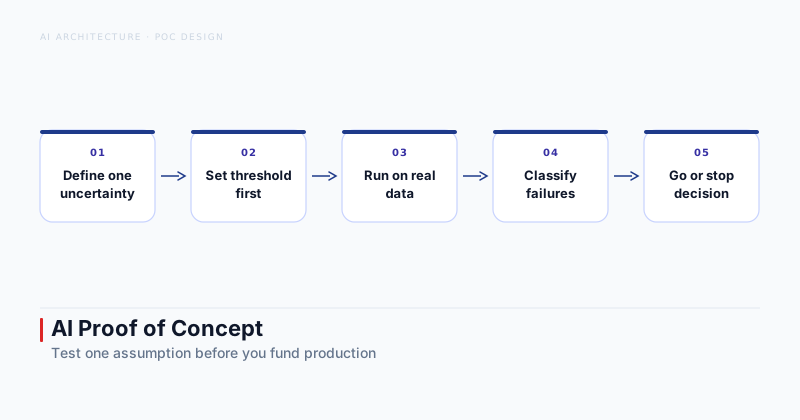
What is an AI proof of concept? An AI proof of concept is a focused experiment that tests one consequential assumption before a team funds production. It should use representative data, define thresholds before evaluation, measure failure cases, latency, unit cost, reviewer effort, and integration limits, then produce an inspectable go, narrow, change, repeat, or stop decision.
Section 01 · Foundation
What an AI proof of concept is for
A PoC is an evidence generator, not a shortcut to production. It tests technical feasibility and potential business value before full integration begins.
Technical feasibility plus business value
The Australian government defines an AI proof of concept as a focused, small-scale experiment. Its purpose is to test technical feasibility and potential business value before full integration and deployment. A strong PoC specifies the problem statement, the success criteria, the data management approach, and the testing method before anyone writes a line of code.
That definition captures something most teams miss: a PoC is not a shortcut to production. It is an evidence generator. The team enters the experiment with a hypothesis — for example, that a retrieval augmented generation system can answer support queries with 85% accuracy on representative cases — and exits with data that either supports or refutes it.
The business value component matters as much as the technical result. A model that performs well on a narrow test but requires 12 hours of data preparation per week, or that fails on the 5% of cases that are most costly to the business, has not passed a meaningful PoC. Technical feasibility and business fitness are both required outputs.
Why a PoC should change an investment decision
A proof of concept that cannot change an investment decision is not a PoC — it is a demo. Before you start, ask: what result would make you stop? What would make you narrow the scope? What would make you change the approach entirely? If the team cannot answer those questions, the experiment needs better scoping first.
A well-run PoC provides evidence for one of five outcomes: go to production, narrow the use case, change the technical approach, repeat the experiment with better data, or stop. Each of those is a legitimate result. Teams that enter a PoC only willing to accept a go decision are conducting theater, not research.
Section 02 · Scope
Choose one consequential uncertainty
Pick the dimension where failure would be a project-stopper. That is your PoC scope.
Quality, data, latency, cost, review, or integration
Six dimensions are worth testing in a PoC: task quality, important failure cases, latency, unit cost, human review effort, and integration constraints. Each represents a different type of production risk. Choosing one to test does not mean ignoring the others — it means being honest about which uncertainty is large enough to change your decision if it goes badly.
Task quality covers whether the model produces correct, useful output on the cases that matter. Failure cases — specifically the costly ones — reveal tail risks that averages hide. Latency matters if the use case is user-facing or time-sensitive. Unit cost determines whether the economics work at production volume. Review effort measures how much human time the system actually consumes once deployed. Integration feasibility tells you whether the production architecture is realistic.
Avoid building a small version of the whole product
The most common PoC mistake is treating it as a scaled-down prototype of the final product. A team that builds a complete interface, a full data pipeline, and a model layer — but smaller — has not run a PoC. It has run a slow and expensive first version.
A real proof of concept tests one thing with the simplest possible instrumentation. If you are testing task quality, a spreadsheet comparing model outputs to a gold set is sufficient. If you are testing latency, a simple wrapper around the model endpoint is enough. The closer the PoC looks to production, the more you have invested before you know whether the investment is justified.
This constraint also keeps the PoC honest. A team that builds a full prototype is unlikely to stop — they have spent too much. A team that builds a focused experiment can walk away from a bad result without writing off months of work.
Section 03 · Rigor
Set the threshold before seeing the result
Agree on the success threshold, acceptable tradeoffs, and holdout examples before final evaluation. Teams that define criteria after seeing results rationalize the outcome they want.
Representative cases and holdout data
The success threshold, the acceptable tradeoffs, and the holdout examples should be agreed before final evaluation. That sequence matters. A team that sees the results first and then decides what counts as success will almost always rationalize the outcome it wants.
Representative cases are cases drawn from the actual distribution of inputs the system will face in production — not the easy ones, not the cases that look good in a demo, and not a random sample that underweights the hard tail. If 10% of support queries involve refunds and refunds are high stakes, the PoC dataset needs refund cases in proportion.
A holdout set — examples the model has not seen during any tuning or prompt engineering — is the honest test. If the team has been iterating on prompts against the same examples they plan to evaluate against, the PoC result is not credible.
Failure categories that matter to the business
Aggregating all failures into a single accuracy number hides the information you actually need. A model that is wrong 15% of the time overall might be wrong 60% of the time on the 5% of cases that carry the most business risk. That is a very different situation from one that distributes errors evenly.
Before evaluation, identify the failure categories that would be unacceptable and track them separately. For a customer support system, those might be refund decisions, legal or compliance queries, and high-value account interactions. For a document extraction system, they might be numerical fields and named entities.
Keeping failures visible — not collapsed into a flattering average — is the discipline that separates a rigorous PoC from a presentation that confirms what the team already wanted to believe.
Section 04 · Stages
Separate a proof from a pilot
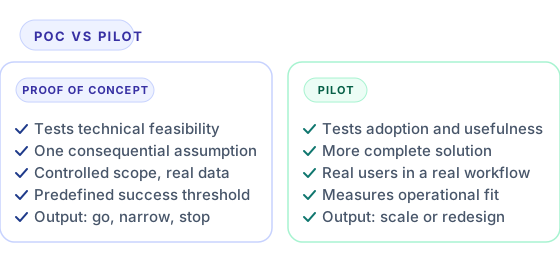
A PoC asks whether the approach is technically feasible. A pilot asks whether the resulting solution is useful and adopted in a real workflow. The questions are sequential and different.
Feasibility versus adoption
A proof of concept asks whether the approach is technically feasible, while a pilot asks whether the resulting solution is useful and adopted in a real workflow. The questions are sequential and different. Passing a PoC does not automatically justify a pilot — it justifies a more informed decision about whether to run one.
A PoC runs in a controlled environment with a focused scope. The team controls the data, the evaluation criteria, and the timeline. A pilot runs with real users in a real workflow, which introduces variables the PoC deliberately excluded: change management, UI friction, integration complexity, and the unpredictability of human behavior at scale.
Teams that skip from PoC to production — bypassing the pilot entirely — often discover that a technically feasible system is not a usable one. The PoC said the model works. The production incident revealed that the interface did not.
What evidence justifies the next stage
Moving from PoC to pilot requires documented evidence that the technical approach is sound: the model meets the predefined accuracy threshold on holdout data, the failure categories are within acceptable bounds, the latency and cost estimates are realistic, and the integration path is understood. That evidence package is what you take to stakeholders to justify the next investment.
Moving from pilot to production requires a different evidence package: adoption data, operational load, edge case inventory, governance sign-off, and a rollback plan. Neither package substitutes for the other. If you are writing a readiness assessment before the PoC, that document should also define what evidence each stage requires before moving forward.
Section 05 · Evidence
Measure against the current baseline
Compare PoC results to what the business actually does today, not to a theoretical ideal. Establishing the baseline before the experiment is not optional.
Business performance before AI
A strong PoC framework answers five questions: Is the business problem measurable? Is the data sufficient? Is the technical approach realistic? Can a working prototype be built? Does the result improve on the current approach?
The fifth question is where most PoCs lose credibility. Teams compare model output to a theoretical ideal — perfect accuracy, instant response, zero cost — rather than to what the business actually does today. A model that classifies support tickets at 78% accuracy is not obviously good or bad. A model that classifies them at 78% when the current manual process runs at 65% is a meaningful improvement. A model at 78% against a rule-based system at 82% is a step backward.
Establishing the baseline before the PoC starts is not optional. If you do not know what you are comparing against, you cannot know whether the result justifies further investment.
Go, pivot, or stop gates
Once you have the baseline and the threshold, the exit decision is mechanical. If the PoC result meets the threshold and improves on the baseline, the case for a pilot is clear. If it meets the threshold but does not improve on the baseline, the approach may be technically viable but not worth the operational cost. If it misses the threshold on the cases that matter, the right move is usually to change the approach — different model, different retrieval strategy, different data — before investing in a pilot.
The build vs buy decision often resets at this point. A PoC that proves feasibility but reveals that custom development is too costly for the expected gain is a legitimate input into a vendor evaluation.
Section 06 · Production
Plan the production path without pretending the PoC is production
A PoC should inform production architecture even though it is not production. Document the decisions that would need to be made at scale before you commit to a pilot.
Architecture and governance questions
While you are running the experiment, document the decisions that would need to be made at scale: Where does the model run? How is the data pipeline secured? Who is accountable for output quality? How are errors surfaced and corrected? What does rollback look like?
You do not need answers during the PoC. You need the questions to be on the table before you commit to a pilot. Teams that skip this step often reach the pilot stage and discover that the governance requirements alone require six months of infrastructure work they did not plan for.
What scaling adds after feasibility
Scaling beyond a PoC requires robust infrastructure, governance frameworks, change management, strategic alignment, clear accountability, and continuous evaluation and monitoring. Each of those is a project in itself.
Infrastructure means moving from a notebook or prototype to a system that handles production volume, latency targets, and availability requirements. Governance means defining who can update the model, how outputs are audited, and what the compliance posture is. Change management means preparing the people whose workflows the system will affect — not just the engineers who built it.
The PoC proves that the idea works. The path to production AI development proves that the team and the organization can operate it. Those are different problems, and conflating them is one of the most reliable ways to fail late in an expensive project.
Section 07 · Checklist
A CTO exit checklist for the PoC
Before closing out a proof of concept, the technical lead should be able to answer each item. If any answer is uncertain, the PoC is not complete.
Go, narrow, change, repeat, or stop
Before closing out a proof of concept, the technical lead or CTO should be able to confirm each of the following:
The success threshold was defined before evaluation and the PoC result was compared against it, not rationalized after the fact. The holdout dataset was representative of the actual production distribution, including the failure-prone cases. Failure categories were tracked separately, not averaged. The result was compared to the current baseline, not to an ideal. The integration path for a pilot is understood and the governance questions are on record.
If any of those answers is uncertain, the PoC is not complete. Close the loop before requesting budget for a pilot.
Evidence package for the next funding decision
A complete evidence package includes the experiment design and its stated hypothesis, the dataset description and holdout methodology, the success threshold agreed before evaluation, the results broken down by category, the baseline comparison, the integration and governance questions identified, and the recommended next step with the reasoning.
That document is what a CTO takes to a founder or board when requesting pilot resources. It is also the document that protects the team if the pilot underperforms — because it shows that the decision to proceed was grounded in evidence, not optimism.
If you are unsure whether your organization is positioned to run a rigorous PoC or to act on its results, an AI architecture review can identify the gaps before you commit the time.