Quick answer
What should AI strategy consulting actually produce? AI strategy consulting should translate business priorities into a ranked portfolio of use cases, data and governance requirements, delivery choices, and measurable value targets. For CTOs, the useful output is not an innovation deck; it is a decision system that ties architecture, operating model, risk, cost, and adoption to business outcomes.
Section 01 · Deliverables
What AI strategy consulting should produce
Most AI strategy engagements produce a presentation. What a CTO actually needs is a decision system that answers: which problems are worth solving, with what data, through which delivery model, at what cost, and with what measurable targets.
IBM describes strategy consulting as aligning teams around a shared vision, activating data, and right sizing roadmaps and technology investments. That framing separates the work from a technology selection exercise or an innovation showcase.
Decision artifacts replace vision slides when the engagement produces a prioritized use case portfolio, a target architecture sketch, a data and governance assessment, operating model decisions, investment logic, and success criteria that business and engineering teams can jointly track.
An executable roadmap differs from a backlog of AI ideas by connecting technical feasibility to commercial value, sequencing by data readiness and risk, and specifying what has to be true at each milestone before the next investment is authorized.
For CTOs evaluating whether to bring in external AI strategy support, the question is not whether the firm has AI credentials. The question is whether the firm can produce artifacts that directly reduce architectural and commercial decision risk for the next six to eighteen months.
Section 02 · Prioritization
Start with value and use case prioritization
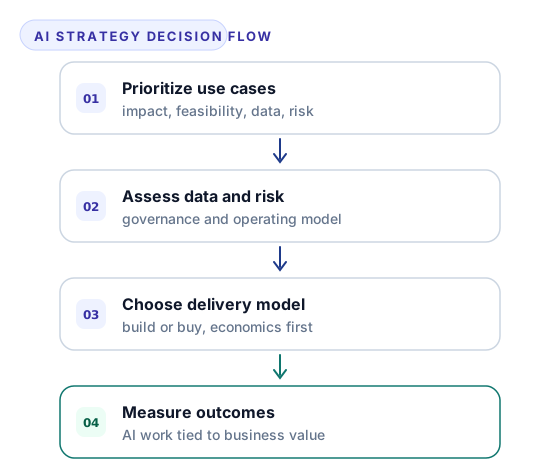
Accenture's enterprise AI strategy work explicitly covers maturity assessments, strategic roadmaps, operating model design, value realization frameworks, and prioritization of use cases across five dimensions: impact, feasibility, data readiness, risk, and scalability.
That ranking across five dimensions prevents two common failures. First, teams avoid chasing high impact use cases that lack data readiness, creating expensive pilots that stall in production. Second, they avoid selecting easy to build use cases that create no material value, generating activity without commercial return.
Ranking business outcomes before selecting models means the prioritization conversation happens at the level of revenue, cost, margin, customer experience, or risk reduction — not at the level of which foundational model to evaluate. Use cases that rank well across all five dimensions become the foundation of the roadmap. Use cases that score high on impact but low on data readiness or feasibility move to a later phase with clear preconditions.
For seed to Series B founders and CTOs, the maturity assessment step often reveals that AI investment prerequisites — clean data pipelines, labeling infrastructure, inference cost models, evaluation frameworks — require budget and timeline that the AI roadmap alone does not capture. A rigorous prioritization exercise surfaces this early.
A useful reference for this phase is the AI readiness assessment framework, which covers how to evaluate data infrastructure and organizational prerequisites before committing to an AI roadmap.
Section 03 · Operating Model
Treat operating model and adoption as core architecture
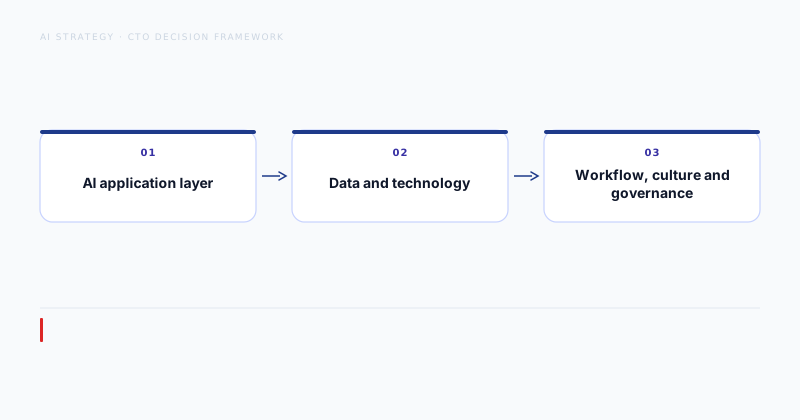
BCG research states that only 10 percent of AI transformation value comes from the AI application itself, 20 percent from data and technology, and 70 percent from workflow redesign, culture, governance, and human and AI collaboration.
This finding reframes what an AI strategy engagement is actually scoping. The largest value pool is not in the model selection or infrastructure layer. It is in how work changes, who owns AI assisted decisions, how accountability is structured, and how teams learn to operate with AI in the loop.
Workflow redesign means identifying which decisions, approvals, or analyses currently require human time that AI can accelerate, augment, or replace — and then specifying what the redesigned workflow looks like, who does what differently, and what new failure modes require new controls.
Decision rights must be explicit: when does an AI recommendation override a human judgment, when does it inform it, and who has authority to override the model. Without clear decision rights, organizations build AI systems that produce recommendations that no one acts on or that everyone overrides without logging the exception.
Change management and training planning belong in the strategy phase, not in the implementation phase. Teams that first encounter operating model changes during deployment resist adoption, create workarounds, and erode the value case that justified the investment.
For CTOs deciding how to structure AI delivery, the build vs buy AI analysis connects directly to operating model choices: what your team will own and what a vendor will operate determines where your workflow redesign and governance investments go.
Section 04 · Governance
Build governance into the strategy
Deloitte's Trustworthy AI approach covers roles and responsibilities, change management and training, AI strategy and governance, risk management, assessments, and tools for model testing and monitoring.
That scope confirms that governance is not a compliance checkpoint added after a model is in production. Governance architecture is a design decision with direct consequences for what you can deploy, in what markets, with what risk exposure, and at what cost.
Risk controls before scale means: what model behaviors are acceptable within your risk tolerance, who certifies that a model meets those standards before it reaches production, and what monitoring confirms it continues to meet them after deployment.
Model testing responsibilities should name specific roles: who writes evaluation sets, who signs off on performance thresholds, who owns monitoring alerts, and who has authority to pull a model from production. These decisions are easier to make in a planning session than after an incident.
A governance framework also affects architecture. If your risk controls require explainability, that constrains model selection. If regulatory requirements in your market mandate audit trails, that shapes your logging and data retention architecture. Deferring these decisions to the implementation phase introduces late stage rework that increases cost and delays go-live.
Section 05 · Economics
Model the economics before committing
Accenture's AI strategy delivery practice explicitly includes estimating licensing, cloud and compute, fine tuning, and ongoing operational costs, then using those estimates to drive sourcing and vendor decisions.
This sequence matters. Most teams select a vendor or a model architecture before modeling what it will cost to operate at the scale required for the business case to hold. Cost estimates that come after vendor selection lock onto what has already been decided, not on what the economics actually support.
Licensing costs vary significantly across foundation model providers and depend on contract structure, volume tiers, and whether fine tuning is permitted. Compute costs depend on inference latency requirements, model size, and whether the team is running on demand or reserved capacity. Fine tuning costs depend on dataset size, iteration cycles, and the infrastructure for evaluation. Operational costs include monitoring, retraining pipelines, and the human review layer for edge cases.
A useful decision framework is to model three scenarios: full build on open source models, licensed foundation model with API access, and a vertically integrated vendor product. Each has a different cost structure, a different capability ceiling, and a different risk profile for the operating model.
The build vs buy AI framework provides a structured way to evaluate these tradeoffs before committing to a vendor or architecture path.
Section 06 · Deployment
Connect strategy to deployment and reinvention
BCG frames AI strategy around three value plays: deploy AI into everyday work, reshape critical functions and workflows, and invent new sources of growth.
These three plays have different timelines, different risk profiles, and different organizational prerequisites. A strategy that does not sequence them by maturity and readiness leaves teams trying to reinvent business models before they have operational AI in production.
Deploy is the foundation: use cases that reduce latency, error rates, or cost in existing workflows with minimal operating model change. These build the internal capability, data infrastructure, and confidence that higher ambition plays require.
Reshape is the transformation layer: redesigning critical functions — customer service, underwriting, procurement, engineering review — so that AI is embedded in the decision flow rather than appended as a tool. This requires the governance and workflow design investments from earlier phases.
Invent is where AI enables new products, pricing models, or markets that were not viable before. This is the highest risk, highest reward category, and it depends on proven AI operations in the deploy and reshape layers.
Metrics that connect technical work to business outcomes should be specified for each play before implementation begins. Deployment metrics include latency reduction, error rate change, and cost per transaction. Reshape metrics include decision cycle time, headcount reallocation, and quality rates. Invention metrics include new revenue, new customer segments, and margin from new products.
For CTOs building the team to execute across all three plays, the AI systems architect role covers what technical leadership looks like when AI is embedded across production systems.